


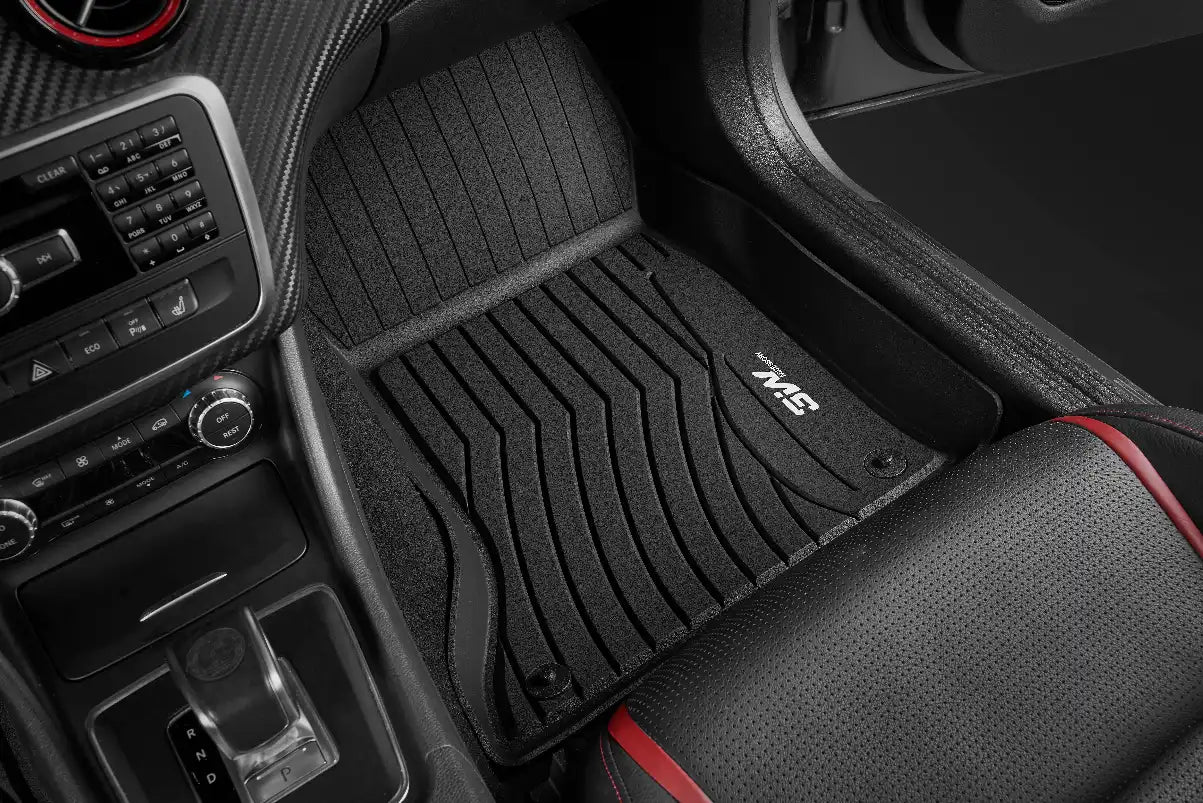
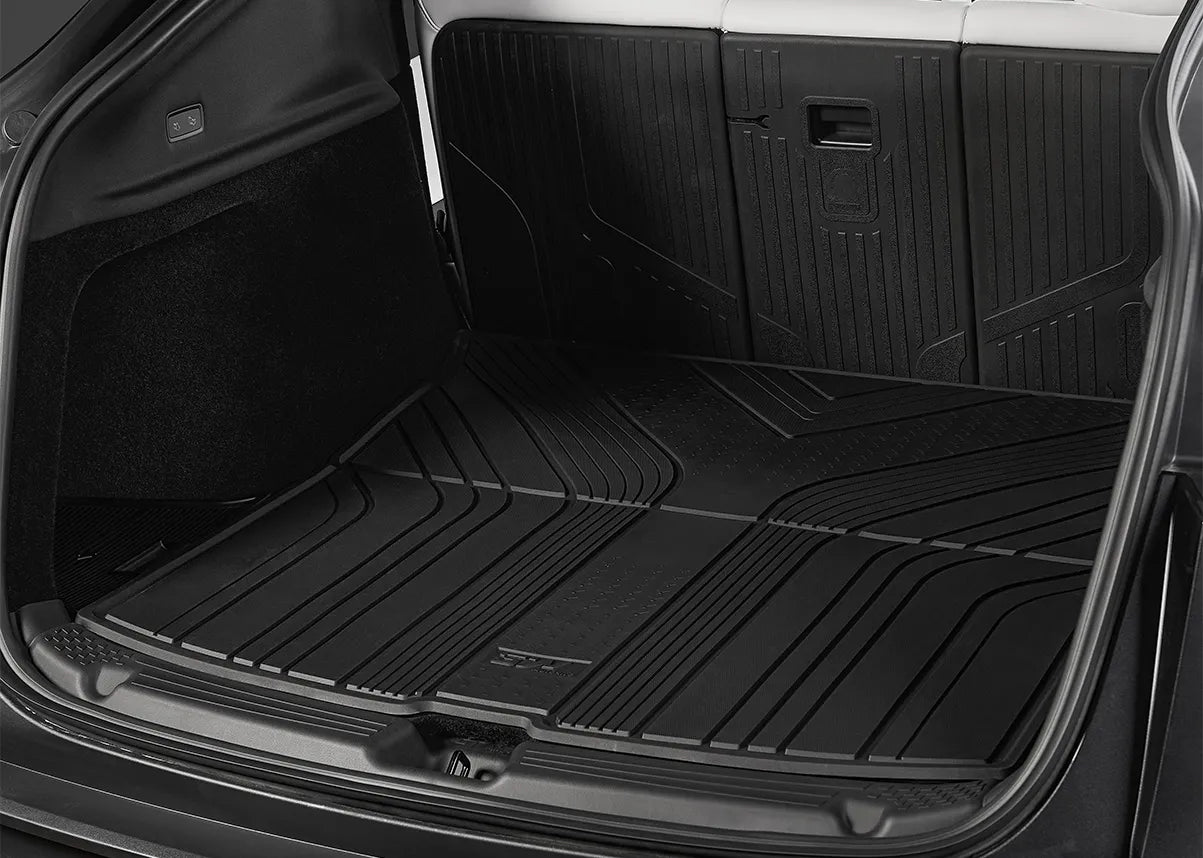
Most floor mat purchases start with a simple question: will this fit? Universal mats answer loosely. Custom-fit mats answer exactly. The difference shapes everything downstream -- how much of the footwell actually gets covered[9], whether liquid stays on the mat or reaches the carpet, and whether the mat stays in position under foot pressure.
This guide explains what custom-fit requires technically, where universal mats consistently fall short, and what to verify before buying any floor mat claiming precision fitment.
What Is a Custom-Fit Floor Mat?
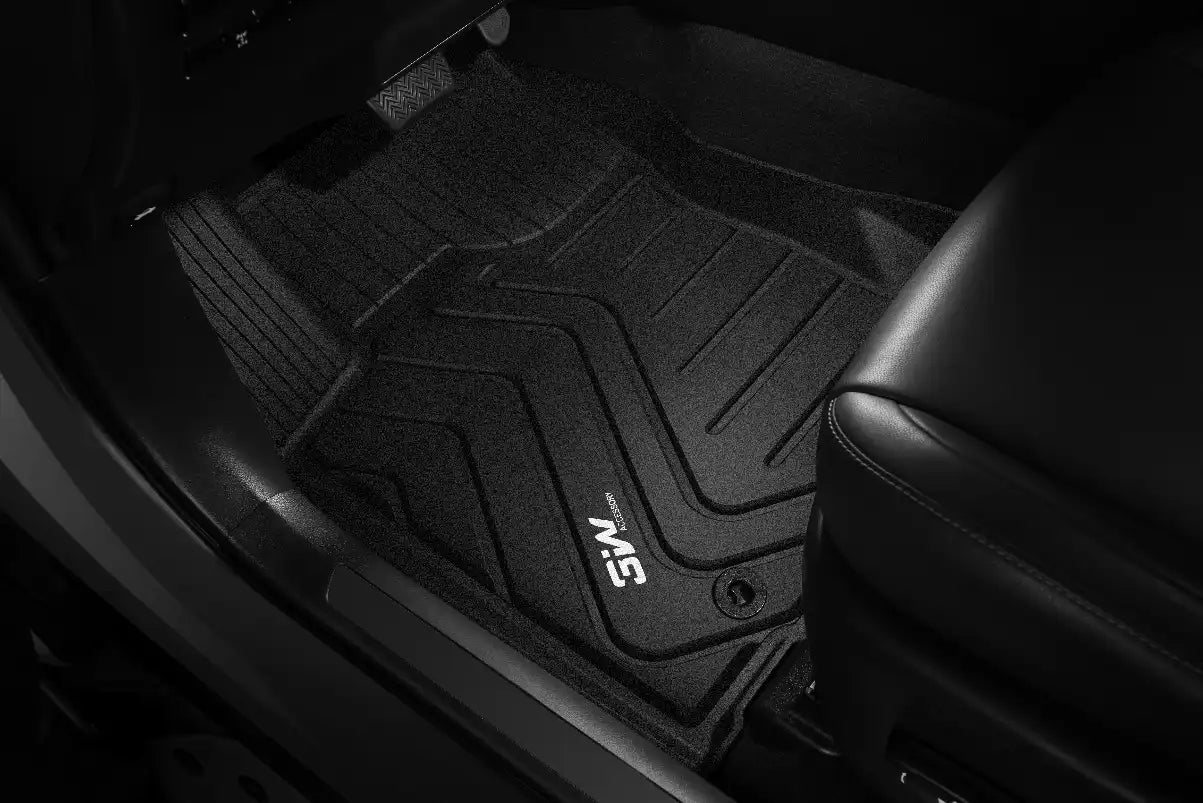
A custom-fit floor mat is engineered to match the exact floor geometry of a specific vehicle -- the transmission tunnel height, sill edges, pedal cutouts, and footwell corner angles. Every vehicle model has a unique floor plan. A Toyota RAV4's rear footwell is shaped differently from a Honda CR-V's, even though both are compact SUVs with similar external dimensions. Off by a quarter inch at the console edge and you have a gap. Off at both corners and you have four gaps.
Two things are required: an accurate dimensional blueprint of the vehicle's floor, and a manufacturing method that can hold those dimensions precisely. 3W uses 3D laser scanning to capture floor contours and injection molding to produce the mat from those measurements.[1][2] That combination is what distinguishes a custom-fit mat from one labeled 'custom' but produced from an approximate generic mold.
What Is a Universal Floor Mat?
A universal floor mat is produced in standardized sizes -- typically small, medium, large -- without a vehicle-specific mold. Some are shaped roughly like a passenger car footwell; others are rectangular pads meant to be trimmed at home. The main appeal is cost and immediate availability.[8][10]
The structural problem is straightforward: a mat designed to cover most vehicles cannot fully cover any specific one. Gaps appear at console edges and firewall corners -- exactly where debris and liquid accumulate under the mat's edge. In the driver footwell, a universal mat that sits too close to the pedals can slide forward, a safety issue that NHTSA has documented in vehicle incidents involving floor mat interference with accelerator pedals.[3]
3D Laser Scanning: From Vehicle Floor to Mold
Custom-fit mat production starts with a 3D scan of the vehicle's actual interior. A laser scanner captures the floor surface in three dimensions -- every ridge, slope, anchor point position, and corner angle -- and converts that into a precise digital model.[1]
That scan data is the source of truth for the mold. It accounts for features that matter most in fitment: the angle at which the console meets the floor, the depth of rear footwell corners, and the precise location of retention clip anchors -- which vary not just across models but across production years within the same model. 3W's blog on 3D floor mat protection describes how this process ensures the mold design is based on a real vehicle measurement, not a manufacturer drawing.[7]
Injection Molding vs. Thermoforming: How Manufacturing Method Affects the Mat
Thermoforming heats a flat sheet of material and presses it over a mold under vacuum pressure. The material is stretched rather than formed, which produces less precise wall heights and edge geometry. Injection molding forces molten material into a closed mold under high pressure, reproducing every detail of the mold precisely. The 3W FAQ explains that injection molding produces a denser, more robust mat that resists cracking, warping, and wear, while thermoforming produces inconsistent thickness and is prone to warping in extreme temperatures.[5]
| Method | How It Works | Wall Consistency | Detail Reproduction | Example |
|---|---|---|---|---|
| Injection Molding | Molten TPE injected under high pressure into precision mold | High -- walls hold angle under sustained load | High -- corner radii and sill edges reproduced | 3W mats |
| Thermoforming | Heated sheet pressed over mold under vacuum | Medium -- walls may compress with use | Moderate -- surface texture less defined | Common in mid-tier mats |
| Universal Press-Cut | Flat sheet cut to approximate footwell shape | None -- no raised walls produced | Low | Budget and generic mats |
3W uses injection molding to achieve precision and resilience that traditional compression molding cannot match, as stated on the About Us page.[2] The key practical advantage is wall retention: walls hold their height and angle after years of repeated foot load.
Why Fitment Gaps Create Real Problems
A floor mat gap has two functional consequences. First, debris -- sand, salt crystals, pet hair, food particles -- falls through the gap and collects under the mat, trapping moisture against the carpet backing. Second, liquid reaching the gap is channeled into the carpet rather than held on the mat surface. A half-inch gap at the console edge routes any significant spill directly into the carpet within seconds.
Truck owners face this more acutely. Full-size truck rear footwells are wide and flat with defined corner angles, and a universal mat that is slightly undersized leaves the outer carpet edges -- where most rear-seat mud lands -- fully exposed.
Anti-Slip Backing: The Third Element of Fitment
Wall height and edge coverage don't matter if the mat slides. A mat that rides forward toward the pedal cluster is a documented safety hazard. Custom-fit mats address this through anti-slip nub backing and compatibility with OEM retention clips.
3W's mats include anti-slip nubs on the underside and are designed to work with OEM retention anchors already installed by the vehicle manufacturer.[4] The installation guide specifies sliding the driver-side mat fully toward the seat before engaging clips. Retention device failure under normal use is covered by 3W's lifetime warranty.[6]
Four Things to Check Before Buying a Custom-Fit Mat
- Model year match: verify the exact year. Floor geometry often changes at a facelift or trim update, not just a full redesign.
- Trim variant: some vehicles have multiple floor configurations within the same year (e.g., F-150 with or without the underseat storage box). These require different SKUs.
- Rear mat configuration: single-piece or split. A split rear mat with a wide center gap leaves the center console base unprotected.
- Known exclusions: hybrid variants, specific cab lengths, and AWD vs. FWD models sometimes have different floor profiles. Confirm on the product fitment page before ordering.
Frequently Asked Questions
Q: What is a custom-fit floor mat?
A: A custom-fit floor mat is built from a 3D scan of your vehicle's specific floor geometry, matching the exact wall heights, angles, and corner dimensions of your footwells. It differs from a universal mat, which is cut to an approximate shape and leaves gaps at the console and sill edges.
Q: Why can't I just trim a universal mat to fit?
A: Trimming changes the edge profile but not the wall height. Without raised walls engineered to match your vehicle's sill geometry, liquid and debris roll off the edges into the carpet. Trimmed edges also tend to interfere with floor mat retention anchors.
Q: How does injection molding differ from thermoforming for floor mats?
A: Injection molding forces molten material under high pressure into a precision mold, producing consistent wall heights and exact corner geometry. Thermoforming stretches heated sheet material over a mold, which produces less precise wall heights that can compress over time. 3W uses injection molding for all its Thorex™ TPE mats.
Q: How do 3W mats stay in place without sliding?
A: 3W mats have anti-slip nubs on the backing surface and are compatible with OEM floor mat retention clips. The installation guide specifies sliding the driver-side mat fully toward the seat before engaging retention clips. The warranty covers retention device failure under normal use.
Q: Does custom-fit work differently for trucks versus cars?
A: The manufacturing process is the same, but truck floors require more complex molds because cab geometry varies more across trim levels. The F-150 has separate mat SKUs for configurations with and without the fold-flat underseat storage box -- those two floor plans are physically different in the rear cab.
Q: What does '3D scanning' actually mean in floor mat production?
A: A laser scanner captures the vehicle floor's three-dimensional surface -- every ridge, slope, anchor point, and corner angle -- and converts that data into the mold geometry. The scan ensures the mold is based on the actual vehicle, not a drawing or estimate.
References
- [1] 3W Blog -- Custom-Fit vs Universal Floor Mats: 3D Scanning, Precision Fit, and Why It Matters -- https://3wliners.com/blogs/car-mats/custom-fit-vs-universal-floor-mats-3d-scanning-precision-fit-and-why-it-matters
- [2] 3W Auto-Life About Us -- Injection Molding Process, OEM Partnerships, Red Dot Award 2017 -- https://3wliners.com/pages/about-us
- [3] NHTSA Recall 09V-388 -- Potential Floor Mat Interference with Accelerator Pedal -- https://static.nhtsa.gov/odi/rcl/2009/RCDNN-09V388-8067.pdf
- [4] 3W Chevrolet Silverado Product Page -- Floor Mat Installation, Non-Slip Nubs and Retention Anchors -- https://3wliners.com/products/chevrolet-silverado-custom-floor-mats-tpe-material-all-weather-protection
- [5] 3W FAQ -- Injection Molding vs. Thermoforming Explained -- https://3wliners.com/pages/faq
- [6] 3W Lifetime Warranty -- Retention Device Failure, Coverage and Exclusion Terms -- https://3wliners.com/pages/3w-lifetime-warranty
- [7] 3W Blog -- Elevate Your Car's Interior with 3D Floor Mats for Ultimate Protection -- https://3wliners.com/blogs/news/elevate-your-car-s-interior-with-3d-floor-mats-for-ultimate-protection
- [8] Slashgear -- 7 Affordable WeatherTech Alternatives, January 2026 -- https://www.slashgear.com/1749159/affordable-weathertech-floor-board-alternatives
- [9] MotorTrend -- Best Floor Mats 2026 Tested: 3W Named Best Coverage -- https://www.motortrend.com/gear-reviews/best-floor-mats
- [10] The Drive -- Custom-Fitted Floor Mats Cost Less Than You Think, April 2026 -- https://www.thedrive.com/news/custom-fitted-floor-mats-cost-less-than-you-think-get-30-off-3w-liners

Leave a comment
All comments are moderated before being published.
This site is protected by hCaptcha and the hCaptcha Privacy Policy and Terms of Service apply.