


The Gap Isn't Just Price — It's What You're Actually Getting
Universal floor mats range from $$15 foam pads to $50 textured rubber sheets. Custom-fit liners from premium brands run $120–220 for a full set. That gap raises a straightforward question: what specifically are you paying for, and does it make a real difference in practice? The answer depends on how each type is made — because the manufacturing process determines every downstream property: coverage, safety, durability, and how well the mat actually sits in your specific vehicle.
How 3D Scanning Produces a Different Product
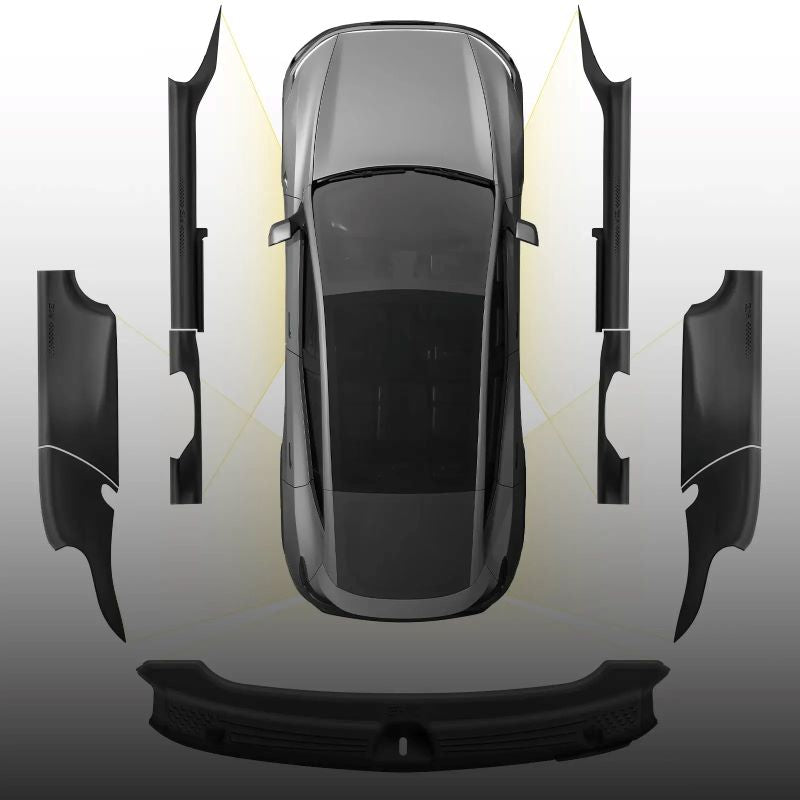
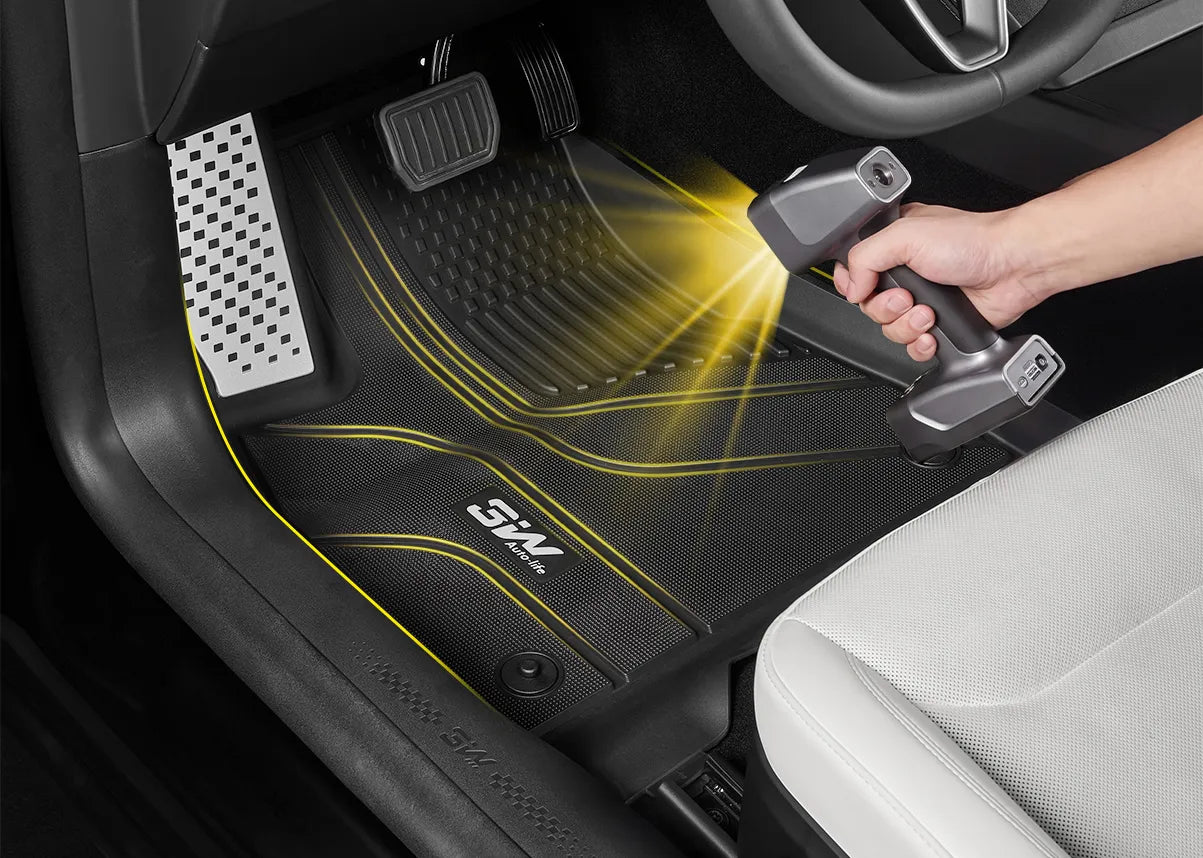
A universal mat starts with a generic shape approximated from common vehicle dimensions. A custom-fit liner starts with a vehicle-specific digital model — either from licensed OEM CAD data or from physical 3D scanning of the actual vehicle interior. 3W uses 3D vehicle scanning to capture the exact geometry of each model it produces mats for.¹ The scan captures:
- Floor pan contour — every hump, recess, and transition from front to rear
- Transmission tunnel height and width, which varies significantly between models
- Pedal clearance zones on the driver side — critical for safety
- Factory retention clip locations that anchor the mat to the floor
- Rear footwell depth, which differs between a Honda CR-V and a Subaru Outback even at similar vehicle sizes
- Cargo area geometry including wheel well intrusions
This scan data drives the mold the mat is injection-molded from. The result is a three-dimensional object that conforms to what that specific model's floor actually looks like. A mat made from a Toyota RAV4 scan doesn't fit a Kia Telluride, and vice versa.

What Universal Mats Leave Uncovered
These are the specific coverage failures that appear when a universal mat goes into a vehicle it wasn't designed for:
Coverage Gap |
What Happens |
Consequence |
Door sill edge |
Mat edge stops short — 1–3 cm gap |
Salt and winter melt run under mat to carpet |
Transmission tunnel |
Flat mat sits elevated at center — gaps on sides |
Liquid pools at tunnel base and reaches carpet |
Rear footwell sides |
Mat covers center only |
Footwear debris accumulates at edges unprotected |
Cargo wheel wells |
Generic mat doesn't follow arch contours |
Sand and mud spill around mat edges to carpet |
No retention clips |
Mat slides under braking or acceleration |
Driver-side mat can migrate toward pedals |
The driver-side sliding issue is the most serious. NHTSA has documented floor mat pedal entrapment in multiple safety recalls, including the widely reported Toyota recall that affected millions of vehicles.² A mat that doesn't anchor to factory retention clips is a variable in that risk. 3W's mats use dual driver-side retention that integrates with factory clip anchors — the mat cannot move during driving.¹
Injection Molding vs Other Manufacturing Methods
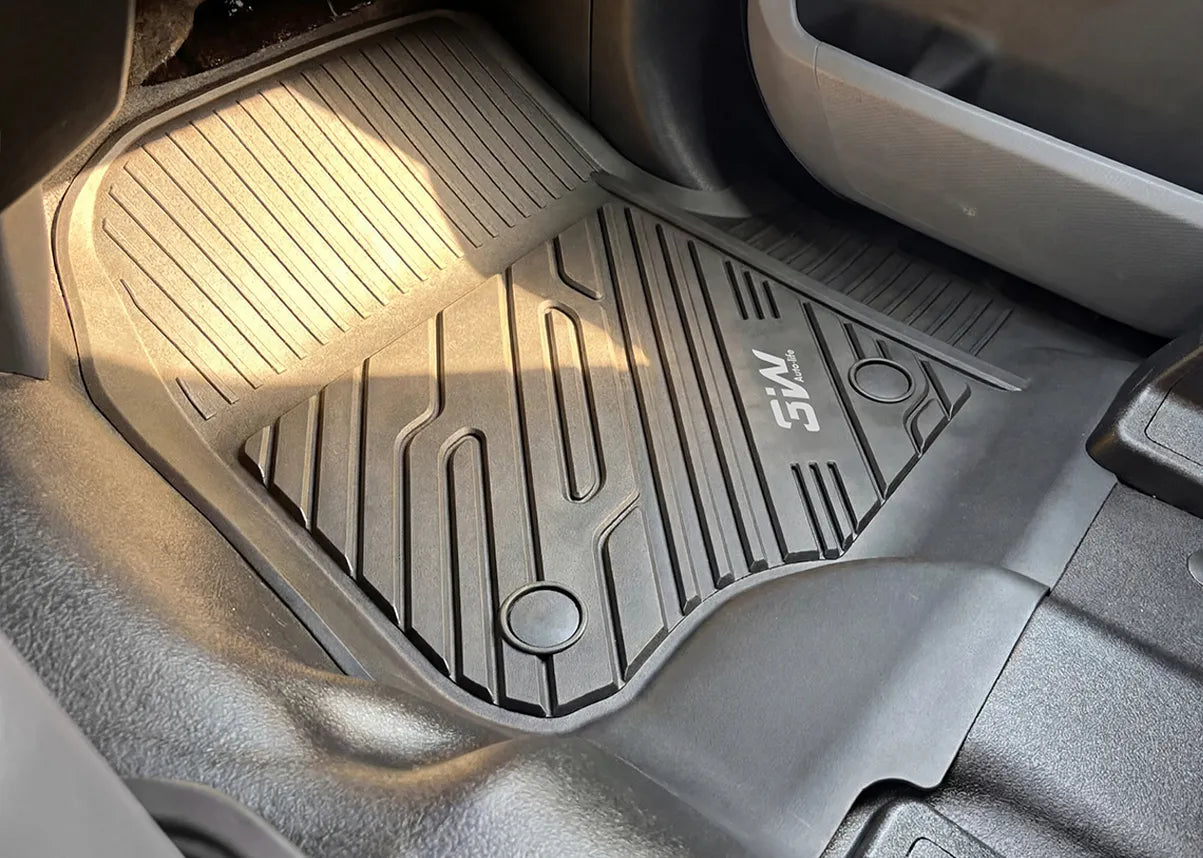
3W uses injection molding — TPE compound injected into a closed mold under pressure, filling the cavity completely and cooling to a uniform wall thickness throughout.¹ Vacuum forming, used by many lower-cost options, presses a heated sheet over a mold. Wall thickness varies because the material stretches unevenly over contours. This matters at the channel walls: injection-molded walls maintain their height under repeated boot impact; vacuum-formed walls gradually compress and flatten, reducing containment performance over time.
Custom-Fit vs Universal: Side-by-Side
Factor |
Universal Mat ($15–55) |
Custom-Fit Liner ($120–220) |
3W Custom-Fit |
Coverage |
Partial — edge gaps common |
Edge-to-edge |
Edge-to-edge, 3D-scanned per model |
Pedal safety |
Not addressed |
Pre-calculated clearance zones |
Model-specific driver-side clearance |
Retention |
None or generic anti-slip |
Factory anchor integration |
Dual driver-side retention clips |
Channel depth |
Flat or 0.25" max |
0.5"–1.25" |
Deep channels, model-matched depth |
Material |
Rubber, PVC, or foam |
Rubber or TPE |
Thorex TPE — HEXPOL-sourced, GRS-certified |
Warranty |
None or 90-day limited |
1–3 years typical |
Lifetime |
Odor risk |
Present in PVC products |
Low with quality TPE |
Odor-free — no PVC content |

The Long-Term Cost Comparison
A $$40 universal set replaced every 2–3 years due to cracking, distortion, or coverage failure costs $80–120 over a decade — and never fully protects the carpet. A $159 full custom-fit set with a lifetime warranty covers the same period once, with complete edge-to-edge protection throughout. For drivers who plan to sell or trade in the vehicle, carpet condition directly affects buyer perception at the first walkthrough.³ Carpet protected from day one is visibly different from carpet that took salt and mud unprotected.
When Universal Mats Make Sense
Universal mats are reasonable for two specific situations: short-term vehicle use (rental car, temporary vehicle while primary is in repair) or very light use in a mild climate where liquid containment isn't a real requirement. For any vehicle driven more than 3 months per year in a climate with rain, snow, or significant dust, the case for custom-fit is straightforward.
Frequently Asked Questions
What is a custom-fit floor mat?
A: A floor mat manufactured using 3D scan or OEM CAD data specific to your vehicle's year, make, model, and trim. It covers the floor edge-to-edge and conforms to the actual floor geometry rather than approximating a generic shape.
Are custom-fit floor mats worth the extra cost?
A: For vehicles kept more than 2–3 years, yes. A lifetime-warranted custom-fit set costs less over time than replacing universal mats repeatedly, and provides better carpet protection throughout.
What is 3D scanning in floor mat manufacturing?
A: Capturing the exact geometry of a vehicle's interior floor — humps, recesses, pedal zones, clip locations — to build a vehicle-specific mold. The mat produced fits that model precisely.
Can universal floor mats cause a safety issue?
A: Yes — mats without a retention system can slide toward the driver's pedals. NHTSA has documented pedal entrapment incidents from unsecured floor mats. Custom-fit mats with factory clip integration prevent this.
What is injection molding for floor mats?
A: TPE compound injected into a closed mold under pressure, producing uniform wall thickness and sharp channel edges. This maintains containment performance better over time than vacuum-formed alternatives.
What is the difference between a floor mat and a floor liner?
A: A floor mat is flat with minimal raised edges. A floor liner is 3D-molded with raised side walls for liquid containment. For all-weather use, liners provide significantly better protection.
Do 3W custom mats need any modification to install?
A: No — they integrate with factory retention clips and require no cutting, adhesive, or tools.
References
[1] 3W Liners — 3D Scanning Technology and Product Specs
[2] NHTSA — Floor Mat Pedal Entrapment Safety Information
[3] Advance Auto Parts — Floor Mats and Vehicle Resale Value
[4] 3W Liners — About 3D Scanning and Custom Fit
[5] TruFit Auto — Custom Fit Car Floor Mats: Ultimate Guide
[6] Slashgear — Affordable WeatherTech Alternatives (January 2026)
[7] Pro Tool Reviews — 3W Floor Mats Hands-On Review
[8] Active Gear Review — 3W Custom Floor Mats Review (December 2025)


Leave a comment
All comments are moderated before being published.
This site is protected by hCaptcha and the hCaptcha Privacy Policy and Terms of Service apply.