




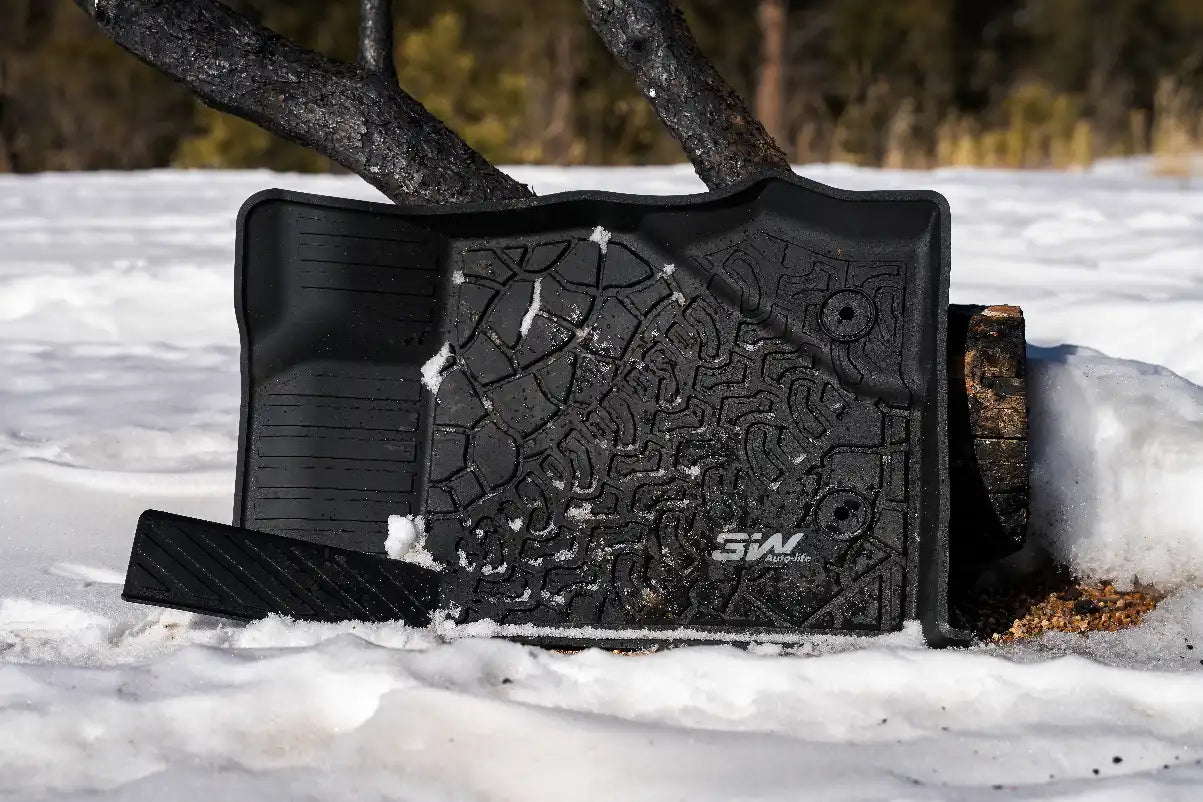
The worst thing a floor mat can do in winter is absorb what it's supposed to contain. Salt crystals dissolved in slush soak into a carpet mat and work toward the metal floor pan beneath -- slowly, invisibly, until rust appears years later. Ice tracked from a parking lot melts under foot heat and pools in the gap between a poorly fitted mat and the console edge. Mud dries in carpet fibers and requires enzyme cleaning to pull out completely.
Each climate scenario attacks vehicle interiors differently. This guide addresses snow and road salt, heavy rain and mud, winter commuting logistics, and summer heat -- because the mat requirements differ for each.
Snow, Ice, and Road Salt: The Chemistry of Floor Damage
Road salt -- sodium chloride or calcium chloride -- is the most chemically aggressive substance a floor mat regularly encounters. Dissolved salt carried in on wet boots reaches carpet fibers and, without a waterproof barrier, contacts the metal floor pan. Metal corrosion from road salt accelerates in humid, enclosed environments -- exactly the conditions a wet carpet mat creates during a winter commute.
A non-absorbent mat breaks that corrosion chain. Salt stays on the mat surface and is removed when you rinse it. 3W's Thorex™ TPE is non-porous by composition: liquid and dissolved salt rest on the surface rather than soaking in.1 That's the core function an all-weather mat needs in northern and mountain-state climates.
The Drive's April 2026 review noted that 3W Liners are laser-measured to fit exact interior dimensions and are robust enough for boots, heels, and paws.2 Cold-weather flexibility matters specifically here: a mat that stiffens and cracks at sub-zero temperatures creates the fitment gaps it's designed to prevent -- salt water then channels through those gaps to the carpet edges.
Which Climate Creates Which Problem
The challenges vary by region. The table below maps each climate profile to the specific floor damage mechanism and what the mat needs to do:
Climate |
Primary Floor Threat |
Why Standard Mats Fail |
What the Mat Needs to Do |
Chicago / Upper Midwest |
Road salt + slush, sub-zero winters |
Carpet absorbs salt brine; rubber may stiffen in extreme cold |
Non-porous TPE with cold-temp flexibility (-4°F+) |
Pacific Northwest |
Rain and mud, year-round |
Universal mats leave gaps; mud migrates under edge |
Edge-to-edge custom-fit with raised walls on all sides |
Mountain States (CO, UT, WY) |
Slush + ice at altitude; dry dust in summer |
Rubber cracks in cold; carpet holds fine dust permanently |
All-season TPE rated -4°F to 167°F |
Southeast / Gulf Coast |
Mud + humidity; brief freezes |
Humidity trapped in carpet creates mold in warm months |
Non-absorbent backing; no moisture retention |
Southwest / Sun Belt |
Sand, UV heat, flash flooding |
Rubber UV-degrades; carpet holds embedded sand |
UV-stable TPE; rinse-clean capable |
Heavy Rain and Mud: What Raised Walls Actually Do
In a rainy climate, the mat's job is containment, not just coverage. A mat that covers the footwell floor but has low side walls is a collection basin: liquid pools on the surface and runs off the edge the first time someone shifts their foot. Wall height -- specifically at the console side and door sill -- determines whether liquid stays on the mat or reaches the carpet.
3W's injection-molded walls are engineered to maintain height under foot load, distinguishing them from thermoformed walls that can compress gradually over months of use. The Bronco6g forum's direct comparison of 3W and WeatherTech in a real vehicle specifically called out 3W's corner wall coverage as a key advantage.3 Corners are where water accumulates first in any significant rain scenario.
Daily Winter Commuting: The Cleaning Frequency Equation
For a daily commuter in a cold climate, cleaning friction is as important as protection quality. A mat requiring fifteen minutes of work gets cleaned once a month. A mat you can rinse in 90 seconds gets cleaned when it needs it -- and in a wet winter, that might be twice a week.
Active Gear Review tested 3W mats through a full Michigan winter and reported complete cleaning with a rinse at season's end: no residual salt embedding, no surface degradation.4 MotorTrend's 2026 floor mat test ranked 3W 'Best Coverage' for the combination of edge fitment and surface performance that makes this routine practical.5
Truck Delivery in Winter: The First-Day Decision
Truck owners who take delivery in winter -- or put a new truck to work on a job site immediately -- face a first-day protection problem that's easy to underestimate. A single boot-scrape from a concrete job site deposits abrasive dust and oil that becomes permanently embedded in new carpet. Cold-weather delivery makes this worse: carpet fibers are stiffer and less forgiving in cold temperatures, and grit works deeper faster.
3W covers the full-size truck segment with model-year-specific sets for the F-150, Silverado, RAM 1500, and GMC Sierra. The official product page states orders typically arrive within 1-7 business days.1 Installation is tool-free, the anti-slip backing engages OEM retention clips, and the mat is functional the day it arrives.
Summer Heat: The Other End of the Temperature Range
A climate guide isn't complete without the warm end of the spectrum. Rubber mats in vehicles parked in summer sun can reach temperatures that cause surface softening and tackiness. Carpet mats amplify odors from previous spills as bacteria metabolize faster in heat and humidity.
Thorex™ TPE is rated stable to 167°F per the official 3W FAQ.6 It doesn't soften, become tacky, or emit fumes at summer parking temperatures. 3W's summer car mats blog confirms this stability across the full seasonal range.7 For a mat used year-round through both a northern winter and a summer heat peak, temperature stability at both ends is the same requirement.
Frequently Asked Questions
Q: What floor mats are best for Midwest winters with road salt?
A: Custom-fit TPE mats with a non-porous surface and raised walls. Salt stays on the mat surface rather than reaching the carpet, and the walls prevent brine from migrating to carpet edges. Thorex™ TPE is rated to -4°F and won't crack at sub-zero temperatures; it may briefly stiffen in extreme cold and returns to full flexibility at room temperature.
Q: Can road salt damage my car's floor even with floor mats installed?
A: If the mats have fitment gaps at the console or door sill edges, dissolved salt in slush can migrate into the carpet and reach the metal floor pan, where corrosion begins. Non-absorbent mats with no gaps contain salt on the surface until you rinse it off.
Q: What floor mat features matter most in the Pacific Northwest where it rains year-round?
A: Raised wall height on all sides -- especially the console and sill edges. Gaps that seem minor in dry conditions become drainage channels in rainy use. Edge-to-edge custom fitment closes those channels completely.
Q: I'm taking delivery of a new truck in winter. When should I order floor mats?
A: Before delivery if possible, or the same week. Carpet damage from a single job-site day is difficult to reverse without professional cleaning. Per the official 3W product page, orders typically arrive within 1-7 business days.
Q: Do TPE floor mats hold up in summer heat?
A: Yes. Thorex™ TPE is rated stable to 167°F per the official 3W FAQ. Unlike rubber, it doesn't become tacky or soft at high summer interior temperatures, and unlike carpet, it doesn't trap heat-amplified odors.
Q: Do I need to clean floor mats differently in winter versus summer?
A: No. Remove, shake off debris, rinse with water, wipe dry -- the same process handles road salt slush and beach sand equally. No season-specific method is needed.
References
- [1] 3W FAQ -- Thorex™ TPE Material, Care and Temperature Guidance -- https://3wliners.com/pages/faq
- [2] The Drive -- Custom-Fitted Floor Mats Cost Less Than You Think, April 2026 -- https://www.thedrive.com/news/custom-fitted-floor-mats-cost-less-than-you-think-get-30-off-3w-liners
- [3] Bronco6g Forum -- 3W Floormat Review + Comparison vs WeatherTech, February 2024 -- https://www.bronco6g.com/forum/threads/3w-floormat-review-comparison-vs-weathertech.89518/
- [4] Active Gear Review -- 3W Custom Floor Mats Review: Michigan Winter Test, December 2025 -- https://www.activegearreview.com/travel-gear/3w-custom-floor-mats-review/
- [5] MotorTrend -- Best Floor Mats 2026 Tested: 3W Named Best Coverage -- https://www.motortrend.com/gear-reviews/best-floor-mats
- [6] 3W FAQ -- Thorex™ TPE Temperature Range -4°F to 167°F, Weather Resistance -- https://3wliners.com/pages/faq
- [7] 3W Blog -- Best Car Mats for Summer: Keep Your Interior Cool, Clean -- https://3wliners.com/blogs/car-mats/best-car-mats-for-summer
- [8] 3W Auto-Life About Us -- Brand History, Founded 2016, Red Dot Award 2017, OEM Supplier -- https://3wliners.com/pages/about-us
- [9] 3W Lifetime Warranty -- Coverage for Defects in Materials and Workmanship -- https://3wliners.com/pages/3w-lifetime-warranty
- [10] 3W 10th Anniversary Press Release, PR Newswire, September 9, 2025 -- https://www.prnewswire.com/news-releases/3w-auto-life-marks-10-years-of-crafting-premium-floor-mats-for-vehicles-with-celebratory-deals-contests-and-a-durability-challenge-302550495.html
- [11] Slashgear -- 7 Affordable WeatherTech Alternatives, January 2026 -- https://www.slashgear.com/1749159/affordable-weathertech-floor-board-alternatives

Leave a comment
All comments are moderated before being published.
This site is protected by hCaptcha and the hCaptcha Privacy Policy and Terms of Service apply.