


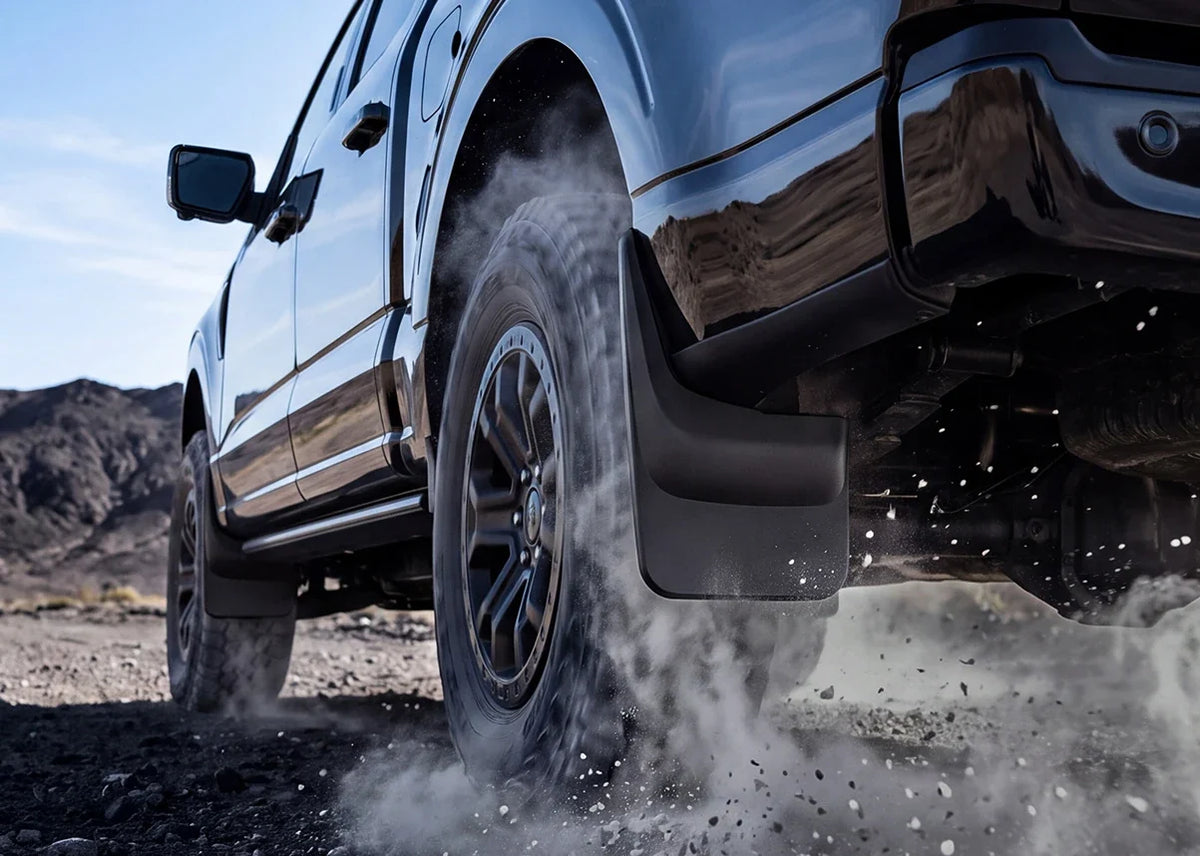
A lift or leveling kit can change the way the tires sit under the truck. They may be larger, farther from the ground or positioned farther outside the fender. This can affect how well a mud flap catches water, mud and gravel.
Mud flaps that worked with the stock suspension may no longer provide enough coverage after an upgrade. Tire size, wheel position and ground clearance all need to be checked.
This guide explains what changes after a lift and what to look for when choosing mud flaps for a modified truck.
How a Lift or Leveling Kit Affects Mud Flap Coverage?
A leveling kit usually raises the front of the truck by about 2 inches. A suspension lift raises the whole vehicle and commonly adds between 2.5 and 6 inches of height ([7]).
Larger tires are often fitted at the same time. A 2-inch leveling kit may allow 33-inch tires, while larger lifts can make room for 35-inch or 37-inch tires ([7]). This increases the area that the mud flap needs to cover.
The mounting points around the fender usually stay in the same place ([5]). What changes is the distance between the tire, the mud flap and the road.
How Wheel Offset Affects Mud Flap Coverage?
Wheel position can also change after an upgrade, especially when aftermarket wheels are installed.
Two measurements are especially useful in this case:
A lower offset usually moves the wheel farther outward. The same can happen with lower backspacing.
As a result, more of the tire may extend beyond the fender. In some setups, the tire can move about 1.5 inches farther out ([7]). When this happens, a standard mud flap may no longer be wide enough to cover the tread properly.
Mud Flap Rules for Lifted Trucks
Mud flap laws are different from one state to another. In many cases, the clearest rules apply to commercial vehicles and trailers, while some lighter pickups are exempt ([4]).
Even where these rules do not apply, they provide a useful reference for tire coverage. Missouri, for example, requires mud flaps to cover the full width of the tire tread and, for vehicles covered by the law, extend to within 8 inches of the ground ([6]). Colorado also requires full tread coverage and sets a maximum distance between the flap and the road ([4]).
Custom-Fit vs. Universal Mud Flaps
Custom-fit and universal mud flaps differ mainly in how closely they match the vehicle.
Custom-fit mud flaps are made for a specific model and follow the shape of its fender well. Universal flaps have a more general shape, so they may need trimming, repositioning or drilling before they can fit correctly([5]).
On a stock truck, that difference is mostly about fit and installation. After a lift or wheel upgrade, however, it can also affect coverage. Wider wheels, a lower offset or larger tires can move the tread farther outside the fender.
If that happens, a custom-fit flap designed around the original setup may no longer cover the whole tire. A universal flap can be easier to adjust to the new wheel position, although the final result depends on how well it is fitted.
What Material Works Best for a Lifted Truck?
Mud flaps on a lifted truck have to deal with stones, water, mud and road debris, so the material needs to be tough without being too rigid.
Polymer and rubber-based materials are common because they can flex when hit by debris and still keep their shape while driving ([4]). This becomes especially important in winter. Some thinner plastics harden in low temperatures, which can make them more likely to crack after an impact ([1]).
In general, a good mud flap material should:
- stay flexible in cold weather;
- resist impacts from stones and debris;
- hold its shape while driving;
- withstand regular exposure to water, mud, and road salt.
With normal use, quality polymer or rubber-composite mud flaps can last for years ([4]).
How Wide Should Mud Flaps Be on a Lifted Truck?
A lifted truck may need wider mud flaps if the tires are larger or if the wheels have been moved farther outside the fender.
These are the main changes to check:
Moving from 33-inch to 37-inch tires, for example, can increase the amount of tread that needs coverage ([7]). A lower offset can have a similar effect by moving the entire wheel outward.
The easiest way to check is to look at the truck after all modifications are installed. If part of the tread extends beyond the fender, a wider mud flap may be needed to catch the water, mud and gravel thrown up by the tire.
Mud Flaps and Ground Clearance Off-Road
A longer flap gives more protection from mud and stones, but off-road it can become a problem if it hangs too close to the ground.
On a truck used mostly on paved roads or gravel, that extra length is usually useful because it keeps more spray away from the body. On rougher trails, though, a shorter flap may make more sense. It is less likely to catch on rocks, deep ruts or uneven sections of the trail.
For that reason, the ideal length depends largely on where the truck is driven most often.
The aim is to keep enough coverage behind the tires without making the flaps so long that they become a problem off-road.
When Mud Flaps Are Most Useful After a Suspension Upgrade?
The benefits of mud flaps can change depending on the truck setup and driving conditions.
What to Measure Before Buying Mud Flaps?
For a modified truck, the best time to check mud flap fitment is after the suspension, wheels and tires are already installed.
Start with the tire tread width and see how much of it needs to be covered ([4]). Then check the wheel offset or backspacing, since both affect how far the tire sits in relation to the fender ([7]).
You should also measure the distance from the mounting point to the ground and confirm the exact model, year, and trim, because mounting points can change between versions ([2]).
Before ordering, check the rules in your state as well, especially those covering tread width and flap height ([3])([6]).
Frequently Asked Questions
Can a lift kit affect mud flap requirements?
It can. Once the truck sits higher, especially with larger tires, more of the tread may be exposed behind the fender ([3])([6]). That can change how much coverage is needed. Since the rules are different from state to state, it is also worth checking the requirements where the truck is driven.
Do I need wider mud flaps with 35-inch tires?
Not in every case. Tire size matters, but wheel width and position matter too. If 35-inch tires sit farther outside the fender, wider mud flaps may be needed to cover more of the tread ([4])([7]).
Does wheel offset matter when choosing mud flaps?
Quite a lot. A lower offset usually moves the wheel farther outward, which can expose more of the tire ([7]). Before choosing mud flaps, check both the wheel size and the offset so you know where the tread actually sits ([2]).
Do mud flaps reduce ground clearance off-road?
They can if they hang too low. On uneven terrain, longer flaps may catch on rocks or ruts. A lifted truck usually gives you more clearance to work with ([7]).
Are universal mud flaps better for modified trucks?
Sometimes. Universal mud flaps are easier to adapt when a truck has larger tires, wider wheels, or other modifications. They may still require trimming or drilling during installation ([1])([2]). If a custom-fit flap suits the modified setup, it can provide a cleaner fit around the wheel well.
What should I check before ordering mud flaps for a modified truck?
Check the tire width, wheel offset, and how far the tread sits outside the fender ([2])([4]). Also confirm the exact model year and trim, since mounting points can vary between versions.
References
([1]) 3W - Best Mud Flaps for Trucks and SUVs in 2026: Custom-Fit vs. Universal: https://3wliners.com/blogs/car-mats/best-mud-flaps-for-trucks-and-suvs-in-2026-custom-fit-vs-universal
([2]) 3W - Custom-Fit Mud Flaps for SUVs: What "Custom" Actually Means When You Order Online: https://3wliners.com/blogs/car-mats/custom-fit-mud-flaps-for-suvs-what-custom-actually-means-when-you-order-online
([3]) 3W - Mud Flaps vs. Splash Guards: What's the Difference and Which Vehicles Actually Need Them: https://3wliners.com/blogs/car-mats/mud-flaps-vs-splash-guards-whats-the-difference-and-which-vehicles-actually-need-them
([4]) 3W - What Are Mud Flaps For? The Simple Yet Smart Protection for Vehicle Exterior: https://3wliners.com/blogs/car-mats/what-are-mud-flaps-for
([5]) 3W - Mud Flaps for the F-150 and Half-Ton Trucks: What to Know About this Simple Upgrade: https://3wliners.com/blogs/car-mats/mud-flaps-for-the-f-150-and-half-ton-trucks
([6]) Missouri Revisor of Statutes, RSMo Section 307.015 - Mud flaps required: https://revisor.mo.gov/main/OneSection.aspx?section=307.015


Leave a comment
All comments are moderated before being published.
This site is protected by hCaptcha and the hCaptcha Privacy Policy and Terms of Service apply.