


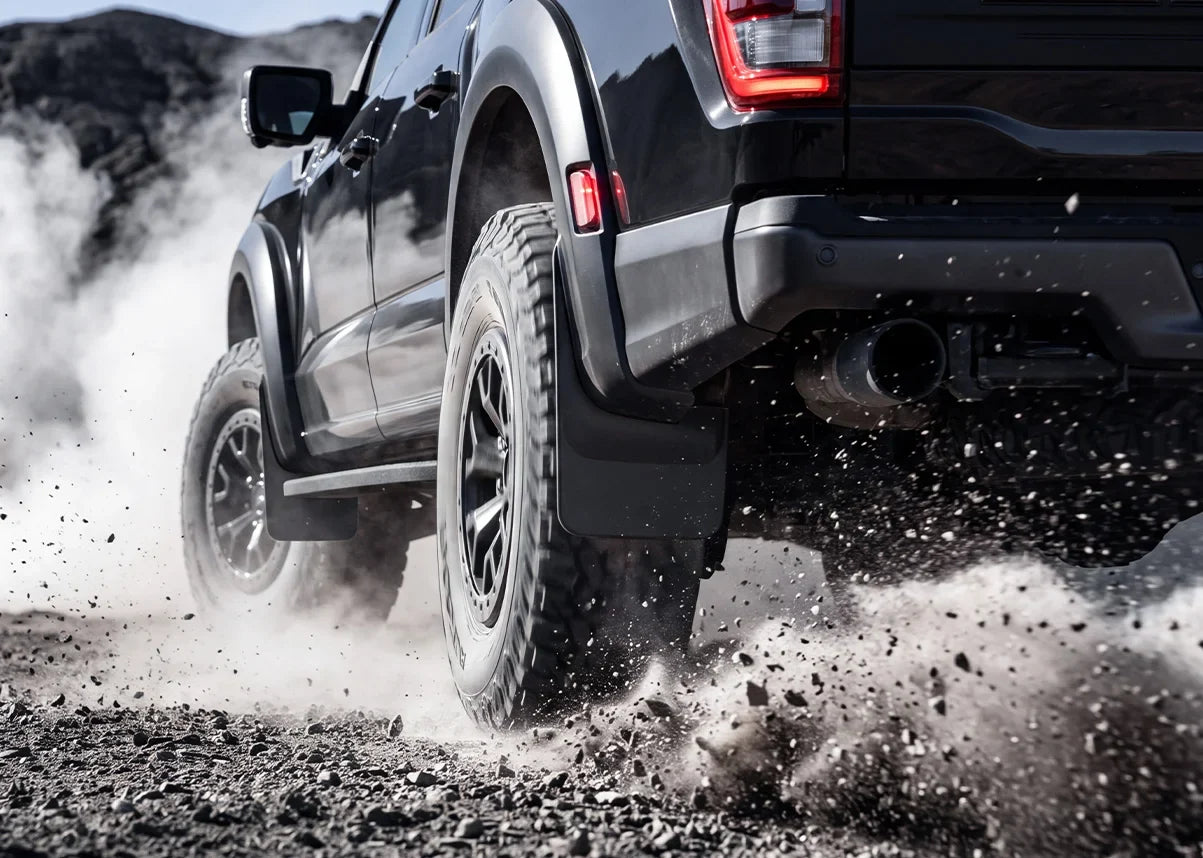
Every mile on the highway sends gravel, road salt, and loose debris straight into your F-150's lower body panels and wheel wells. Damage starts accumulating from day one and adds up quietly until it shows up as rock chips and rust.
Installing custom-fit mud flaps F-150 is one simple upgrade to stop that wear. But choosing the right set means understanding what mud flaps protect, what the law requires, and which materials hold up. This guide covers all of that before you buy.
What Do Mud Flaps Actually Protect on an F-150 or Half-Ton Truck?
Mud flaps sit directly behind each wheel and block the spray of rocks, mud, and water a spinning tire throws backward. ([1]) A half-ton truck rides noticeably higher than most passenger vehicles. For those trucks, the spray travels further and hits more surface area than most owners expect.
Paint and Body Panel Protection from Rock Chips
Rocks and road debris kicked up by the front tires travel back along the rocker panels and toward the rear fenders and bed sides. Those repeated impacts chip away at clear coat and paint over time. Once paint is broken, the exposed metal underneath is directly exposed to moisture and road salt. ([2])
That's how a small rock chip eventually turns into a disgustingly noticeable rust spot months later. Blocking that debris path before it reaches the panel is the ultimate objective of having a mud flap. It's also why states covered in the next section have active splash-guard laws.
Wheel-Well and Undercarriage Protection from Mud and Road Salt
Beyond visible paint damage, mud flaps reduce how much mud, slush, and road salt gets thrown up into the wheel wells and undercarriage. Road salt accelerates corrosion on exposed metal components. So, cutting down how much reaches those areas is a meaningful part of protecting a truck's long-term structural condition. ([1] [2])
Is There a Legal Requirement to Have Mud Flaps?
In many states, yes. However, the specifics vary reasonably. Check your state's requirements rather than assuming national uniformity.
What California's Law Requires
California Vehicle Code Section 27600 requires any motor vehicle with three or more wheels to be equipped with fenders, covers, or devices. It includes flaps or splash aprons that effectively minimize the spray or splash of water or mud to the rear of the vehicle. ([3])
Such equipment should be at least as wide as the tire tread. Colorado deployed a similar splash-guard requirement specifically for larger trucks. Most states have some version of the rule, though the exact wording and vehicle-weight thresholds differ. ([4])
Why Lifted Trucks Need to Double-Check Compliance
A lifted or leveled F-150 changes tire position relative to the factory fender line. It can leave stock coverage inadequate even if the truck passed inspection stock.
You may have modified your suspension or wheel setup. In that case, it's worth re-checking whether your mud flap coverage still meets your state's width and coverage requirements.
Custom-Fit vs Universal Mud Flaps: What's the Real Difference?
The core difference is precision. It's also the most important factor that defines good custom-fit mud flaps F-150. Custom-fit mud flaps are molded to a specific vehicle's wheel-well geometry and mounting points. Universal flaps, by contrast, roughly fit a wide range of vehicles. ([1])
Custom-Fit: No-Drill, Factory Mounting Points
A properly developed custom-fit kit uses a truck's existing factory mounting points or trim plugs. So, installation shouldn't take more than an hour without drilling into painted body panels. Such precision also means the flap's edges sit exactly where the wheel-well geometry needs them. ([2])
Universal: Trim-to-Fit Flexibility, Less Precise Coverage
Universal flaps can work across a wide range of vehicles, making them a flexible option. However, coverage depends heavily on how carefully you trim and mount them. Also, they're less likely to match wheel-well contours as precisely as a design built around one specific truck's dimensions.
Which Material Survives Highway Speed and Winter Cold?
Thermoplastic elastomer, or TPE, handles sustained highway-speed airflow and cold-weather flexing better than rigid rubber or low-cost PVC.
TPE vs Rigid Rubber vs PVC
Rigid rubber flaps can offer strong impact resistance but tend to stiffen in cold weather. Low-cost PVC options become brittle faster under UV exposure and temperature swings. ([5])
TPE strikes a practical balance. It's flexible enough to absorb repeated debris impact without cracking. Also, TPE stays dimensionally stable at highway speeds instead of flapping loose.
Cold-Flex: Why Cheap Flaps Crack in Winter
A mud flap that stiffens in freezing temperatures is more likely to crack when it's struck by road debris or ice. Rigid material has less give to absorb impact energy.
High-quality TPE mud flaps, like upcoming 3W options, stay pliable well below freezing. It's exactly the condition road-salt season puts a mud flap through most often.
Do Mud Flaps Interfere with Bigger Tires or Lift Kits?
Yes, it's probable. The chances are higher when the flap doesn't match your specific tire and suspension setup. Check before you order, not during or after installation.
Checking Clearance Before You Buy
- Confirm your current tire size and any aftermarket wheel offset against the mud flap's listed compatibility.
- Note whether your truck has been leveled or lifted, since that changes flap position relative to the tire.
- Check for clearance with factory or aftermarket fender flares, which can conflict with certain flap mounting styles.
- Confirm whether the flap coverage still meets your state's width requirement after any suspension changes.
Low-Profile vs Full-Coverage Designs
Low-profile flaps sit tighter to the body and suit trucks with limited clearance or larger tires. In contrast, full-coverage designs extend further down and back for maximum debris protection. ([6]) Match the design to your exact tire and suspension setup. It avoids the rubbing or reduced coverage that comes from choosing based on looks alone.
How Do You Choose the Right Mud Flaps for Your Half-Ton Truck?
Getting the perfect fit up front means custom-fit mud flaps for F-150 owners can install something that actually does the job. And you'll avoid rattling, loose flaps, or rubbing against a tire. ([1] [2])
Choosing Checklist
- Confirm your exact truck, model year, and cab/bed configuration against the flap's listed fitment.
- Check tire size and any lift or leveling kit against the manufacturer's clearance notes.
- Prioritize a no-drill, factory-mounting-point design if you want to avoid modifying painted panels.
- Choose a cold-flexible material like TPE if you drive through real winters.
Common Mistakes When Choosing Mud Flaps
- Assuming universal flaps will match wheel-well contours as precisely as a vehicle-specific kit.
- Skipping a thorough clearance check after a lift or wheel upgrade.
- Choosing a rigid or low-cost material without considering how it performs in freezing temperatures.
- Not confirming your state's coverage and width specs before assuming any flap is "legal enough."
Which Setup Fits How You Drive Your Truck?
How you use your F-150 or half-ton truck day to day should factor into which mud flap style and material makes the most sense.
Daily Commuters on Salted Winter Roads
Trucks that see regular winter driving on salted roads benefit most from full-coverage protection and a cold-flexible material. Road salt exposure is frequent and sustained through an entire season. 3W mud flaps combine materials that keep rust from taking hold on lower body panels and wheel wells over years of winter commuting.
Jobsite and Gravel-Road Trucks
Trucks running frequent gravel roads or jobsite access deal with larger, sharper debris. A durable, impact-resistant material matters more here than in most daily-commute scenarios. Debris impacts are more frequent and larger. ([1] [2])
Lifted or Modified Trucks
Owners who've already lifted or leveled their truck need to treat mud flap selection as part of that modification. Clearance, coverage width, and state compliance all shift once tire position changes. So, re-evaluate mud flap fit at the same time as any suspension work. Assuming factory-spec equipment still applies means you're making a mistake.

How Do You Maintain Mud Flaps After Installation?
Mud flaps are largely maintenance-free, but periodic checks keep them doing their job. It also catches problems early before they become bigger repairs.
Routine Checks
- Inspect mounting hardware periodically for looseness, especially after rough roads or off-pavement driving.
- Check for cracks or splits near the mounting points, which are the most common failure point.
- Rinse off accumulated mud or road salt to prevent buildup or stress on the mounts.
- Replace promptly if a flap is torn or missing, both to maintain protection and stay within your state's compliance requirements.

What's Available for F-150 Owners Right Now?
3W's current mud flap lineup focuses on Tesla Model Y applications. It uses a no-drill design that relies on factory trim plugs and a flexible, impact-resistant material to stay pliable in winter cold. ([7])
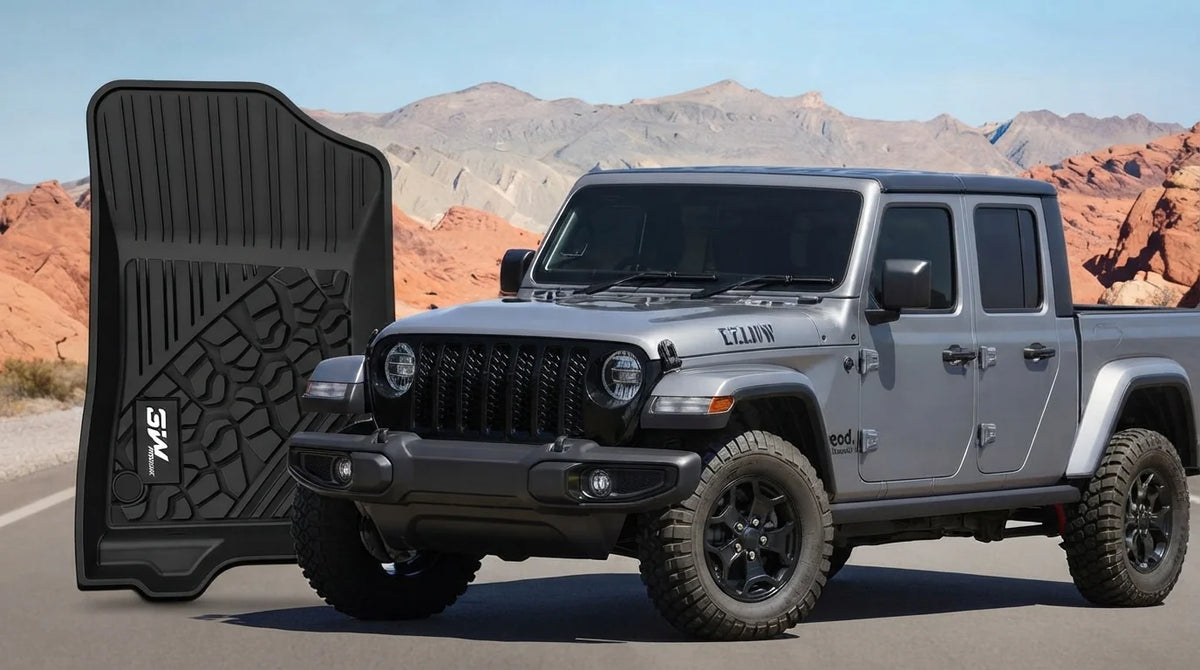
Mud flaps for popular half-ton trucks, including the F-150, are in development as 3W expands its truck accessory lineup, alongside its existing F-150 floor mats and bed mat products.
Use the criteria discussed to evaluate the custom-fit option available for your specific F-150. Check 3W's current collection for the latest on truck-specific mud flap availability. ([8])

Conclusion
Mud flaps solve a problem that's easy to ignore until the damage is already visible. Rock chips, road salt corrosion, and mud packed into wheel wells start from the same source. A properly fitted flap blocks it at the source. Beyond protecting paint and body panels, many states legally require some form of splash guard.
You can go for available options or wait for 3W's custom-fit mud flaps F-150. Nonetheless, prioritize a cold-flexible TPE with a precise, vehicle-specific fit over a generic universal option. This difference can make or break how well your investment holds up. Explore 3W's current truck protection lineup for what's available. ([8])
Frequently Asked Questions (FAQs)
Are mud flaps legally required on my truck?
In many states, some form of splash guard is required by law. However, the specific wording and vehicle-weight thresholds vary. California, for example, requires fenders, covers, or flaps that minimize rear spray on any vehicle with three or more wheels.
Do mud flaps really stop rock chips on the F-150's paint?
They significantly reduce rock-chip impacts by physically blocking debris the front tires throw backward toward the rocker panels and rear fenders. Still, they can't eliminate every impact from debris kicked up by other vehicles.
Will mud flaps fit my lifted or leveled F-150?
It depends on the specific kit. A lift or leveling kit changes tire position relative to the factory fender line. So, confirm clearance and coverage for your exact suspension setup.
What's the difference between custom-fit and universal mud flaps?
Custom-fit flaps are molded to a specific vehicle's wheel-well geometry. It usually installs at factory mounting points without drilling. Universal flaps are trimmed to approximate that fit across a wider range of vehicles, with less precise coverage as a trade-off.
Does 3W make/have mud flaps for Ford F-150 models?
Not yet. 3W's current mud flap lineup covers Tesla Model Y applications, with half-ton truck options including the F-150 in development. You can look into 3W's existing F-150 floor mats and bed mats.
References
[1] 3Wliners: "What are Mud Flaps for" – https://3wliners.com/blogs/car-mats/what-are-mud-flaps-for
[2] 3Wliners: "Mud Flaps vs Splash Guards" – https://3wliners.com/blogs/car-mats/mud-flaps-vs-splash-guards-why-the-confusion-costs-truck-owners-money
[3] California Legislative Information: "Vehicle Code: Equipment of Vehicle" – https://leginfo.legislature.ca.gov/faces/codes_displaySection.xhtml?sectionNum=27600&lawCode=VEH
[4] Justia Law: "Colorado Code: Regulation of Vehicles" – https://law.justia.com/codes/colorado/title-42/regulation-of-vehicles-and-traffic/article-4/part-14/section-42-4-1407-5/
[5] 3Wliners: "TPE vs PVC" – https://3wliners.com/blogs/car-mats/tpe-vs-pvc
[6] Ram-Trx: "Low-Profile Mud Flaps" – https://www.ram-trx.com/threads/anybody-try-these-low-profile-mud-flaps.23791/
[7] 3Wliners EU: "Mud Flaps for Tesla Model Y" – https://eu.3wliners.com/products/mud-flaps-for-tesla
[8] 3Wliners: "Floor Mats for Pickup Trucks" – https://3wliners.com/collections/floor-liners-for-pickup-trucks


Leave a comment
All comments are moderated before being published.
This site is protected by hCaptcha and the hCaptcha Privacy Policy and Terms of Service apply.