


A forensic look at how TPE, rubber, and carpet floor mats really wear after real-world mileage — not marketing claims.
Most floor mat marketing describes a product on day one. Ten thousand miles later, the picture looks different, and that gap is exactly where buyers get misled. What actually shows up on a mat by that mileage mark — cracked edges, a lingering smell, flattened texture — depends on the base material far more than the brand printed on the packaging [1].
Where Wear Shows Up First
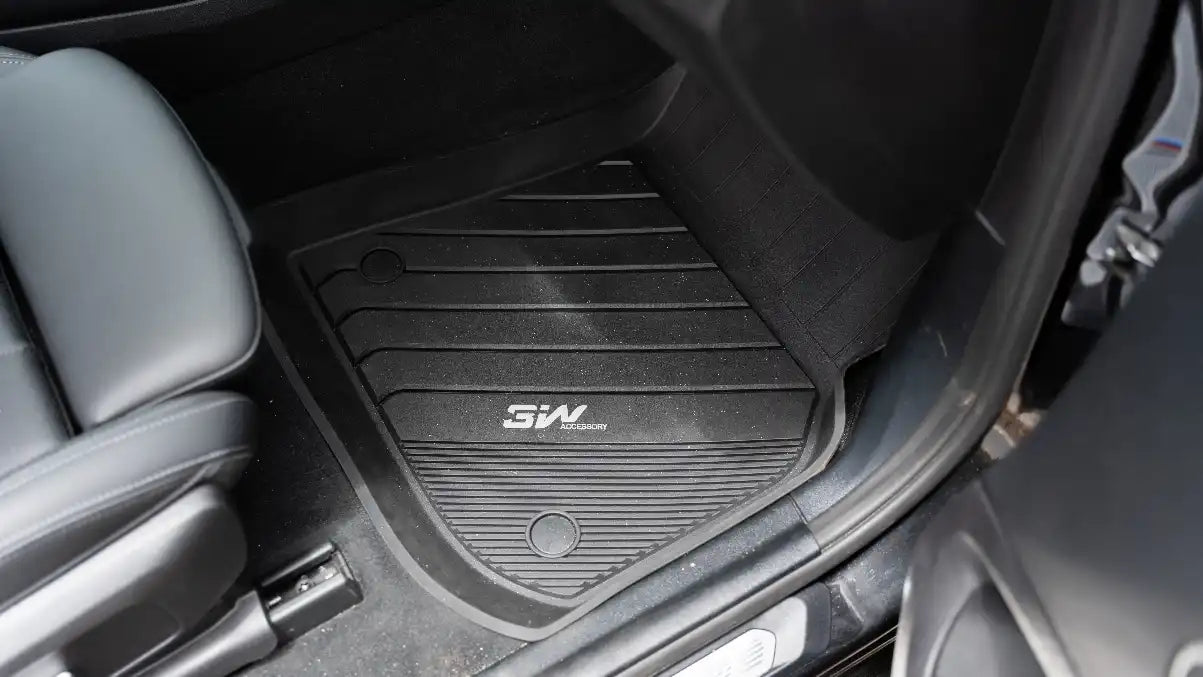
The driver's-side heel-strike zone is the fastest tell. It absorbs more repeated pressure and friction than any other point on the mat, so it's the first place a weak material fails. On carpet and lower-grade rubber, this area develops a visible sheen or thinning well before 10,000 miles. TPE compounds hold up longer here because the polymer flexes and recovers under pressure instead of permanently deforming, though rubber performs comparably well in raw durability — its main weakness shows up seasonally, not from foot traffic alone [1][7].
What Happens to Each Material by the 10,000-Mile Mark
Material |
Typical Condition at 10,000 Miles |
Odor After Heat Exposure |
Behavior in Cold |
TPE |
Surface intact, edges stay sealed, no curling |
No plasticizer smell |
Stays flexible down to roughly -4°F |
Rubber |
Grips well, but can develop a tacky glaze in heat |
Can carry a rubber odor after repeated hot-cabin exposure |
Prone to stiffening or micro-cracking in freeze-thaw cycles |
Carpet |
Fibers matted down, moisture absorbed into backing |
Traps odor from spills over time |
Least weather-resistant of the three |
The odor column matters more than it sounds. TPE blends without plasticizers don't off-gas the way vulcanized rubber can when a cabin heats up past 150°F on a sunny afternoon — that's a chemistry difference, not a branding one [1][3].
Why Injection Molding Changes the Wear Pattern
Two mats made from the same TPE resin can still age differently depending on how they're formed. Injection-molded mats are shaped under pressure into a single dense piece, which is what keeps the edges sealed and resistant to curling. Compression-molded or thermoformed sheet mats — common in budget lines — are more prone to edge lift after repeated flexing, because the sheet was never fully fused into one uniform structure. 3W manufactures its floor liners by injection molding from a 3D scan of each vehicle's footwell, which is part of why edge curling isn't a common complaint in owner reviews at the one-year mark [3].
What Official Guidance Can Confirm After Real Mileage
Official 3W materials focus on confirmed factors a buyer can check: vehicle-specific fitment, material construction, cleaning guidance, and warranty coverage. Those sources are more useful than anecdotal ownership claims when deciding whether a mat is suitable for the vehicle and conditions you drive in [4][5][6].
Cold Weather Is the Real Stress Test, Not Heat
Summer heat softens weak plastics, but winter is where structural failure actually happens. Road salt is both corrosive and abrasive, and repeated freeze-thaw cycling is what causes brittle materials to crack at the edges or around retention-clip mounting points. This is a documented failure mode in unbranded rubber mats after a single hard winter, while materials rated to stay flexible down to roughly -4°F are built specifically to avoid it [1][2].
Reading a Warranty as a Durability Signal
3W's warranty covers manufacturing defects — such as abnormal cracking or clip failure — for as long as the original buyer owns the vehicle, but it explicitly excludes ordinary wear, sun fading, and misuse [2]. The exclusions clarify what falls outside the warranty's coverage; they do not predict when normal wear will begin.
A Three-Point Check for Any Mat You Already Own
You don't need to wait a year to judge a mat's material quality. Check the heel-strike zone for premature thinning or gloss, check the edge where the mat meets the factory carpet for curling (a sign of thermoforming rather than injection molding), and check whether the mat still smells neutral after the car has sat closed up on a warm day. A mat that passes all three checks at 10,000 miles is very likely to keep aging slowly rather than degrading suddenly [1][3].
A Common Mistake: Judging Durability From the Box
Unboxing photos and first-week reviews dominate online shopping decisions, but they're the worst point to judge a floor mat's long-term material quality. A stiff, slightly odorous mat straight out of packaging can still outlast a soft, pleasant-smelling one a year later — packaging odor mostly reflects how the material was stored and shipped, not how it will behave after repeated heat cycling. The three-point check described above (heel-strike wear, edge curling, and odor after a closed, warm cabin) only becomes meaningful after a few months of actual use, not on delivery day [1].
Why Some Owners Still Prefer Carpet Despite the Downsides
Carpet isn't obsolete — it has a real advantage in vehicles that rarely see spills, pets, or winter driving: it matches factory interior aesthetics more closely than TPE or rubber, and for a garage-kept commuter car used mainly for dry, short trips, its weaker moisture resistance may never become a practical issue. The materials comparison in this piece is about matching wear resistance to actual conditions, not declaring one material universally superior [1].
How Vehicle Type Changes the Wear Timeline
The same material ages at different rates depending on the vehicle. A sedan used mainly for a dry commute puts far less stress on floor mats than a truck used for job-site work, where grit, moisture, and heavier footwear accelerate wear at the heel-strike zone. Owners comparing durability claims across reviews should factor in how the reviewer actually used the vehicle — a mat praised as holding up well after a year of light commuting isn't necessarily making the same claim a contractor's truck would test [1].
Frequently Asked Questions
Do TPE floor mats really outlast rubber ones?
TPE tends to hold its shape and surface texture longer in the heel-strike zone because the material flexes and recovers instead of deforming, while rubber is more prone to stiffening or cracking in cold weather over time.
Why do some floor mats smell bad after installation?
The smell usually comes from plasticizers in rubber or lower-grade plastic compounds. TPE blends made without plasticizers don't off-gas the same way, which is why they stay odor-free even in a hot cabin.
How can I tell if a mat was injection-molded or just cut from a sheet?
Check the edges — injection-molded mats form a single dense piece with sealed edges, while sheet-formed mats are more prone to curling or lifting at the edges after repeated flexing.
What does a floor mat warranty actually cover?
3W's lifetime warranty covers manufacturing defects like abnormal cracking or clip failure for as long as the original buyer owns the vehicle, but it does not cover normal wear, sun fading, or misuse.
References
[1] 3W Auto-Life — The Floor Mat Durability Test: What 12 Months of Real Use Does to TPE, Rubber, and PVC: https://3wliners.com/blogs/car-mats/the-floor-mat-durability-test-what-12-months-of-real-use-does-to-tpe-rubber-and-pvc
[2] 3W Auto-Life — 3W Lifetime Warranty: https://3wliners.com/pages/3w-lifetime-warranty
[3] 3W Auto-Life — About Us: https://3wliners.com/pages/about-us
[4] 3W Auto-Life — FAQ: https://3wliners.com/pages/faq
[5] 3W Auto-Life — Best Rear Seat Back Protectors for SUVs: TPE vs. Fabric vs. Neoprene Compared: https://3wliners.com/blogs/car-mats/best-rear-seat-back-protectors-for-suvs-tpe-vs-fabric-vs-neoprene-compared
[6] 3W Auto-Life — The 3W Product System: Floor Liners, Cargo Mats, Seat Protectors, and Truck Bed Mats Explained: https://3wliners.com/blogs/car-mats/the-3w-product-system-floor-liners-cargo-mats-seat-protectors-and-truck-bed-mats-explained
[7] 3W Auto-Life — Why TPE Material Floor Mats Are More Safe: https://3wliners.com/blogs/news/why-tpe-material-floor-mats-are-more-safe-old

Leave a comment
All comments are moderated before being published.
This site is protected by hCaptcha and the hCaptcha Privacy Policy and Terms of Service apply.