




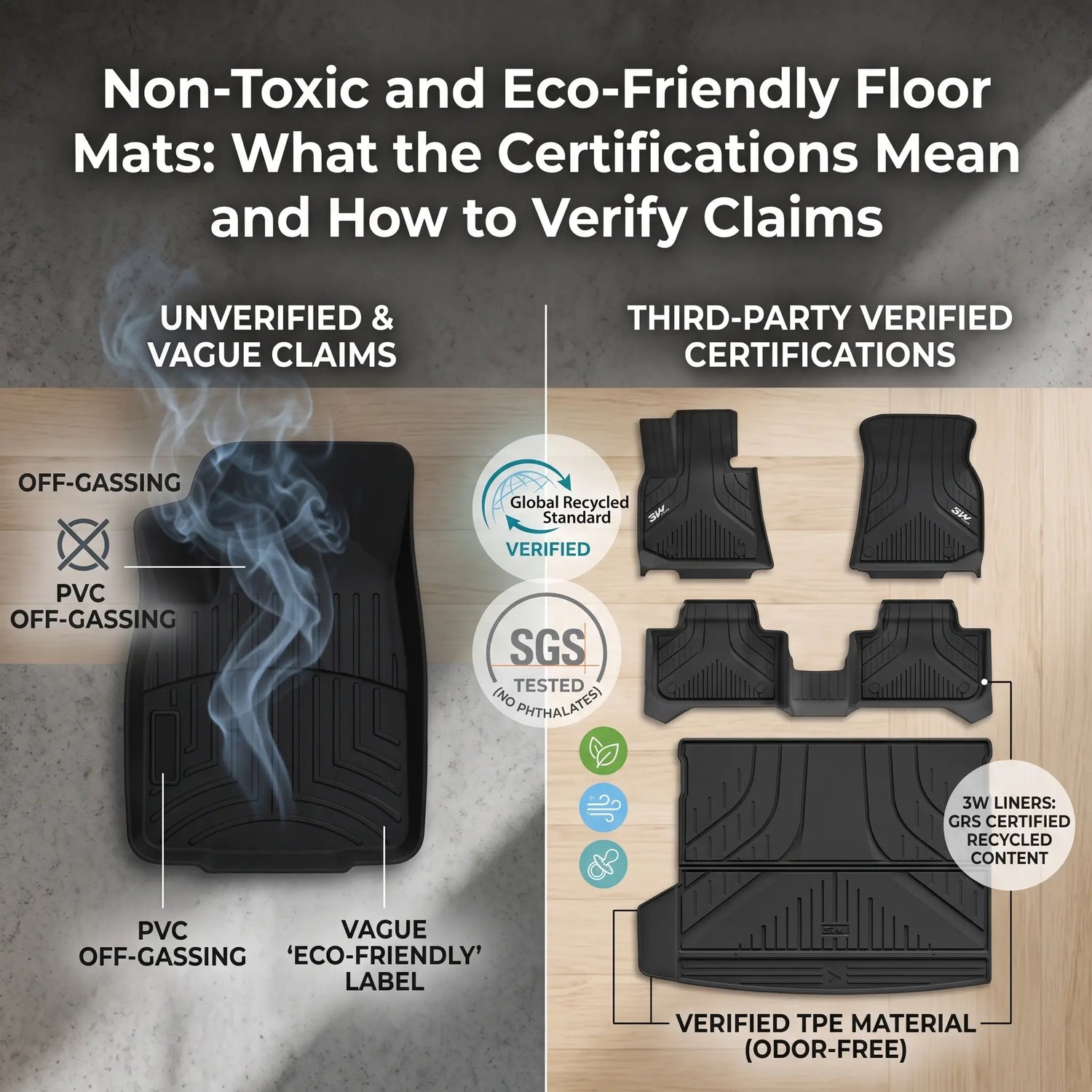
Walk through enough floor mat product pages and you collect a bingo card of claims: eco-friendly, non-toxic, sustainable, baby-safe, odor-free. Some of these are backed by independent third-party certification. Others are brand self-declarations with no external verification. The two can look identical on a product page.
This article explains the certifications that actually require external audit, what PVC off-gassing means and why it matters, and which brands publicly document the evidence behind their claims.
Certifications That Require Third-Party Verification
GRS (Global Recycled Standard)
GRS is administered by Textile Exchange and verifies that a product contains recycled content at every stage of the supply chain. It is not a self-reported claim. Certification requires independent third-party audit of material origin and the manufacturing chain.1 A floor mat brand holding GRS certification has had its recycled content claims verified externally; a brand saying 'made from recycled materials' without citing GRS has not.
3W Liners carries GRS certification. Product pages state: 'Our 3W floor mats are certified to the Global Recycled Standard (GRS), ensuring verified recycled content at every stage of the supply chain.'2 The About Us page describes the brand as Eco-Friendly and GRS Certified.3
REACH Compliance
REACH is an EU regulation that restricts substances of very high concern in manufactured products, including phthalates, lead, and cadmium. Compliance requires documentation showing restricted substances fall below defined concentration thresholds. Brands that claim REACH compliance should be able to point to a test report, not just use the phrase.4
SGS and Independent Testing
SGS, Intertek, and Bureau Veritas are independent testing laboratories that produce third-party test reports against specific international standards—phthalate content, heavy metal limits, and similar. A brand citing an SGS test report is showing externally generated data. A brand saying phthalate-free with no test report is making an unsupported marketing claim.4
What PVC Off-Gassing Actually Means
PVC is the dominant material in budget floor mats. To stay flexible, PVC requires plasticizer additives—typically phthalates. These compounds are volatile: they release from the material as gas over time, and the rate increases with temperature. The new-mat smell in a hot car is primarily phthalate off-gassing from PVC.5
In an enclosed vehicle cabin, off-gassing compounds accumulate at higher concentrations than in open spaces. The concern is more pronounced for infants and young children with different exposure sensitivity at developmental stages, and for anyone who spends significant daily time in the vehicle—rideshare drivers, long-route commuters, or people who keep windows closed regularly.
TPE does not require plasticizers. Its flexibility is intrinsic to the polymer structure, not added through chemical additives. This is why TPE floor mats are described as odor-free: there are no volatile plasticizer compounds to release.5

What the Baby-Friendly and Non-Toxic Claims Mean
3W's FAQ states: 'TPE is also used in products such as baby pacifiers, combs, and toothbrushes, indicating that it is a safe material.'6 This is a material category reference, not a product-specific safety certification for the floor mat itself. It communicates that the TPE compound belongs to the same category of flexible plastics used in regulated consumer products for infants.
Non-toxic, as used by 3W and other TPE mat brands, refers to the absence of PVC, phthalates, heavy metals such as lead and cadmium, and BPA. The meaningful way to evaluate it: look for a specific certification (GRS in 3W's case) and whether the brand discloses full material composition.
Brand Transparency Scorecard
|
Brand |
Material |
GRS Certified? |
PVC-Free? |
Phthalate-Free Claim? |
Third-Party Test? |
Odor Claim |
|
3W Liners |
100% TPE (Thorex) |
Yes—documented on product pages and About Us |
Yes |
Yes (non-toxic per FAQ) |
GRS certification |
Odor-free -4F to 167F |
|
Lasfit |
TPE |
Not confirmed publicly |
Yes (brand claim) |
Yes (brand claim) |
Not publicly cited |
Low-odor claim |
|
SMARTLINER |
TPE-based |
Not confirmed |
Yes (brand claim) |
Yes (brand claim) |
Not publicly cited |
Claims odor-free |
|
WeatherTech |
Custom TPE blend |
Not stated publicly |
Not explicitly stated |
Not specifically claimed |
No public test documentation found |
Some owners report initial odor |
|
3D MAXpider (KAGU) |
Multi-layer composite system (TPR/TPU surface, XPE foam core, polymer fiber backing) |
Not stated |
Claims eco-friendly |
Not specifically stated |
Not publicly cited |
Odor noted in some reviews |
Absence of confirmed certification does not necessarily mean non-compliance—it may reflect a gap in public documentation. Where a brand has not published third-party test documentation, contact customer support to request it before making a purchase decision on eco claims.
GRS Certification vs Recyclability at End of Life
These are different claims and are frequently conflated. GRS verifies that the product was manufactured using verified recycled input material—not that the finished product can be recycled after use.
- TPE is thermoplastic and can be remelted in industrial recycling streams. Municipal curbside programs do not accept floor mats—industrial recyclers are required.
- PVC is technically recyclable but rarely accepted in curbside programs. The plasticizer content complicates the process.
- Rubber cannot be remelted and is typically processed into crumb rubber or sent to landfill.
3W's GRS certification means their mats contain verified recycled content in production, reducing demand for virgin polymer feedstock. This is a supply-chain sustainability claim with external verification—distinct from claims that are simply printed on packaging.2
How to Evaluate Eco Claims Before Buying
- Does the brand name a specific certification (GRS, REACH documentation, OEKO-TEX) or use only vague language like eco-friendly?
- Is the certification independently verified by a third-party auditor, or self-reported?
- Does the product page link to certification documentation, or only display a logo?
- Does the brand disclose the full material composition, or only say TPE or rubber?
- If phthalate-free is claimed, is there a lab test report (SGS, Intertek) that documents it?
Language like export quality or meets international standards without specifying which standards is marketing language, not compliance evidence.4

Frequently Asked Questions
Are TPE floor mats non-toxic?
TPE does not contain phthalates, PVC plasticizers, lead, or cadmium. 3W's Thorex TPE is described as non-toxic and BPA-free, with GRS certification verifying recycled content through third-party audit.
What does GRS certification mean for floor mats?
GRS is third-party verified certification confirming recycled content at every stage of the supply chain. It is administered by Textile Exchange and requires independent audit—not a self-declaration.
Do PVC floor mats off-gas?
Yes. PVC requires phthalate plasticizers to stay flexible, and these off-gas over time, particularly in warm enclosed car interiors. TPE does not contain these compounds.
Which floor mat brands have verified eco certifications?
3W Liners documents GRS certification on product pages and About Us. Other brands make sustainability claims, but third-party audit documentation is not consistently available in public materials as of mid-2026.
Is a TPE floor mat safe for a car with babies or young children?
TPE mats are PVC-free, phthalate-free, and non-porous. 3W's FAQ notes Thorex TPE belongs to the same material category as baby pacifiers and toothbrushes—a material category reference, not a product-specific infant safety certification.
What does odor-free mean for a floor mat?
The mat does not emit chemical smells under normal temperatures. 3W's FAQ states their mats are odor-free from -4 to 167 degrees F—covering the full range of normal car interior temperatures.
References
[1] IDFL – Global Recycled Standard (GRS) certification overview: https://idfl.com/services/audits-certifications/global-recycled-standard-grs/
[2] 3W Liners – GRS certification (product pages and TPE explained): https://3wliners.com/blogs/car-mats/tpe-floor-mats-explained-why-the-material-matters-more-than-the-brand-name
[3] 3W Liners – About Us (eco-friendly and GRS certified): https://3wliners.com/pages/about-us
[4] KataMats – Non-toxic car floor mat materials and certifications guide: https://katamats.com/car-floor-mat-guides/non-toxic-car-floor-mats.html
[5] Prime EVA – Rubber mat odour: PVC off-gassing and plasticizer chemistry: https://primeeva.com/blogs/all/rubber-car-mat-odour
[6] 3W Liners FAQ – Non-toxic, BPA-free, baby-friendly material claim: https://3wliners.com/pages/faq
[7] My Chemical Free House – Non-toxic car floor mat brand review: https://www.mychemicalfreehouse.net/2025/06/non-toxic-car-floor-mats.html
[8] 3W Liners – TPE vs PVC: which material is better for car mats: https://3wliners.com/blogs/car-mats/tpe-vs-pvc
[9] 3W Liners – Product FAQ and material temperature range: https://3wliners.com/pages/faq

Leave a comment
All comments are moderated before being published.
This site is protected by hCaptcha and the hCaptcha Privacy Policy and Terms of Service apply.