


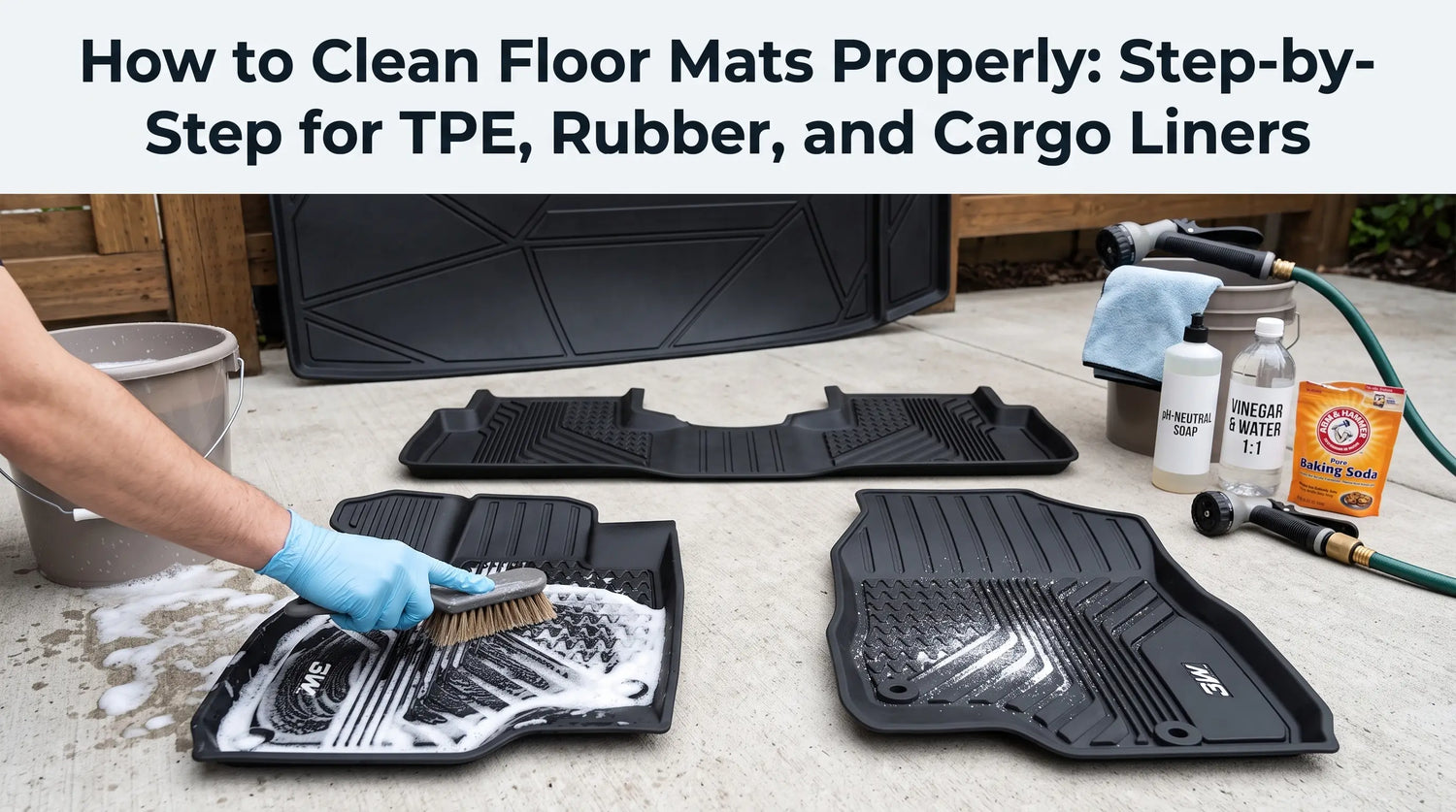
A floor mat with dried salt residue from three winters, ground-in sand in every channel, and a coffee stain from six months ago is not protecting your carpet—it is the reason your carpet will need replacing. Floor mats do their job as long as they are actually clean. A mat layered with embedded grit acts as sandpaper. A mat reinstalled while damp traps moisture that breeds mold in the carpet beneath it.
This guide covers the correct cleaning process for TPE, rubber, and cargo liners—with material-specific protocols, scenario tips for common messes, and a reference table of what actually damages mat surfaces.
Know Your Material Before You Start
|
Material |
Surface type |
Drying time |
Main cleaning risk |
|
TPE (e.g. 3W Thorex) |
Non-porous, flexible |
20-30 minutes |
High-pressure spray strips surface texture |
|
Natural rubber |
Dense, slightly porous |
45-60 minutes |
Alkaline degreasers cause surface oxidation |
|
Cargo liners (TPE or rubber) |
Large flat surface with raised edges |
30-45 minutes |
Corners and wheel-well seams trap debris |
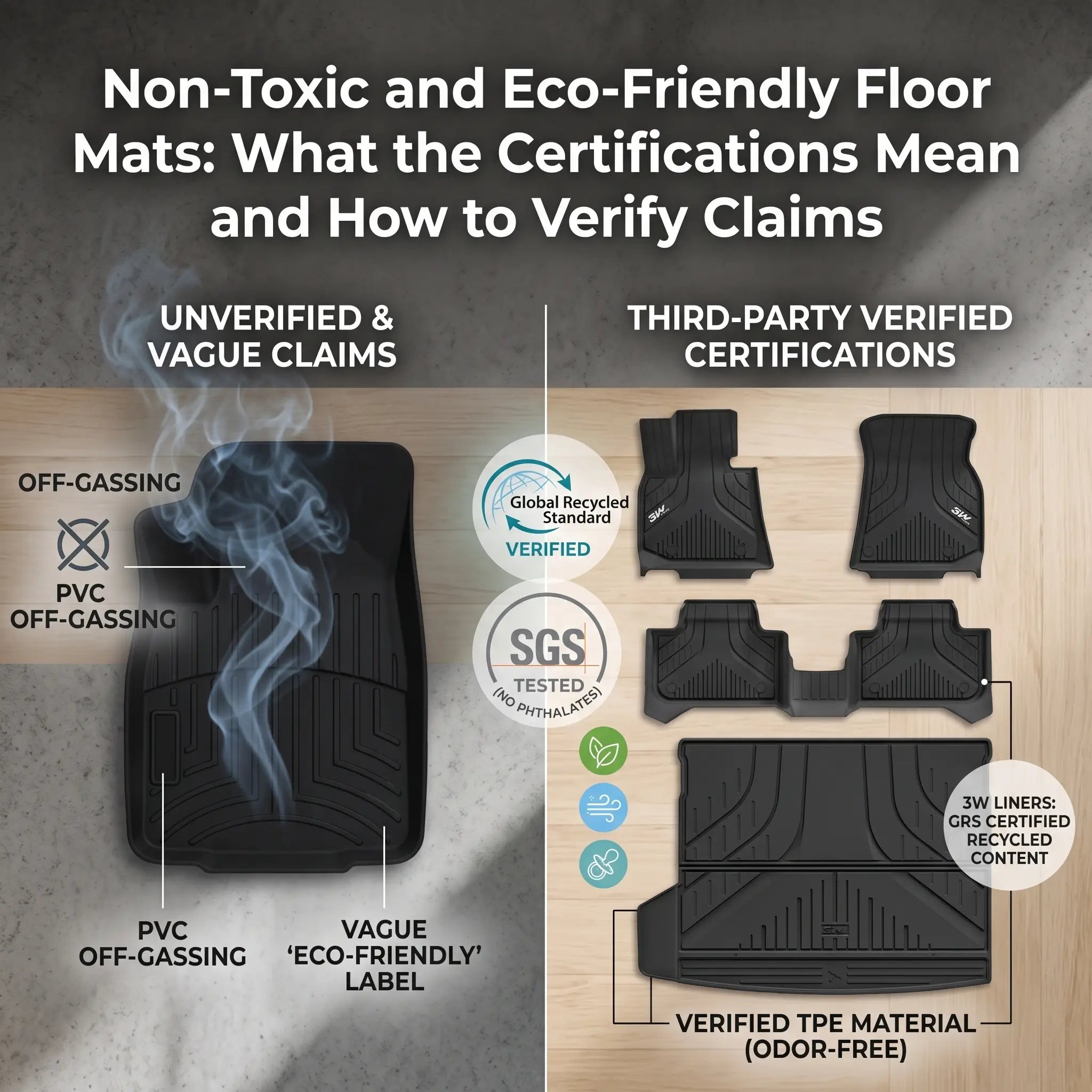
3W's floor mats and cargo liners use 100% Thorex TPE, which is non-porous and resistant to chemicals, oils, and spills. The material does not emit odor from -4 to 167 degrees F.1 Non-porous means liquid and debris sit on the surface rather than soaking in, which is why a 30-minute cleaning cycle is realistic.
What You Need
- Mild dish soap or pH-neutral automotive cleaner
- Soft to medium-bristle brush
- Garden hose or bucket (standard pressure—not a pressure washer)
- Microfiber towels
- Vacuum cleaner to remove loose grit before wetting the mat
- White vinegar 1:1 with water (for salt residue only)
- Baking soda paste (for persistent food odors)
The Standard Cleaning Process for TPE Mats
- Remove mats from the vehicle. Cleaning in place traps soapy water under the mat.
- Shake firmly and vacuum both sides. Pull loose grit out of the grooves before scrubbing—wet scrubbing over loose grit grinds it deeper.
- Pre-rinse with a hose or bucket to lift surface dirt.
- Apply mild dish soap and warm water. Let it sit one to two minutes.
- Scrub with a medium-bristle brush. Focus on groove areas where debris compresses.
- Rinse until the water runs completely clear. Soap residue left on the surface attracts new dust.
- Shake off excess water. Air-dry upright in shade for 20 to 30 minutes—not flat where water pools, and not in direct midday sun.
- Dry the underside fully before reinstalling. A damp mat traps moisture in the carpet. In warm conditions, mold can establish within 48 hours.

Rubber Mats: Two Adjustments
- Allow 45 to 60 minutes for drying. Rubber holds moisture longer than TPE.
- Use a pH-neutral cleaner rather than an alkaline degreaser. Alkaline products accelerate surface oxidation on rubber over time.3
Cargo Liners: Two Focus Areas
- Wheel-well coverage areas: raised perimeter sections trap standing water and road debris. Work the brush specifically along these edges.
- Corner seams: cargo loads compress dirt into corners. A brush needs to reach corner angles, not just sweep across the flat surface.
Scenario-Specific Cleaning
Winter salt and slush
Road salt leaves a white crystalline residue that dulls surfaces and accelerates material degradation if left. The standard soap-and-rinse process lifts most of it, but hardened deposits need more. Mix equal parts white vinegar and water, apply to the residue, and let it sit two to three minutes. The acetic acid in vinegar breaks down salt crystal bonds.4 Scrub, then rinse fully.
For drivers in northern states, a post-winter deep clean—including the underside of the mat and the carpet section directly beneath it—prevents salt residue from working into the carpet backing.
Mud and sand
Scrubbing wet mud grinds it deeper into channels. Let it dry first. Once dry, shake and vacuum to remove the bulk before introducing water. This single step reduces cleaning time by roughly half and avoids embedding grit into the mat surface.
Pet hair
Pet hair embeds into mat texture at an angle that standard vacuuming misses. Run a rubber brush or lint roller over the surface first to lift the hair out before vacuuming. TPE's non-porous surface does not hold pet allergens inside the material—they remain on the surface and rinse off in the standard wash cycle.
Food spills and sticky residue
Spot-clean fresh spills immediately with a damp cloth and mild soap—the sooner, the easier. For dried food residue, apply a paste of baking soda and a small amount of water, let it sit three to five minutes, then scrub and rinse. Baking soda is safe on both TPE and rubber and neutralizes food odors without chemical residue.1
Cleaning Reference: What to Use and What to Avoid
|
Cleaner or method |
Safe for TPE? |
Safe for Rubber? |
Why |
|
Mild dish soap + warm water |
Yes |
Yes |
Removes grease and grime without degrading the surface |
|
pH-neutral automotive cleaner |
Yes |
Yes |
Best choice for rubber; prevents surface oxidation |
|
White vinegar 1:1 with water |
Yes |
Yes |
Effective for salt residue; rinse fully after |
|
Baking soda paste |
Yes |
Yes |
Safe for food odors and dried residue |
|
Bleach or chlorine cleaner |
No |
No |
Degrades both TPE and rubber; causes brittleness and color stripping |
|
Engine-strength degreaser |
No |
No |
Too alkaline; strips texture and accelerates cracking |
|
High-pressure washer |
No |
Use with caution |
Strips surface texture on TPE; rubber is more tolerant but not immune |
|
Machine washing |
No |
No |
Agitation cycle warps mat shape and damages anti-slip backing |

Frequently Asked Questions
What is the best way to clean TPE floor mats?
Remove, shake and vacuum, pre-rinse, scrub with mild soap and a medium-bristle brush, rinse until clear, and air-dry upright in shade for 20 to 30 minutes before reinstalling.
Can I use bleach to clean car floor mats?
No. Bleach degrades both TPE and rubber surfaces. Mild dish soap handles all common stains effectively.
How do I remove salt residue from floor mats?
Apply a 1:1 mix of white vinegar and water, let sit two to three minutes, scrub, and rinse thoroughly.
How often should I clean my floor mats?
Every two weeks for regular daily use. Weekly in winter or muddy conditions. Rideshare drivers and tradespeople benefit from two to three times per week.
Can floor mats go in the washing machine?
No. Machine washing warps the mat shape and damages anti-slip backing. Hand washing with a brush and hose is the correct method.
How do I dry floor mats quickly?
Shake off excess water, press a microfiber towel against the surface, then air-dry upright in shade. Never reinstall a mat while it is still damp.
References
[1] 3W Liners FAQ – Cleaning care, temperature range, chemical resistance: https://3wliners.com/pages/faq
[2] 3W Liners – How to clean all-weather car mats: https://3wliners.com/blogs/car-mats/how-to-clean-all-weather-car-mats
[3] Flooring Inc. – How to get rid of rubber mat smell: https://www.flooringinc.com/blog/how-to-get-rid-of-rubber-mat-smell-in-7-steps
[4] Owleys – How to clean car floor mats step-by-step guide: https://owleys.com/how-to-clean-car-floor-mats/
[5] Truck HQ – Maintaining TPE floor mats clean: https://www.truckhq.ca/blogs/news/clean-spotless-pristine
[6] 3W Liners – Is 3W a good brand: 1-year durability and smell test: https://3wliners.com/blogs/car-mats/is-3w-a-good-brand
[7] Practical Travel Gear – Clean Up is Easy with 3W All-Weather Car Mats: https://practicaltravelgear.com/clean-up-is-easy-with-3w-all-weather-car-mats
[8] 3W Liners – Floor liners collection page:

Leave a comment
All comments are moderated before being published.
This site is protected by hCaptcha and the hCaptcha Privacy Policy and Terms of Service apply.