


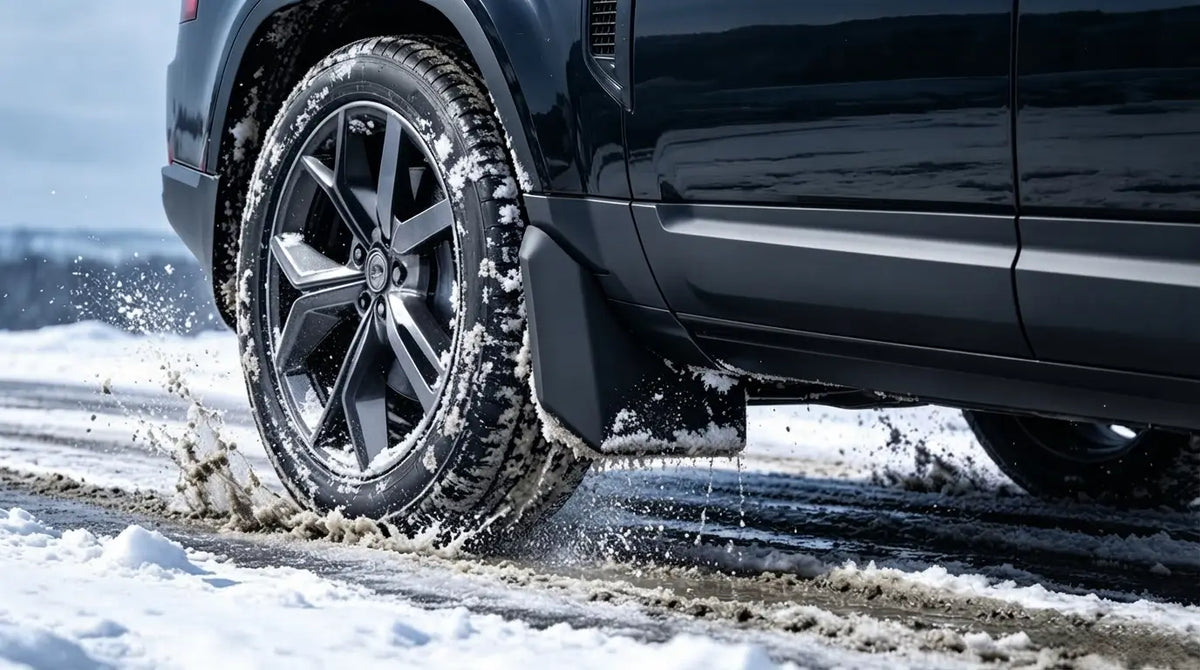
Salt season really gets going when temperatures start dropping towards freezing. Road salt in the US leads to $3 billion in annual vehicle rust damage, as reported by AAA research .
Most of that damage doesn't occur all at once. Every time you drive, salt spray hits your rocker panels and fender wells.
Over several weeks and months, chloride ions will eat through primer and bare metal from behind, long before there's any sign of bubbling paint. For fall and winter duties, mud flaps are one of the most practical ways to reduce how much of that spray hits your bodywork.
This guide covers what cold-season conditions require from a mud flap, which materials hold up well, and what fleet operators must address before the salt season.
What Fall and Winter Actually Do to an Unprotected Vehicle
Drivers often underestimate how quickly salt and slush damage accumulates. The figures really support this fact. Over a five-year period, some 22 million US drivers dealt with rust repairs caused by salt and de-icing chemicals at an average repair cost of $490 per incident .
Road Salt and Slush: The Real Threat
Road salt, almost always sodium chloride, will lower the freezing point of water on the road surface. Chloride ions in the salt get past the protective oxide layer on metal and speed up corrosion a lot quicker than plain water does on its own .
Slush is the most aggressive form of delivery. Wet slush flings off the rear tires in a constant, high-velocity spray aimed straight at your rocker panels, the lower body sections located below the doors. If there are no mud flaps on work trucks or passenger vehicles, that spray hits exposed metal hundreds of times during a single journey.
The Rocker-Panel Corrosion Timeline
Rocker-panel rust develops invisibly over months until it becomes apparent. Salt spray seeps into gaps behind the panel, where it stays in contact with exposed metal . This unseen corrosion will normally take one to three winters to produce noticeable bubbling, although structural damage begins in the very first season.
Repairing a full set of rocker panels at a body shop costs $800 to $2,500 per vehicle . For a fleet of ten vehicles, that's $8,000 to $25,000 in avoidable repairs, damage that mud flaps for fleets could greatly reduce.
Autumn: When the Damage Season Actually Starts
Fleet operators often view winter mud flap protection as a January concern. However, the damage season actually starts a bit earlier. Autumn brings wet leaves, early applications of road salt in colder states and heavy rain that flings all sorts of debris onto fender wells.
Mud flaps made for fall driving need to cope with wet conditions and the volume of debris before the first gritting truck even appears. Installing mud flaps right before the wet season begins will give your bodywork the maximum amount of protection through the entire corrosion season .
Which Mud Flap Materials Actually Work in Cold Weather
Not all mud flap materials hold up as well when temperatures drop. Some crack, some stiffen, and some sail in the slipstream.
Rubber and Rubber Composite: The Winter Default
Rubber is really the most reliable material for mud flaps if you're going to be using them in winter since it stays flexible at very low temperatures. Standard vulcanized rubber, rubber that's been heat-treated with sulfur to improve its durability, remains pliable right down to about -40 degrees Fahrenheit (-40 degrees Celsius), which covers even the coldest continental US winters .
Plain rubber's main problem in winter is sliding; the flap deflects horizontally in the vehicle's slipstream at highway speeds, reducing debris coverage exactly when salt spray is heaviest. Rubber composite flaps fix this problem by having stiffening ribs or weighted bottom strips that will hold the flap upright even at 70 miles per hour . For work trucks' mud flaps for winter use, rubber composite is practically the minimum specification.
TPE Blends: Precision Fit in Cold Conditions
Thermoplastic elastomer (TPE), a rubber-like polymer engineered so that it can be moulded very precisely, retains its shape in cold weather and also resists UV degradation in the summer, both things that matter for mud flaps on vehicles parked outside all year round . A well-made TPE flap will follow the exact fender contour, completely eliminating any edge gaps that let salt spray bypass the flap altogether.
TPE flaps are perfect for SUVs and light trucks where getting a good fit is just as important as the material performing well. If the flap doesn't seal properly against the fender edge in the winter, when salt spray hits at wider angles because of slush, then a TPE custom-fit unit will pay for itself in avoided paint damage. TPE isn't the best choice for very demanding commercial applications where thick rubber or metal guards are the industry standard .
Sheet Metal: On-Road Only
Mud guards made from stainless steel and aluminium offer a very professional finish and zero-sail performance at any speed. Rigidity is the key feature, and the biggest limitation. On very deep snow or any unpaved surface, a rigid metal guard could dig in, shear its mounting equipment, or bend in ways that rubber would simply flex through .
Sheet metal mud flaps for fleets really do make sense for urban delivery trucks and vehicles serving on paved roads all the time. For vehicles capable of handling mixed terrain or off-road conditions, rubber or TPE would be a lot safer in winter conditions.
What Fleet Operators Need to Think About Before Winter
When it comes to work trucks and fleets' mud flaps, the financial logic of winter protection is pretty clear-cut. The harder decision is setting the right specification for your entire fleet, especially if it's got many different models. Here's what you should focus on locking down just before the salt season starts.
Standardizing Across Vehicle Types
A fleet running a mix of big diesel trucks, mid-size pickups and SUVs will need quite different mud flap specifications for each one, all tailored to their different fender shapes, ground clearance and tire width. Universal flaps trimmed to fit consistently still leave those annoying edge gaps. Mud flaps for work trucks and fleets that are custom-made for each individual vehicle model eliminate these gaps altogether .
Purchase your needs in bulk well before winter rather than on a vehicle-by-vehicle basis as the season progresses. This will generally decrease the cost per unit and also sidestep supply delays that are prevalent when there is very high demand.
Installation: What Can Go Wrong in Cold Weather
Cold weather installation does affect the fit quality of your new mud flaps. Rubber flaps installed below 32 degrees Fahrenheit might feel stiffer while fitting, making alignment much more difficult. However, TPE composite flaps will keep their shape much better during very cold installations . For both types of flaps, try to install them in a heated workshop if at all possible.
Winter-ready mud flap fitment key installation checks are:
Legal Requirements for Winter Commercial Use
Commercial vehicles in almost all US states have to meet certain minimum rear mud flap specifications, regardless of the season.
Several states actually require flaps to be located within 8 inches of the road surface, and to cover the entire width of the drive tire, requirements that become a lot more important in winter when the salt spray coming from unprotected tires poses an even bigger threat to following vehicles .
Vehicles towing trailers definitely need their own set of mud flaps independent of the towing vehicle. Its rear axle sits far behind the final fender, and those unguarded tires send debris flying straight at any following traffic.
Fleet operators should check their state's commercial trailer regulations against each trailer's Gross Vehicle Weight Rating (GVWR, the maximum legal weight that the vehicle was actually designed to carry and tow) right before winter .
Pre-Winter Mud Flap Inspection: What to Check Before the Season
Installing brand-new mud flaps right before winter is really the way to go. And so is having a good look over your existing flaps right before the temperature drops too low. A cracked or very poorly mounted flap in the winter provides zero protection.
Have a glance at this list right before that first frost:
A real world example is a regional delivery fleet in Minnesota finding that their mud flap failure rate more than doubled in the second winter when they missed their pre-season inspection. Split and warped flaps resulting from UV exposure went unseen and the fleet had to face rocker panel repairs that a quick look-over would have picked up.
Frequently Asked Questions
Do mud flaps for fall and winter actually make a measurable difference to corrosion?
Yes. Road salt results in $3 billion in vehicle rust damage each year in the US, as reported by AAA research . Mud flaps catch the main delivery route of salt-laden tire spray right before it hits rocker panels and fender wells. Total rocker-panel rust repair costs $800 to $2,500 per vehicle .
What is the best mud flap material for cold climates?
Rubber or rubber composite. Standard rubber stays pretty flexible all the way down to -40°F and resists cracking during those frequent freeze-thaw cycles that are so typical of winter climates . Rubber composite with reinforcing ribs or heavier bottom strips is better suited for high-speed road use where regular rubber may sail and lose its debris coverage.
Do mud flaps for fleets need to be replaced every winter?
No, not necessarily. A properly maintained rubber or TPE mud flap will last for many seasons. Look out for cracks, warping and compromised fittings prior to each winter, a failed flap offers no protection whatsoever .
Can I install mud flaps myself before winter?
Yes, on the vast majority of vehicles using the original equipment manufacturer's (OEM) factory mounting holes. Universal flaps generally need just 1/8 inch pilot holes drilled through the fender liner; this is a routine installation procedure . If you want a clean fit for wintertime, fit them in a warm place above 32°F so the material holds its correct form and angle.
At what temperature does road salt stop working?
Standard sodium chloride road salt starts to lose its effectiveness at temperatures below about 15°F (-9°C) . When that happens, liquid de-icers or calcium chloride are used instead. Both are equally corrosive to the bodywork of your vehicle, and both spray off your tires in the same way, making mud flaps just as vital at any winter temperature.
References
AmericanTrucks.com, Best Mud Guards & Mud Flaps Tech Guide (material types, sail, cold weather performance, installation): https://www.americantrucks.com/best-mud-guards-flaps-at-tech-guide.html
3Wliners.com, What Are Mud Flaps For? (debris physics, corrosion, sizing, installation): https://3wliners.com/blogs/car-mats/what-are-mud-flaps-for
NTEA, Commercial Vehicle Mud Flap Compliance Overview (state requirements by GVWR).
AAA Newsroom / South Jersey AAA, Road De-Icers and Rust Damage Fact Sheet. $3 billion annually in US salt-related rust damage; 22 million drivers affected over five years; average $490 per repair: https://newsroom.aaa.com/wp-content/uploads/2017/02/Road-De-icers-and-Rust-Damage-Fact-Sheet-FINAL.pdf
ThePricer.org, Rocker Panels and Cab Corners Replacement Cost ($800, $2,500+ per vehicle): https://www.thepricer.org/rocker-panels-and-cab-corners-replacement-cost/

Leave a comment
All comments are moderated before being published.
This site is protected by hCaptcha and the hCaptcha Privacy Policy and Terms of Service apply.