


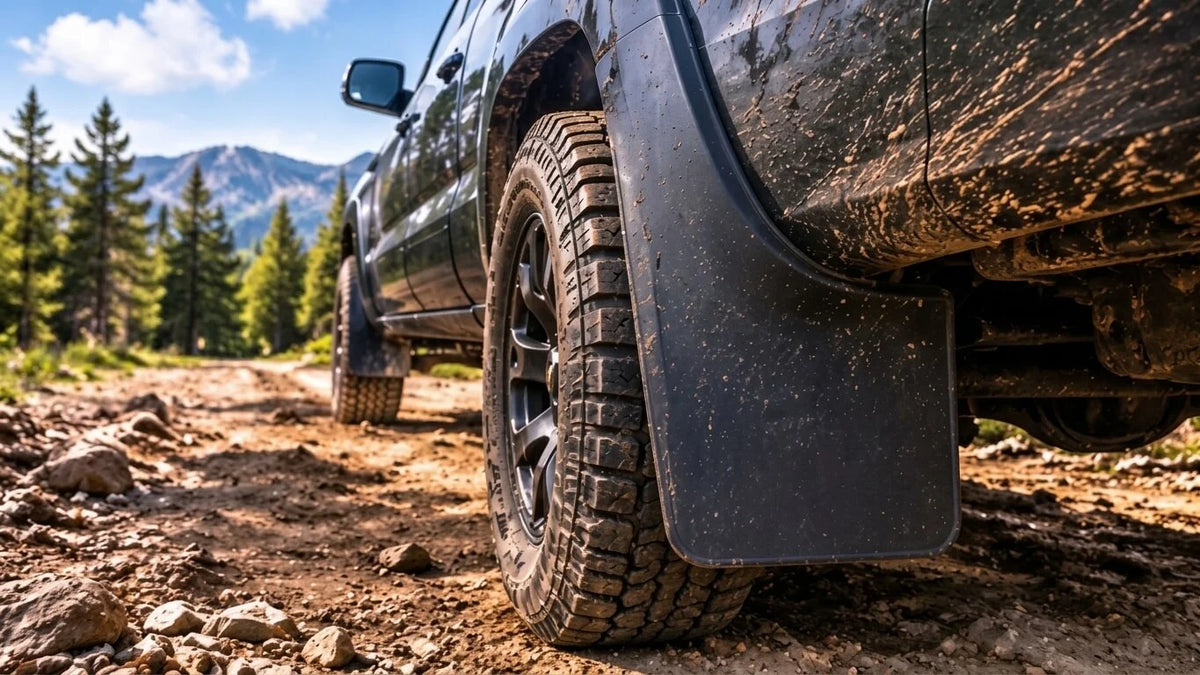
The best mud flaps for a Toyota Tundra or Tacoma should match the truck's model year, trim, wheel and tire setup, and fender configuration. Custom-fit mud flaps are generally designed around specific vehicle mounting points, while universal options may require trimming, drilling, or additional adjustments. For trucks regularly driven on gravel roads, muddy trails, or salt-treated highways, properly fitted mud flaps can help reduce debris thrown toward the lower body panels and vehicles behind.
Before choosing a set, Toyota Tundra and Tacoma owners should compare the product's actual coverage, mounting method, material, and installation requirements rather than relying on labels such as "mud flaps" or "splash guards" alone.
What Do Mud Flaps Actually Protect on a Toyota Tundra or Tacoma?
Mud flaps are flexible or semi-rigid panels installed behind a vehicle's wheels to intercept some of the mud, water, gravel, and road debris thrown outward by rotating tires. On a Toyota Tundra or Tacoma, they can provide additional protection for areas around the wheel openings, rocker panels, lower bodywork, and nearby vehicles.
Their value becomes more noticeable when a truck regularly travels through conditions that generate road spray or loose debris.
Protection Against Mud, Gravel, and Road Spray
When tires move over wet or loose surfaces, they can pick up and throw debris toward the rear and sides of the vehicle. Mud flaps help reduce the amount of material that reaches these areas.
For example:
- Gravel roads: Small stones and loose particles can be thrown toward lower body panels and nearby vehicles.
- Wet roads: Water mixed with dirt can collect around wheel openings and along the lower body.
- Muddy trails: Thick mud can accumulate behind the wheels and around the fender areas.
- Winter highways: Snow, slush, and road-treated residue can be thrown toward the lower bodywork.
Mud flaps do not prevent every impact or eliminate road spray. Their effectiveness depends on their size, position, material, fitment, and the conditions in which the truck is driven.
Mud Flaps vs. Splash Guards: Are They the Same?
The terms "mud flaps" and "splash guards" are often used interchangeably in aftermarket listings. However, product names alone do not always explain differences in coverage, mounting position, or design. Comparing these specifications is more useful when choosing an accessory for a Toyota Tundra or Tacoma [3].
For a closer look at how these terms are used in the aftermarket, read 3W's guide to Mud Flaps vs. Splash Guards: Why the Confusion Costs Truck Owners Money.
The Three Main Types of Debris That Make Mud Flaps Useful
The driving environment is one of the most important factors when deciding whether a Toyota Tundra or Tacoma needs additional wheel-area protection. Different surfaces expose the truck to different types of debris.
Gravel and Small Stones
Gravel roads are common around construction sites, rural properties, campgrounds, and off-road trail access points. Loose stones can be picked up by the tires and thrown toward the wheel arches and lower body panels.
Drivers who frequently travel on unpaved roads may prefer mud flaps with sufficient coverage behind the tires. However, the flap should not hang so low that it catches on rocks, uneven ground, or obstacles.
Mud and Wet Trail Debris
Mud can collect around the wheel wells, suspension components, and lower bodywork after driving through wet trails or construction areas.
A mud flap can reduce some of the debris thrown outward, but it is not a substitute for cleaning the wheel wells and underbody after particularly muddy trips.
For off-road drivers, the flap's flexibility and mounting security are also important. A panel that is too rigid or poorly secured may be more vulnerable to damage when it contacts an obstacle.
Snow, Slush, and Road Salt
In winter, tires can throw a mixture of snow, water, dirt, and road-treatment residue toward the lower bodywork. This is particularly relevant for trucks driven regularly on highways in regions that use road salt.
Mud flaps can help reduce some of this spray, but they do not protect the entire underbody from corrosion. Regular washing and inspection remain important.
It is also worth considering interior protection. Snow, mud, and salt residue can enter the cabin on footwear, so exterior accessories and vehicle-specific floor liners serve different purposes.
For more information about winter cabin protection, see 3W's guide to Floor Mats for Snow, Ice, and Salt.
Mud Flap Materials: Rubber, TPU, and Polyurethane
Mud flap material affects flexibility, durability, weight, and resistance to everyday driving conditions. Toyota Tundra and Tacoma owners should consider both the driving environment and the way the truck is configured before choosing a material.
Rubber Mud Flaps
Rubber is commonly used for flexible automotive splash protection. It can bend when exposed to minor contact and is available in different thicknesses and levels of stiffness.
Potential advantages include:
- Flexibility when encountering light contact.
- A relatively simple, practical construction.
- Availability in different sizes and thicknesses.
However, not all rubber formulations perform the same way. Temperature resistance, thickness, and manufacturing quality can affect long-term performance.
TPU Mud Flaps
Thermoplastic polyurethane (TPU) is used in some automotive accessories because it can combine flexibility with resistance to abrasion and repeated deformation.
When evaluating a TPU mud flap, check the manufacturer's specifications rather than assuming that all TPU products offer identical flexibility or impact resistance.
Polyurethane and Other Plastic Materials
Some mud flaps use polyurethane-based materials or other molded plastics. These products can provide a more structured appearance, but their flexibility and cold-weather behavior depend on the specific material formulation.
A very rigid panel may be less suitable for trucks that frequently encounter rocks, uneven trails, or winter conditions. A softer panel, on the other hand, must still maintain its position and provide adequate coverage at normal driving speeds.
Which Material Should Tundra and Tacoma Owners Choose?
There is no single material that is best for every truck. Compare the product's thickness, flexibility, temperature guidance, mounting design, and warranty terms. Material names alone are not enough to determine real-world durability.
Toyota Tundra Mud Flap Fitment: Trim, Tires, and Fender Flares
A Toyota Tundra's size and configuration make fitment an important part of mud flap selection. A product that fits one Tundra version should not automatically be assumed to fit every model year or trim.
Confirm the Tundra Model Year and Generation
The Tundra has undergone major design changes across generations. Wheel-well contours, factory mounting locations, and exterior trim details can differ between model years.
When comparing mud flap options, verify:
- Exact model year and generation.
- Cab and bed configuration, if specified by the manufacturer.
- Factory fender liner design.
- Existing factory mud flap or splash guard mounting points.
- Whether the product is designed for the front, rear, or all four wheels.
A general listing that only says "Toyota Tundra" may not provide enough information to confirm compatibility.
Vehicle-specific accessories should be selected according to the exact model year and configuration rather than the vehicle name alone. Differences in generations, body styles, and mounting locations can affect compatibility [1].
Toyota owners can also review 3W's Toyota vehicle-specific floor mat fitment guide to understand why checking the exact model year and vehicle configuration matters when choosing accessories.
Check Fender Flares and Aftermarket Body Modifications
Fender flares can change the shape and width of the wheel opening. Some aftermarket flares also use different mounting points or extend farther from the original body line.
Before ordering, compare the mud flap's mounting design with the truck's actual fender configuration. A flap designed for a standard wheel arch may not sit flush against an aftermarket flare.
Consider Wheel and Tire Changes
Larger tires, wider wheels, wheel spacers, and suspension lifts can all affect the space available around a mud flap.
A wider tire may extend farther beyond the original wheel opening, changing how much coverage is needed. A lifted truck may also have a different relationship between the tire, wheel arch, and flap.
For these configurations, confirm the product's stated compatibility instead of assuming that a factory-fit accessory will work with modified wheels and suspension.
Toyota Tacoma Mud Flap Fitment: TRD Off-Road, TRD Pro, and Trailhunter
The Toyota Tacoma is often used for outdoor activities, trail driving, and work-related travel. Its different trims and available configurations make it important to verify fitment at the vehicle level rather than choosing an accessory based only on the Tacoma name.
Tacoma TRD Off-Road
The Tacoma TRD Off-Road is commonly associated with drivers who use their trucks on unpaved roads and trails.
When selecting mud flaps, pay attention to tire size, wheel offset, suspension changes, and the shape of the fender area. If the truck has been modified after purchase, factory accessory compatibility should be checked again.
Tacoma TRD Pro
TRD Pro owners may have a different combination of factory equipment, wheels, tires, and suspension components from other Tacoma trims.
Do not assume that a mud flap advertised for a standard Tacoma will fit the TRD Pro without modification. Check whether the listing specifically includes the relevant model year and trim.
Tacoma Trailhunter
The Tacoma Trailhunter is designed with overlanding-oriented equipment and a distinct exterior configuration.
Owners should pay particular attention to any aftermarket additions around the wheel arches, including fender protection, wider tires, and suspension modifications. These changes may affect the mounting position and clearance of an aftermarket mud flap.
Why Model Year and Generation Matter
Tacoma fitment has changed across generations, so a kit designed for a 2016–2023 Tacoma should not automatically be treated as compatible with a 2024 or newer model.
A Tacoma's trim name alone may not be enough to confirm accessory compatibility. Model year, wheel and tire changes, suspension lifts, and aftermarket fender flares can all influence fitment. Buyers should verify these details against the manufacturer's compatibility information before ordering [1][3].
For additional guidance on comparing custom-fit and universal designs, see 3W's article on Best Mud Flaps for Trucks and SUVs in 2026: Custom-Fit vs. Universal.
Off-Road vs. Highway Mud Flaps: Which Design Makes More Sense?
The best mud flap design depends on where the truck spends most of its time. A truck used for daily commuting has different requirements from one that regularly travels over rocky trails or muddy access roads.
For Daily Highway Driving
For highway use, consider:
- Stable mounting that minimizes vibration.
- Adequate coverage behind the tires.
- Clearance from the tires and road surface.
- A design that does not interfere with normal vehicle operation.
- Materials suited to the local climate.
A flap that is too large or hangs too low may be inconvenient on steep driveways, parking ramps, or uneven roads.
For Off-Road Driving
Off-road use introduces additional challenges, including rocks, branches, deep ruts, and uneven ground.
Drivers who frequently travel off-road should consider:
- Flexible construction that can tolerate some movement.
- Secure mounting hardware.
- Sufficient clearance from larger tires.
- A flap position that is less likely to catch on obstacles.
- Ease of inspection and replacement after trail use.
No mud flap is immune to damage. Even a well-fitted panel can be torn or bent if it catches on a rock or other obstacle.
For Trucks Used Both On-Road and Off-Road
Many Tundra and Tacoma owners use their trucks for commuting during the week and outdoor activities on weekends.
For mixed use, a practical choice should balance coverage, flexibility, mounting security, and ground clearance. Consider the most demanding conditions the truck regularly encounters rather than selecting a product based only on its appearance.
Mud Flap Installation: What Toyota Tundra and Tacoma Owners Should Check
Installation requirements vary by vehicle and product. Some vehicle-specific kits use existing factory mounting points, while universal products may require trimming, drilling, or additional hardware.
Before starting, read the manufacturer's instructions and confirm that the kit is designed for the exact truck configuration.
Tools and Preparation
Depending on the kit, basic tools may include:
- Socket set or appropriate wrench.
- Screwdriver or trim-removal tool.
- Clean cloth and mild cleaning solution.
- Flashlight for inspecting mounting points.
- Included clips, bolts, or other mounting hardware.
Drill-on installations may require additional tools, such as a drill, drill bits, marking tools, safety glasses, and suitable protection for any exposed metal edges.
Park on a firm, level surface, engage the parking brake, and secure the vehicle before working around the wheels. If lifting the truck is necessary, use appropriate jack stands and approved lifting points. Never rely on a jack alone.
Step-by-Step Installation Overview
The general process for installing mud flaps includes the following steps:
A reliable installation starts with confirming vehicle compatibility, checking the mounting points, and ensuring that the flap is correctly aligned before tightening the hardware. Tire clearance and mounting security should also be checked before driving [2].
For a more detailed installation walkthrough, readers can refer to 3W's How to Install Mud Flaps guide.
No-Drill vs. Drill-On Installation
A no-drill kit uses existing factory mounting points and avoids creating new holes in the vehicle. This can make installation more straightforward when a compatible vehicle-specific design is available.
A drill-on kit may be necessary when the product does not use factory mounting points or when a universal design requires additional holes.
If drilling is required, follow the kit's instructions carefully and protect exposed metal edges against corrosion. Do not force a universal product into factory mounting holes if the alignment is incorrect.
Common Installation Mistakes
Several problems can affect the fit and performance of mud flaps:
- Incorrect fitment: Mounting holes do not align with the vehicle.
- Uneven positioning: The flap does not follow the wheel arch properly.
- Loose hardware: Vibration causes rattling or movement.
- Insufficient tire clearance: The flap contacts the tire during steering or suspension movement.
- Excessive ground clearance issues: The flap hangs too low and catches on obstacles.
If the holes do not align or the flap contacts the tire, stop and recheck the fitment. Do not force the hardware or continue driving with a loose or rubbing flap.
How to Maintain Mud Flaps and Protect the Rest of Your Truck
Mud flaps need periodic inspection, especially on trucks exposed to gravel, mud, winter road salt, or off-road obstacles.
Inspect Mounting Hardware Regularly
Check for loose fasteners, missing clips, cracked mounting points, and changes in flap position.
It is good practice to inspect the hardware after the first few drives and continue checking it periodically. Follow the product manufacturer's recommended inspection schedule.
Regularly inspecting mounting hardware, checking for cracks, and looking for signs of tire contact can help identify installation or wear-related problems early. These checks are particularly important after driving on rough roads or through demanding conditions [2].
For additional installation and inspection guidance, see 3W's How to Install Mud Flaps guide.
Clean Away Mud and Road Salt
Mud and road residue can accumulate behind the flaps and around the wheel wells.
During regular vehicle washing:
- Rinse away loose mud and gravel.
- Remove accumulated salt and slush.
- Check behind the flaps for trapped debris.
- Inspect the surrounding wheel-well liner and lower bodywork.
This is particularly important in winter, when road salt and moisture can remain around areas that are difficult to see.
Look for Cracks, Deformation, and Tire Contact
Inspect the flap for torn edges, cracks, permanent deformation, or signs of rubbing against the tire.
A flap that has shifted out of position may no longer provide the intended coverage. Replace damaged hardware or components as needed, and confirm the fitment again if the truck's tires, wheels, or suspension have changed.
Protect the Cabin as Well as the Exterior
Mud flaps and floor liners protect different parts of a truck. Mud flaps help reduce debris thrown outward by the tires, while floor liners help contain dirt, water, snow, and residue brought into the cabin by occupants.
Choosing the correct floor liner also requires checking the truck's generation and cab configuration. Toyota Tundra owners can explore 3W's Toyota Tundra Floor Mats guide for more information about interior fitment and cabin protection.
A complete truck-care routine should consider the wheel wells, lower bodywork, underbody, and cabin rather than relying on one accessory to protect every area.
Conclusion
Choosing mud flaps for a Toyota Tundra or Tacoma involves more than comparing product photos or selecting the lowest-priced option. Model year, trim, wheel and tire size, fender flares, suspension modifications, material, and mounting design all influence whether a set will fit properly.
Custom-fit options can offer a closer match to factory mounting points and wheel-arch contours, while universal designs may require additional trimming or installation work. Neither option should be selected without checking the product's stated compatibility and coverage.
For trucks used on gravel roads, muddy trails, and winter highways, properly fitted mud flaps can help reduce debris thrown toward the lower bodywork. Regular cleaning and hardware inspections help maintain their position and condition over time.
Frequently Asked Questions
1. Do Toyota Tundra and Tacoma trucks need mud flaps?
Mud flaps can be useful for Tundra and Tacoma owners who regularly drive on gravel roads, muddy trails, or salt-treated highways. They help reduce some of the debris thrown outward by the tires, although the level of protection depends on the flap's coverage and fitment.
2. Are custom-fit mud flaps better than universal mud flaps?
Custom-fit mud flaps are designed for specified vehicle models and configurations, so they may align more closely with factory wheel arches and mounting points. Universal mud flaps can fit a wider range of vehicles but may require trimming, drilling, or manual adjustment. The right choice depends on vehicle compatibility and installation requirements [1].
3. Will Tacoma TRD Off-Road or TRD Pro mud flaps fit a standard Tacoma?
Not necessarily. Trim differences, model years, wheel configurations, and exterior components can affect fitment. Always check the manufacturer's compatibility information for the exact Tacoma year and trim before ordering.
4. Can I install mud flaps on a lifted Toyota Tundra or Tacoma?
Yes, but a lifted truck may require a different flap size or mounting arrangement. Larger tires, wheel spacers, and aftermarket fender flares can also affect clearance and coverage. Confirm compatibility with the modified configuration before installation [1][3].
5. Do mud flaps require drilling?
Not always. Some vehicle-specific kits use existing factory mounting points, while universal or other aftermarket designs may require drilling or trimming. Check the installation instructions before purchasing [2].
References
[1] 3W Auto-Life — Best Mud Flaps for Trucks and SUVs in 2026: Custom-Fit vs. Universal
[2] 3W Auto-Life — How to Install Mud Flaps
[3] 3W Auto-Life — Mud Flaps vs. Splash Guards: Why the Confusion Costs Truck Owners Money

Leave a comment
All comments are moderated before being published.
This site is protected by hCaptcha and the hCaptcha Privacy Policy and Terms of Service apply.