


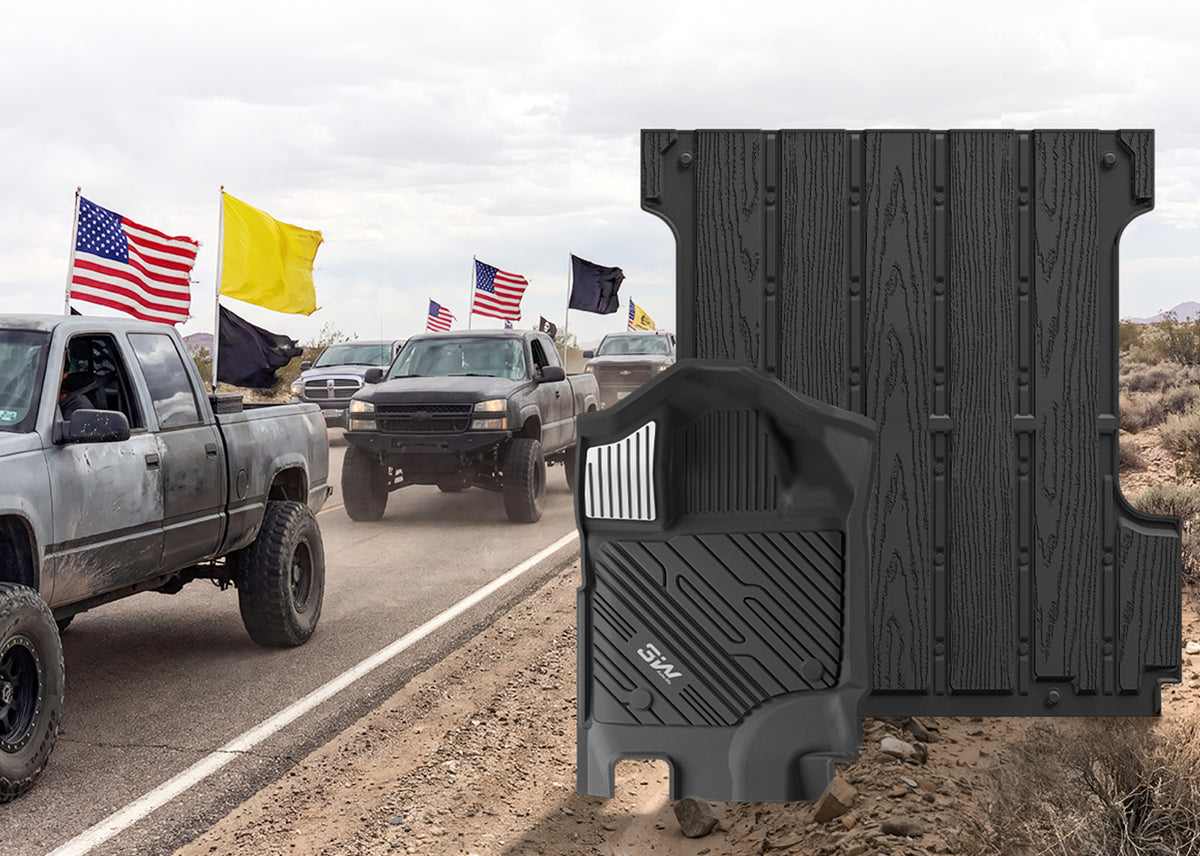
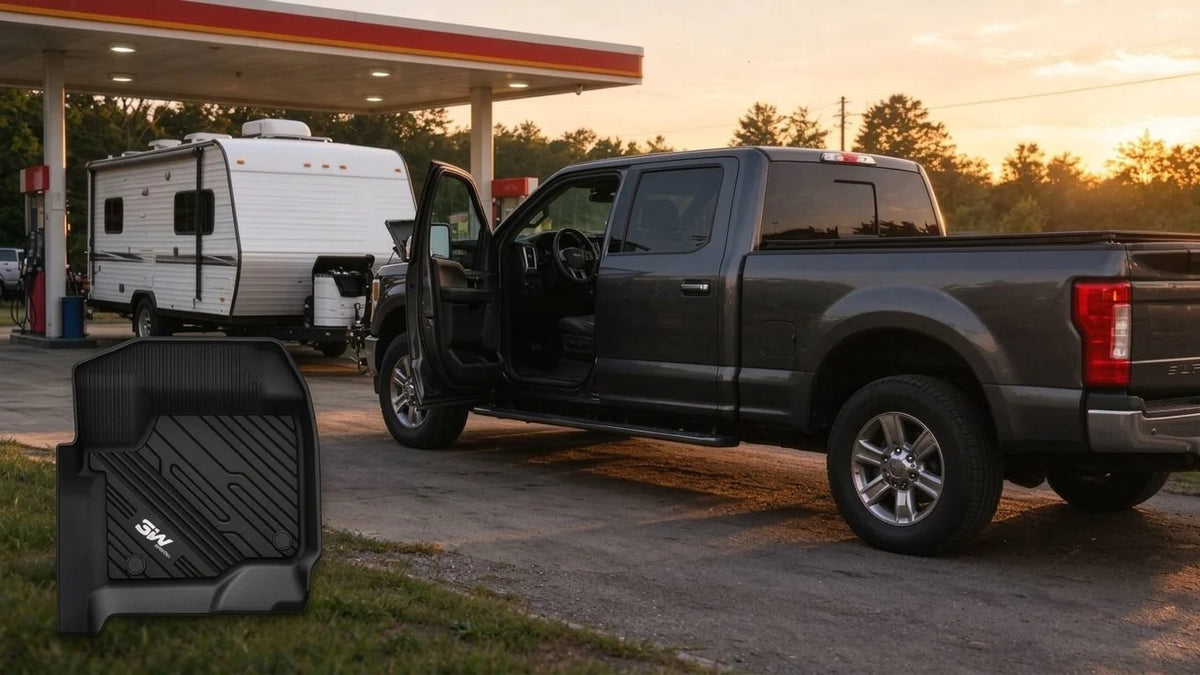
If you manage a mixed-brand truck fleet, you already know the procurement headache. The construction supervisor drives an F-150. The towing crew runs Silverado 2500s. The heavy-haul team depends on Ram 3500s. Every truck brings its own floor pan shape, its own retention-post layout, and its own carpet dimensions — but the mud, job-site gravel, winter road salt, and work-boot grit coming through those doors are identical regardless of what badge sits on the grille.
Most fleet managers discover the hard way that mixing floor mat brands across trucks creates more problems than it solves — different cleaning protocols, incompatible retention systems, and gaps in coverage that let salt water seep into factory carpet. The 3W truck floor mat takes a different approach: one supplier, one TPE material formulation, one warranty, with vehicle-specific 3D-scanned molds for each truck platform. No parts-number scavenger hunt. No hoping a universal trim-to-fit mat covers the right spots.
This guide walks through what separates a mat built for commercial duty cycles from a consumer all-weather liner, where fit differences matter across Ford, Chevy, and Ram platforms, and how the right choice pays for itself before the first truck in your fleet reaches trade-in mileage.
The Real Cost of Unprotected Fleet Truck Interiors
Fleet trucks typically cycle out between 80,000 and 120,000 miles. The condition of the factory carpet at trade-in — stained through, worn to the backing, holding a musty odor that detailers cannot remove — directly reduces resale or auction value by $200 to $500 per vehicle. Across a fleet of 15 trucks cycling every four years, that is $3,000 to $7,500 in avoidable depreciation. Across 50 trucks, the number climbs past $25,000.
A set of custom-fit floor mats costs roughly what one professional carpet detail costs per truck — and provides continuous protection for years instead of a single cleaning. The U.S. Department of Transportation, through NHTSA, has also documented accelerator pedal entrapment incidents caused by unsecured or incompatible floor mats — a liability concern no fleet safety officer should overlook [4].
Procurement leads should treat custom-fit mats not as an accessory expense, but as a depreciation hedge with a safety compliance component. Skip them, and the fleet is prepaying for carpet replacement and detail work that a one-time mat purchase would have prevented.
Why One Supplier Across All Three Brands Changes the Math
When every truck in a fleet runs a different floor mat from a different brand — ordered at different times, by different people — the small inefficiencies compound into real operational costs.
One mat requires a specific cleaner the yard does not stock. Another never engaged its factory retention clips and has been sliding forward under braking for six months. A third was ordered as a universal trim-to-fit liner and leaves a two-inch gap along the door sill where salt water seeps through every winter. Each problem is minor in isolation. Across 15, 20, or 50 trucks with rotating drivers, those small problems become a steady drain on maintenance time, driver complaints, and eventually, carpet replacement costs.
Standardizing on one supplier with custom-fit molds for each vehicle platform eliminates those variables entirely. The material stays consistent — every truck gets the same TPE formulation. Every retention system clips into the same OEM anchor posts using the same mechanism. The cleaning protocol is identical: pull the mat, hose it off, wipe it down, reinstall. When a mat eventually wears out at 80,000 miles, reordering is one part number per vehicle — not a scavenger hunt across three manufacturers' accessory catalogs.
For fleet managers running both pickups and passenger vehicles — taxi fleet operators, municipal motor pools, or utility crews with mixed sedans and SUVs — the same standardization logic applies. One material, one supplier, vehicle-specific molds per platform. The math scales linearly: more vehicle types under management only strengthens the case for a single sourcing relationship.
TPE vs. Rubber vs. TPO: What Holds Up Under Commercial Duty Cycles
The three materials that dominate all-weather floor mats behave differently under the demands of a commercial fleet. A privately owned truck might see 12,000 miles a year with one driver. A fleet truck can log 30,000 miles a year across three different drivers — and the mat has to hold up through all of it.
Rubber floor mats are heavy and familiar, but they carry a known trade-off: a strong chemical odor in a hot cab after a summer afternoon on an Arizona job site, and a tendency to crack after repeated freeze-thaw cycles. For fleet trucks that cycle between cold overnight yards and heated daytime cabs, rubber's thermal fatigue accelerates faster than most fleet managers expect.
TPO (thermoplastic olefin) mats stay dimensionally stable under heat and carry a lower odor profile than rubber, which makes them serviceable for light-duty fleet applications like courier vans and delivery sedans. But TPO stiffens noticeably below roughly 20°F and the surface can develop a slick, polished texture when wet — a slip hazard for drivers climbing in with muddy or snow-caked boots.
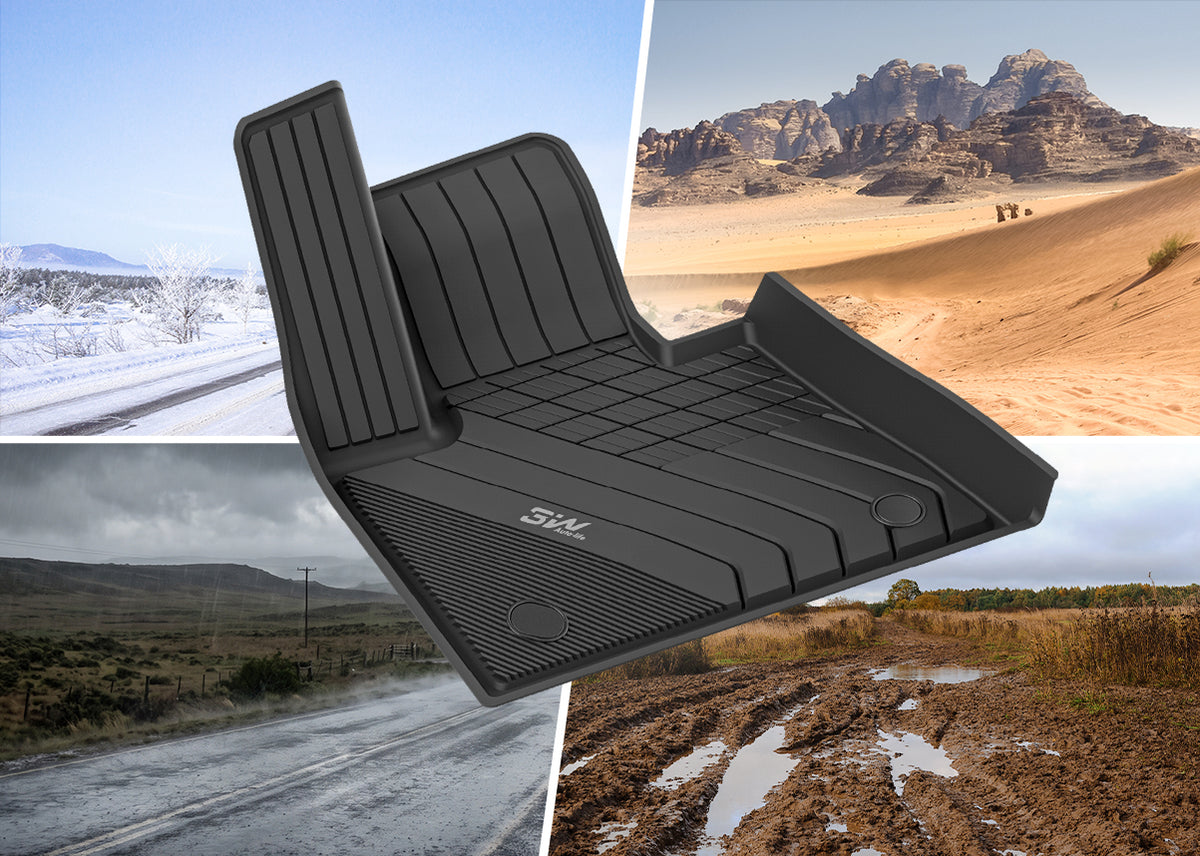
TPE (thermoplastic elastomer) sits between the two. It combines the flexibility of rubber with the structural stability of plastic, stays pliable to −4°F, and emits no chemical odor. Its textured surface maintains consistent grip whether wet or dry. Multiple manufacturers offer TPE-based custom-fit mats, including 3Wliners, WeatherTech, and Husky Liners. The 3W Custom Floor Mats use a Thorex™ TPE formulation with GRS-certified recycled content and a rated temperature tolerance from −4°F to 167°F [1].
The following table summarizes how the three material families compare across the factors that matter most for commercial fleet duty cycles:
For a fleet manager purchasing across three truck brands, TPE delivers a single material specification that works regardless of climate zone — Minnesota winter to Arizona summer, same part logic, same expected service life.
As noted in an independent SlashGear comparison of affordable all-weather floor mat brands, more than four out of five verified reviewers gave the 3W floor mats a five-star rating, with one reviewer reporting the mats were "better quality than weather tech and honestly fit so much nicer" [5].
|
Material
|
Cold-Weather Behavior
|
Heat and Odor Profile
|
Wet-Traction Surface
|
Durability Under Rotating Drivers
|
Best Fleet Application
|
|
Rubber
|
Stiffens; cracks after repeated freeze-thaw cycles
|
Strong chemical odor in hot cabs
|
Adequate grip wet or dry
|
Moderate; material degrades under thermal cycling
|
Single-driver owner-operator trucks
|
|
TPO (thermoplastic olefin)
|
Hardens noticeably below 20°F
|
Low odor; dimensionally stable
|
Can polish slick when wet; slip risk
|
Good; holds shape at moderate mileage
|
Light-duty delivery and courier fleets
|
|
TPE / Thorex™
|
Stays pliable to −4°F [1]
|
Low odor; no chemical off-gassing
|
Consistent wet/dry texture
|
High; resists cracking through heavy cycles
|
Heavy commercial and mixed-brand fleets
|
Fit Differences That Matter: F-150, Silverado, and Ram HD
A floor mat designed for a 2023 Ford F-150 will not fit a 2023 Chevy Silverado 1500, and neither will fit a 2023 Ram 2500. Transmission tunnel widths, retention-post locations, and footwell contours differ across all three manufacturers even within the same model year. For fleet buyers, this means standardizing on one supplier who maintains vehicle-specific molds — not one mat that claims to fit everything.
|
Truck Platform
|
Model Years
|
Cab Configuration
|
Mat Configuration
|
Key Fitment Note
|
|
Ford F-150
|
2015–2026
|
SuperCrew only
|
TPE; single- or double-layer options
|
Two rear mat variants: with or without factory underseat storage
|
|
Chevy Silverado 1500
|
2019–2026
|
Crew Cab; Extended Cab and WT Standard Cab 2-Door for 2025–2026
|
TPE; single- or double-layer options
|
Carpet floor, bucket seating, and original rear under-seat storage required; not compatible with plastic rear storage boxes
|
|
Ram 2500/3500
|
2019–2027
|
Crew Cab only
|
TPE; single- or double-layer options
|
Bucket seats only; does not fit PTO-kit or chassis-cab models
|
Ford F-150 (2015–2026)
The 3W All-Weather Floor Mats for Ford F-150 SuperCrew cover 2015–2026 SuperCrew trucks and are available in two rear-mat configurations: one for trucks with the original factory folding under-seat storage box and one for trucks without it [1]. This is a critical distinction for fleet ordering — getting it wrong means a mat that bunches up behind the front seats. The same two part numbers cover both the earlier (2015–2020) and current (2021–2026) F-150 generations, because the fitment split is driven by the storage-box configuration rather than by model year: a 2021–2026 truck with the factory box uses the with-storage part number, and the same truck without one uses the without-storage part number. Fitment also requires carpet floor and bucket seating.
Chevy Silverado 1500 (2019–2026)
The 3W Chevrolet Silverado Custom Floor Mats cover the Silverado 1500 from 2019 through 2026 and the 2500 HD and 3500 HD from 2020 through 2026, using 3D-scanned molds [2]. Fitment is decided by model year and cab configuration rather than by floor-pan platform generation, so a pre-refresh and a post-refresh truck in the same configuration run the same mat set. The constraints are real and fleet managers should order against them: the mats require carpet floor, bucket seating, and original rear under-seat storage, and a truck fitted with a plastic rear storage box is not compatible. For the 2025–2026 model years, coverage extends beyond Crew Cab to Extended Cab and WT Standard Cab 2-Door configurations.
Ram 2500 and 3500 (2019–2027)
Ram's heavy-duty trucks use a floor pan with deeper footwells and a different tunnel profile than the Ram 1500. The 3W Custom Floor Mats for Ram 2500 and 3500 Crew Cab are designed for the 2019-and-newer HD cab with bucket seats — they do not fit PTO-kit models or older chassis-cab configurations [3]. Fleets running both Ram 1500 and Ram HD trucks should expect at least two distinct mat SKUs, as the half-ton and HD cabs do not share floor pan geometry.
The ordering logic for fleet managers running a mix of these trucks: one supplier, one material, one warranty, different part numbers per vehicle. The part-number management is what the supplier handles — that is the point of standardizing on a brand with coverage across all three manufacturers.
Fleet Procurement Checklist: What to Look For Before Ordering
Before placing a fleet order, verify these five criteria against any mat under consideration. A mat that checks every box eliminates the most common fleet-floor-mat failure modes before the first truck leaves the yard.
These five criteria apply whether the fleet runs five trucks or fifty, one brand or three. What changes is the number of part numbers — not the standard the parts are held to.
How Fast Cleaning Saves Fleet Labor Hours
A single-layer TPE liner can be pulled from the vehicle, hosed off, wiped down, and reinstalled in under five minutes with no drying time [1][2][3]. Compare this to scrubbing carpet or waiting for a double-layer mat's removable insert to dry — the labor gap compounds quickly at fleet scale.
A 10-truck fleet doing two cleanings per week and saving 10 minutes per cleaning versus carpeted or multi-piece alternatives recovers approximately 173 labor hours per year. A 25-truck fleet on the same schedule recovers over 430 hours — more than ten full work weeks redirected from scrubbing floor liners to revenue-producing fleet maintenance.
The practical side matters as much as the spreadsheet math. Mats that clean fast get cleaned more often. Mats that require special products, drying racks, or extended downtime tend to get skipped when turnaround windows are tight. For fleet vehicles that accumulate mud, salt, and grime at an accelerated rate, consistent cleaning is what prevents long-term carpet damage — not the occasional deep-clean that happens when someone finally notices the smell.
Lifetime Warranty as a Fleet Cost-Control Mechanism
Limited lifetime warranties are common in the consumer floor mat market. For a fleet buyer, they serve a different function: a per-unit cost cap. The 3W Lifetime Warranty covers defects in material and workmanship, non-normal cracking or tearing not caused by external trauma, retention-device failure, and significant fitment issues — and it runs for as long as you own the vehicle the mats were originally installed in. The warranty is non-transferable and applies only to the original purchaser and the original vehicle of installation, while normal wear and tear (fading, natural discoloration, minor scuffing, surface abrasion), accidents including fire, chemical contamination, and pet damage, and misuse remain excluded. When a fleet manager orders 15 to 50 sets of mats at once, that converts an unpredictable, recurring maintenance expense into a bounded one-time capital outlay on the initial set.
The math is straightforward. At roughly the cost of one professional carpet detail per truck, a set of 3W Custom Floor Mats provides continuous carpet protection through the full service life of the vehicle. When the truck reaches its trade-in mileage, the factory carpet underneath is in delivery-day condition. For a fleet of 15 trucks cycling every four years, a modest $300 improvement in per-vehicle trade-in value represents $4,500 recovered at turnover — enough to equip the replacement fleet with new mats. Across 50 trucks, the same math delivers $15,000 in avoided carpet-related depreciation [1].
Which Configuration for Which Fleet Role
|
Fleet Role
|
Recommended Configuration
|
Reason
|
|
Construction and job-site crews
|
Single-layer TPE
|
Fastest cleaning; nothing to lose or misalign between shifts
|
|
Utility and municipal vehicles
|
Single-layer TPE
|
Rotating drivers, heavy mud/salt exposure, frequent turnaround
|
|
Delivery and courier fleets
|
Single-layer TPE
|
High-mileage cycles; consistent cleaning protocol across all stops
|
|
Fleet supervisor trucks (mixed duty)
|
Double-layer
|
Job-site durability plus client-facing interior appearance
|
|
Executive and admin vehicles
|
Double-layer
|
Lower abuse, higher expectation of finished interior look
|
Conclusion
The 3W Custom Floor Mats turn fleet floor protection into a one-time procurement decision instead of a recurring maintenance problem. One supplier covers the Ford F-150, Chevy Silverado, and Ram HD platforms with vehicle-specific 3D-scanned molds, the same Thorex™ TPE formulation, and one lifetime warranty — one cleaning protocol, one retention system, and one reorder path for every truck in the yard [1][2][3]. For a fleet buyer, that standardization is the value proposition: fewer variables, fewer driver complaints, and no carpet replacement line item at trade-in.
The math closes the case. A set of 3W truck floor mats costs roughly what one professional carpet detail costs per truck, protects the factory carpet for the full service life of the vehicle, and avoids the $200-to-$500 per-vehicle depreciation hit that stained, odor-damaged carpet takes at trade-in [1]. Across a 15-truck fleet, that is $4,500 or more recovered at turnover — enough to outfit the replacement fleet. Skip the mats, and the fleet prepays for detail work and carpet replacement that a single order would have prevented.
Frequently Asked Questions
What are the best fleet vehicle floor mats for a mixed-brand truck fleet?
Custom-fit TPE liners from a single supplier, with vehicle-specific 3D-scanned molds for each truck platform. The key operational advantage is standardization — one material across all trucks means one cleaning protocol, one retention system, and one reorder path regardless of whether the truck is a Ford, Chevy, or Ram [1][2][3].
Can I use the same floor mats across different truck brands?
No. Each truck platform has a unique floor pan shape, retention-post layout, and footwell contour. A mat designed for a Ford F-150 will not fit a Chevy Silverado or a Ram HD truck. Standardize on one supplier who offers custom-fit molds for all three brands, using vehicle-specific part numbers for each [1][2][3].
How do TPE mats compare to rubber for commercial fleet use?
TPE stays flexible below freezing and emits no chemical odor. Rubber cracks after repeated freeze-thaw cycles and off-gasses noticeably in hot cabs [1]. For fleets operating across multiple climate zones — where trucks might see Minnesota winters and Arizona summers in the same calendar year — TPE is the safer single-material specification.
How much do fleet floor mats cost per truck?
At retail, a three-piece TPE liner set for a full-size pickup runs approximately $130 to $250 depending on the brand and vehicle. Fleet buyers should contact manufacturers directly for volume pricing on orders of 10 sets or more, which typically brings the per-unit cost below published retail [1][2][3].
Do floor mats actually protect fleet resale value?
Yes. Factory carpet that stays clean and dry underneath a custom-fit mat avoids the $200-to-$500 per-vehicle depreciation hit from stained or odor-damaged carpet at trade-in. Across a fleet, the avoided depreciation alone covers the cost of equipping the replacement fleet with new mats.
Reference

Leave a comment
All comments are moderated before being published.
This site is protected by hCaptcha and the hCaptcha Privacy Policy and Terms of Service apply.