


Table of Contents
- Industry Overview
- Truck and CUV Dominance
- Consumer Trends
- Aging Fleet Drives Demand
- EV, Hybrid and ICE Outlook
Industry Overview
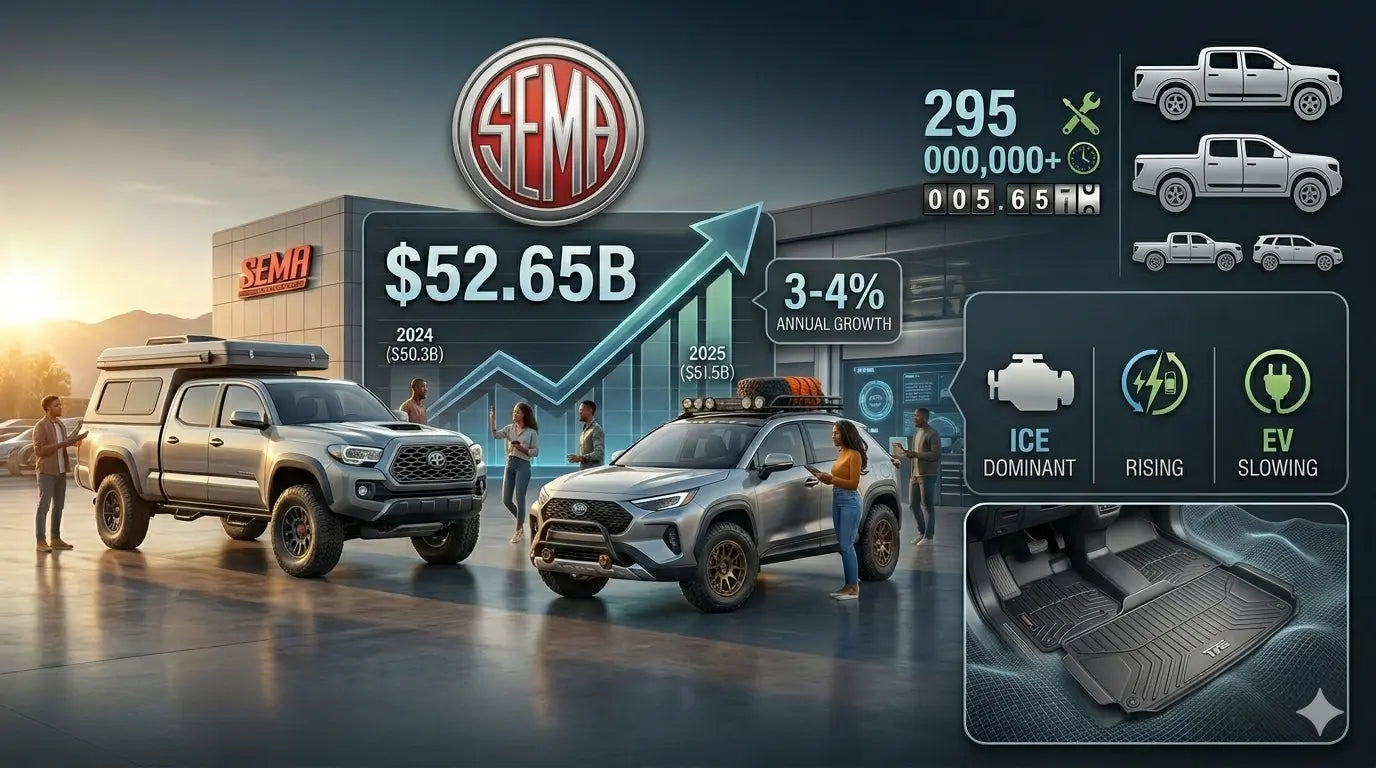
The specialty-equipment aftermarket has stabilized at $52.65 billion in sales, with growth expected to settle at a 3 to 4 percent annual pace, according to the 2026 SEMA Future Trends and Industry Update. After years of pandemic-era disruption, the market is entering a new phase defined by steadier demand, higher borrowing costs, and ongoing tariff and inflation uncertainty. SEMA notes that companies focused on value, differentiation, and service will be best positioned as the market normalizes.
Truck and CUV Dominance
Light trucks and crossover utility vehicles now account for more than 80 percent of new-vehicle sales in the United States. SEMA recommends that product development and fitment strategies align with trucks, crossovers, and aging vehicles to capture the largest addressable market segments. This vehicle mix directly supports demand for interior protection products including custom-fit floor mats, cargo liners, and seat covers.
Consumer Trends
Consumer spending in the aftermarket remains uneven. Affluent buyers continue investing in premium upgrades and personalization, while cost-conscious consumers prioritize essential maintenance and lower-cost improvements. SEMA advises businesses to serve both ends of the market by offering premium innovation alongside practical, value-driven solutions.
Aging Fleet Drives Demand
The total number of vehicles on U.S. roads has surpassed 295 million and continues to grow. Vehicles are staying in service longer than ever, translating directly into sustained demand for repair, maintenance, and personalization products. Higher interest rates—around 7.6 percent for new vehicles and 11.4 percent for used—are pushing more buyers to hold onto their vehicles longer, extending the replacement cycle for interior accessories like floor mats and cargo liners.
EV, Hybrid and ICE Outlook
EV adoption is slowing amid cost concerns and infrastructure challenges, causing automakers to recalibrate investments. Hybrids are gaining traction as a practical middle ground, while internal combustion engine vehicles will remain dominant for years. SEMA notes that the aftermarket does not need to pivot overnight: ICE products remain essential, hybrid opportunities are growing, and EV strategies can be more measured.

Leave a comment
All comments are moderated before being published.
This site is protected by hCaptcha and the hCaptcha Privacy Policy and Terms of Service apply.