


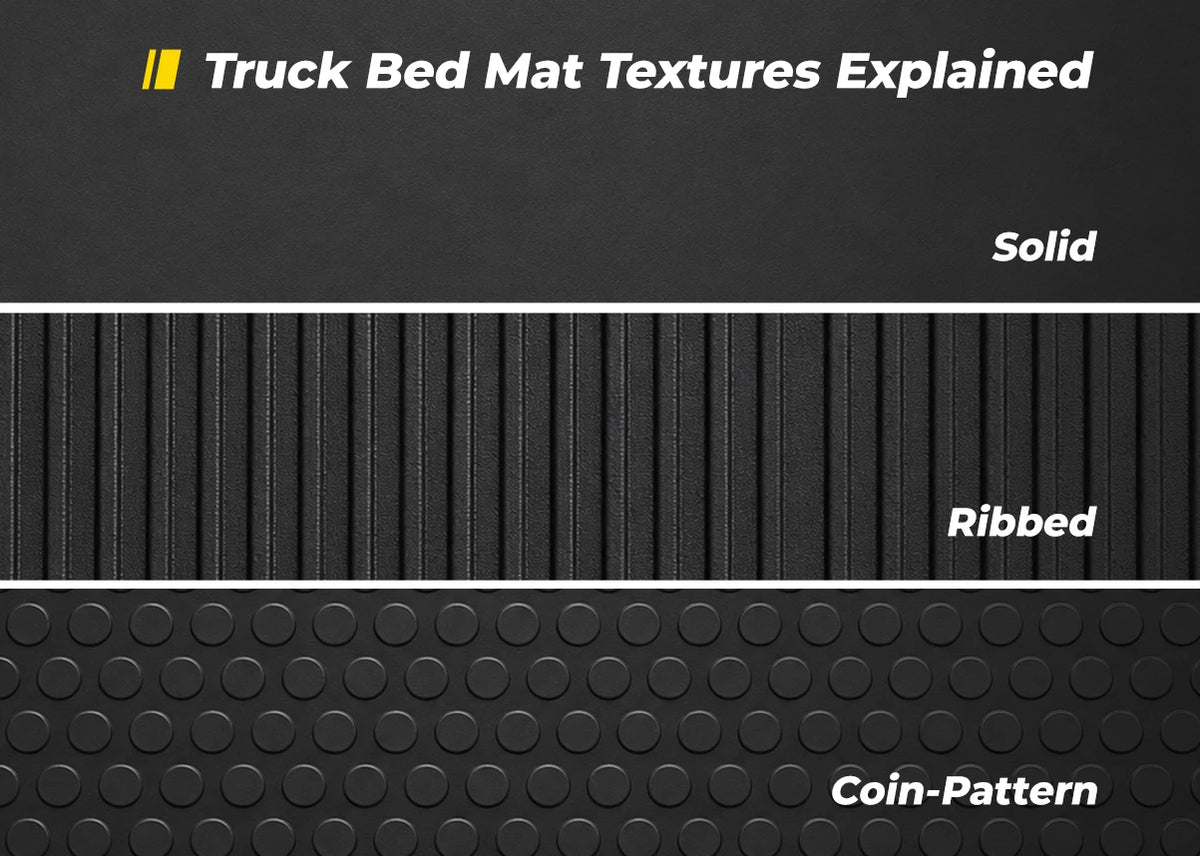
If you shop bed mats, you will run into three texture names: solid, ribbed, and coin-pattern. They are worth a minute of attention — but they are also the reason this article is shorter than a category explainer usually is. 3W makes one textured bed mat, not three: a custom-fit, 3D-scanned TPE mat with a tread pattern molded directly into the surface and deep channels engineered to trap mud, sand, snow, and spills before they reach your truck bed. There is no solid, ribbed, or coin-pattern option to choose between at checkout [1][2].
So here is how the market's three textures behave, followed by what 3W's single texture actually does.
Solid vs. Ribbed vs. Coin-Pattern: Grip Comparison
Cargo grip is the primary reason to choose one texture over another. Each texture creates grip through a different mechanism — material friction, mechanical interlock, or multiplied contact points — and the differences are measurable in how far cargo slides during a hard stop.
Solid/Smooth: Material Friction Only, Loses Grip When Wet
A solid mat holds cargo through the natural coefficient of friction between the mat material and the cargo surface. On dry pavement with dry cargo — sealed cardboard boxes, packaged goods, flat-bottomed furniture — a solid rubber or TPE mat provides adequate grip for normal driving. The problem is wet conditions: rubber's coefficient of friction drops significantly when the surface is wet. A cardboard box that stays put on a dry smooth mat will slide several inches during moderate braking on the same mat after rain. Solid mats also have zero mechanical interlock — there are no raised features for a round firewood log or a bag of gravel to catch against, so these loads slide freely during any hard stop [1].
Ribbed / Channel: debris settles in the channels
A push broom clears the ridge tops but leaves material in the channel bottoms, so a stiff-bristle brush or a pressure washer is needed to clear it fully.
Coin-Pattern: the hardest surface to clean
Every coin creates an edge where debris can lodge, and the valleys between coins trap fine material that a push broom cannot reach, so a pressure washer aimed into the valleys is the practical method.
Grip Verdict
Coin-pattern provides the highest absolute grip, followed by ribbed, followed by solid/smooth. For the cargo most non-commercial truck owners haul — packaged goods, furniture, bagged materials, camping gear — ribbed texture provides more than enough grip without the cleaning burden of coin-pattern. MotorTrend's expert review panel has validated TPE as a top-performing floor protection material in comprehensive comparison testing, noting that material choice matters as much as surface pattern for real-world grip [5].
Where 3W's mat sits: the molded tread pattern and deep channels are what grip the cargo and what trap debris before it reaches the bed floor, and the same molded surface is what you hose off in under 5 minutes. 3W describes it as a textured, non-slip surface that keeps items from sliding around while driving, and as a surface that can be hosed down in the bed, wiped clean, or slid out for a quick wash [1].
Solid vs. Ribbed vs. Coin-Pattern: Cleanability Comparison
Cleaning speed is the dimension where the three textures diverge most dramatically. The difference between a one-minute sweep and a fifteen-minute pressure-wash session is the daily experience of owning the mat.
Solid / Smooth: the fastest surface to clean
A single pass with a push broom clears a flat surface, and a short hose-off removes the remaining fine dust. There are no channels or recesses for debris to lodge in.
Ribbed/Channel: 5 to 10 Minutes, Requires Brush or Pressure Washer
A ribbed mat traps debris in the channels between ridges. After hauling a load of firewood, bark fragments and wood chips settle into the channel bottoms. A push broom clears the ridge tops but leaves material in the channels. A stiff-bristle brush run along each channel dislodges most debris in about 5 minutes. A pressure washer clears all channels in 5 to 10 minutes but requires the mat to be lifted out or the bed to be angled for drainage. The cleaning process is not difficult, but it is not quick — a ribbed mat adds 5 to 10 minutes of cleaning time after every load that generates fine debris [1].
Coin-Pattern: 10 to 15 Minutes, Pressure Washer Required
A coin-pattern mat is the hardest surface to clean. Every coin — and there are dozens per square foot — creates an edge where debris can lodge, and the valleys between coins trap fine material that a push broom cannot touch. After hauling a single load of damp mulch — the kind of yard-waste cargo detailed in 3W's fall bed mat guide [3] — the coin valleys fill with packed organic material. A pressure washer aimed into each valley is the only way to fully clear the surface, and the process takes 10 to 15 minutes for a full-size truck bed. The cleaning burden is the practical reason coin-pattern mats are standard in commercial trucking — where cleaning speed is secondary to cargo grip — and rare in personal-use trucks where the owner does the cleaning themselves. Products designed for sustained heavy use over years, as CarBuzz noted in its lifetime-accessories roundup, are built with "design features that support them" through repeated cleaning cycles and cargo loads [4].
Cleanability Verdict
Solid mats win cleanability decisively — under one minute, zero residual debris. Ribbed mats require moderate effort — 5 to 10 minutes. Coin-pattern mats require the most effort — 10 to 15 minutes with a pressure washer.
The 3W mat is a molded tread pattern with deep channels — so it is not a smooth surface, and it is not a coin-valley surface either. Debris sits in the channels until you rinse it out, and 3W's own care guidance is that this takes under 5 minutes [1].
Solid vs. Ribbed vs. Coin-Pattern: Water Drainage Comparison
Water on a truck bed mat comes from rain, snowmelt, hose-downs, and wet cargo. How each texture handles that water determines whether cargo sits in a puddle or stays dry above the drainage line.
Solid/Smooth: Water Pools on the Surface
On a solid mat, water has nowhere to go. It pools on the flat surface and evaporates slowly — cargo sitting on the mat after rain is in direct contact with standing water, absorbing moisture from below. Cardboard boxes wick water up from the pooled surface. Bagged materials develop condensation on the underside. The only way to clear water from a solid mat is to tilt the truck or sweep the water toward the tailgate manually [1].
Ribbed/Channel: Water Flows Through Channels to Drain Points
On a ribbed mat, water flows through the channels between ridges toward the tailgate or factory bed drain points. Cargo rests on the ridge peaks, elevated above the water flowing in the channels below. A load of bagged mulch sitting on a ribbed mat after a rainstorm stays dry on the underside because the water drains away underneath rather than pooling against the cargo. This is the defining practical advantage of ribbed texture for trucks that haul cargo in wet conditions — the cargo stays above the water line [1].
Coin-Pattern: Air Gap Reduces Moisture Transfer
On a coin-pattern mat, water drains into the valleys between coins while cargo rests on the raised coin tops. The air gap between the mat body and the cargo reduces moisture transfer from below — similar to how a ribbed mat elevates cargo above the water, but with more contact points (coin tops vs. ridge peaks) and a smaller air gap. The drainage performance is good, though water can pool in coin valleys longer than it flows through ribbed channels because the valleys are discrete depressions with no continuous flow path to the tailgate [1].
Drainage Verdict
Ribbed texture provides the best water drainage — continuous flow channels, cargo elevated on ridge peaks. Coin-pattern provides good drainage with an air gap but slower water clearing from individual coin valleys. Solid/smooth provides the worst drainage — water pools with no flow path.
3W does not publish a drainage design for its bed mats, so the honest position is that drainage is not a stated feature of the product — what 3W does state is the molded tread pattern and deep channels that trap mud, sand, snow, and spills before they reach your truck bed, and the maintenance instruction to remove the mat regularly so dirt and liquids underneath do not sit against the bed [1].
Solid vs. Ribbed vs. Coin-Pattern: Cargo Compatibility
Each texture works well with specific cargo types and poorly with others. Matching the texture to the cargo the truck actually carries avoids the two failure modes: cargo that slides on a surface too smooth, or cargo that damages itself on a surface too uneven.
Cargo That Works on Each Texture
- Solid/smooth: Best for flat-bottomed, dry packaged goods — sealed boxes, furniture with flat bases, appliances, sheet goods like drywall and plywood that need a perfectly flat support surface to avoid cracking. Worst for: round objects (firewood logs roll freely), heavy loose items (bagged gravel slides), and anything that gets loaded wet (grip disappears).
- Ribbed/channel: Best for round, heavy, or irregularly shaped cargo — firewood, bagged soil and mulch, landscape pavers, lumber, wet plants and landscaping materials. Worst for: flat sheet goods (drywall bridges the ridges and cracks under its own weight), finished furniture (ridge marks can imprint on wood surfaces).
- Coin-pattern: Best for heavy, mixed commercial loads — equipment parts, bulk containers, steel and construction materials where maximum grip is non-negotiable. Worst for: any cargo that generates fine debris (mulch, leaves, sand, sawdust — the coin valleys fill up and require extensive cleaning).
How Cargo Flatness Determines Texture Choice
A stack of drywall sheets or a glass tabletop requires a flat support surface — any unevenness concentrates the cargo's weight on the high points and risks cracking or breakage. Solid/smooth texture is the only appropriate choice for these loads. Ribbed texture concentrates weight on the ridge peaks. Coin-pattern texture concentrates weight on the individual coin tops — dozens of small pressure points instead of a continuous support surface. For any cargo that must sit perfectly flat, solid texture is mandatory [1].
Texture Comparison Table
|
Dimension
|
3W truck bed mat (official wording)
|
Solid / smooth
|
Ribbed / channel
|
Coin-pattern
|
|---|---|---|---|---|
|
Surface
|
Tread pattern molded into the Thorex TPE surface, with deep channels that trap mud, sand, snow and spills
|
Flat, no channels
|
Raised longitudinal ridges with channels
|
Raised coin perimeters
|
|
Grip
|
Textured, non-slip surface that keeps items from sliding around while driving
|
Material friction only
|
Mechanical interlock from ridge walls
|
Interlock plus multiplied contact points
|
|
Cleaning
|
Hoses clean in under 5 minutes; remove, shake off, rinse with water
|
Fastest to sweep
|
Needs a brush or pressure washer
|
Needs a pressure washer
|
|
Drainage
|
Not specified by 3W
|
Water pools on the surface
|
Water flows along the channels
|
Water collects in the coin valleys
|
Summary
Solid, ribbed, and coin-pattern bed mat textures represent a straight trade-off: grip increases, cleaning time increases. Solid mats clean in under a minute but lose grip when wet and pool water under cargo. Coin-pattern mats grip better than anything else on the market but demand 10 to 15 minutes of pressure-washing after every load of debris-generating cargo. Ribbed mats sit in the middle — high mechanical grip from raised ridges, excellent water drainage through continuous channels, and a 5-to-10-minute cleaning process — making them the best all-around choice for trucks that haul firewood, bagged materials, and wet cargo. The 3W textured TPE bed mat offers a fourth path: a fine-grain surface that provides medium-high grip with a sub-five-minute hose-off clean, bridging the gap between smooth and ribbed for truck owners who want more grip than a smooth mat without the cleaning time of a ribbed or coin-pattern surface. As 3W's winter floor mat guide explains, TPE maintains its surface grip and flexibility in conditions from −13°F to 175°F, where rubber stiffens and loses the friction its texture pattern was designed to provide [6].
Frequently Asked Questions
What truck bed mat surface is best for preventing cargo from sliding?
A coin-pattern texture provides the most mechanical grip through raised coins that cargo edges catch against, followed by ribbed texture. For general use, the textured TPE surface on 3W truck bed mats provides sufficient grip for packaged goods, furniture, and bagged materials without the cleaning burden of deep patterns [1].
Are smooth bed mats easier to clean than ribbed or coin-pattern ones?
Yes. A smooth mat sweeps and hoses clean in under a minute because there are no channels or recesses. A ribbed mat takes 5 to 10 minutes — debris settles in the channels and requires a brush or pressure washer. A coin-pattern mat takes 10 to 15 minutes — debris lodges in dozens of coin valleys per square foot and requires a pressure washer aimed into each valley [1].
Does bed mat texture affect water drainage?
Yes. A solid mat pools water on the surface. A ribbed mat channels water through the grooves toward the tailgate — the best drainage of the three textures. A coin-pattern mat drains water into the coin valleys, which clear more slowly than continuous ribbed channels.
Which texture is best for hauling firewood and bagged mulch?
Ribbed texture is the best choice for firewood and bagged mulch — the ridges provide mechanical grip that prevents logs from rolling, the channels drain rainwater away from the cargo, and the surface cleans up in 5 to 10 minutes with a brush or pressure washer after hauling bark-shedding loads [1].
Reference
[1] 3W: Truck Bed Mats Collection — TPE Bed Protection for Pickup Trucks: 3wliners.com/collections/bed-mats-for-pickup-trucks
[2] SlashGear: Affordable WeatherTech Floor Mat Alternatives (January 6, 2026): slashgear.com/1749159/affordable-weathertech-floor-board-alternatives/
[3] 3W Blog: Truck Bed Mats for Fall Yard Work — Hauling Mulch, Leaves, and Pumpkins Without Bed Damage: 3wliners.com/blogs/car-mats/truck-bed-mats-for-fall-yard-work
[4] CarBuzz: Car Accessories That Actually Last a Lifetime Are More Accessible Than Ever (September 10, 2025): carbuzz.com/car-accessories-that-actually-last-a-lifetime-are-more-accessible-than-ever/
[5] MotorTrend: Best Floor Mats — 2026 Expert Reviews and Recommendations (June 19, 2026): motortrend.com/gear-reviews/best-floor-mats
[6] 3W Blog: Best Car Floor Mats for Winter — Protect the Original Flooring Against Cold Mess: 3wliners.com/blogs/car-mats/best-car-floor-mats-for-winter
[7] 3W Blog: The Truck Bed Mat Buyer's Handbook — Rubber, Foam-Backed, and Coin-Pattern Explained: 3wliners.com/blogs/car-mats/the-truck-bed-mat-buyer-s-handbook-rubber-foam-backed-and-coin-pattern-explained


Leave a comment
All comments are moderated before being published.
This site is protected by hCaptcha and the hCaptcha Privacy Policy and Terms of Service apply.