The cargo area of a family SUV or crossover faces its most punishing season in winter, and the direct answer to what protects it is a custom-fit TPE cargo liner -- a single-piece waterproof mat, 3D-scanned to the vehicle's specific trunk contours, with a raised perimeter lip that contains salt melt, grocery spills, and organic debris within the mat footprint. Unlike a universal flat rubber sheet that slides with every cargo shift, a custom-fit cargo liner stays in place permanently and requires no removal between shopping trips. When MotorTrend rounded up the best floor mats on the market, the top-rated products shared the same features that define a well-designed cargo liner: 3D-scanned fitment, TPE construction, and a lift-out, hose-off maintenance profile [6].
What Makes Winter the Toughest Season for a Trunk or Cargo Floor?
Winter cargo duty is harder on a trunk floor than summer cargo duty because the loads are wetter, heavier, chemically active, and subject to condensation cycling. Summer loads -- beach chairs, dry grocery bags, a gym duffel -- are benign. Winter loads introduce road salt, frozen-food condensation, heavy beverage cases, and organic debris from holiday shopping, all of which interact with carpet in ways that compound over a single season.
Road Salt and Chemical De-Icers
Road salt tracked in on shopping bags is the most pervasive winter trunk contaminant. A shopper walks across a salted parking lot, sets a bag in the trunk, and the salt residue on the bottom of the bag transfers to the carpet. Over a December of repeated shopping trips, the trunk carpet accumulates a white crystalline residue that works into the fibers and does not vacuum out completely. Road salt is hygroscopic -- it attracts and holds moisture -- which means salted carpet stays damp longer than unsalted carpet, creating the moisture conditions that lead to mildew and that persistent musty trunk odor that airs out only after professional extraction.
Chemical de-icers, primarily calcium chloride and magnesium chloride, are more aggressive than plain rock salt. They leave an oily residue that bonds to carpet fibers and resists household carpet cleaners. On unprotected trunk carpet, de-icer residue from a single winter season can leave permanent discoloration in the high-traffic loading zone near the tailgate [3].
Grocery Spills and Freeze-Thaw Cycling
Winter grocery spills are more damaging than summer spills because of the freeze-thaw cycle. A gallon of milk tips over during a Costco run and soaks through the trunk carpet into the spare-tire well. In a heated garage, warm groceries hitting cold trunk surfaces cause condensation that wets the carpet from above while the frozen underbody keeps it cold from below -- the carpet stays damp for hours and dries slowly. A second spill the following weekend compounds the damage before the first one has fully dried out. Over a winter of weekly shopping, the trunk carpet in an unprotected family vehicle accumulates layered moisture damage that professional detailing cannot fully reverse.
Holiday Cargo: Heavy, Sharp, and Organic
Holiday-specific cargo introduces threats that summer shopping does not. A fresh-cut Christmas tree sheds needles and sap that embed in trunk carpet fibers. Pine sap bonds to carpet chemically and hardens within hours -- removing it requires solvent-based cleaners that can damage the carpet backing. Large gift boxes with sharp corners abrade the carpet pile during cornering. Cases of bottled beverages, holiday dinner ingredients, and bulk party supplies load the trunk to capacity, concentrating weight and abrasion on the carpeted floor. A single December weekend of holiday shopping deposits more trunk-floor contamination than three months of summer grocery runs [4].
How a Custom-Fit TPE Cargo Liner Protects Against Salt, Slush, and Spills
A
custom-fit TPE cargo liner addresses winter trunk damage with three characteristics that work together: a waterproof non-porous barrier, a raised perimeter containment lip, and material flexibility that holds from sub-freezing to summer heat. The 3W cargo liner is molded from 3W's Thorex™ TPE (thermoplastic elastomer), 3D-scanned to the specific contours of each vehicle model's trunk floor, and designed to remain permanently installed across all four seasons [1].
Waterproof and Non-Porous Barrier
TPE is waterproof and non-porous, which means liquid sits on the surface rather than soaking through. A gallon of milk that leaks onto a TPE cargo liner pools on top of the mat where it can be wiped up with a paper towel -- nothing reaches the carpet underneath. Road salt residue sits on the textured TPE surface, not in carpet fibers, and rinses off with water. The impermeable surface also blocks moisture transfer from below: when condensation forms on the cold trunk floor pan, the liner keeps it away from cargo sitting on top of the mat. Unlike carpeted trunk mats that absorb spills into their fiber layer and hold them against the floor, a TPE liner is a physical barrier from edge to edge [5].
Raised Perimeter Lip Contains Spills
The raised perimeter lip on a custom-fit cargo liner is a containment wall that runs the full circumference of the mat. If a leaking jug of laundry detergent tips over in the trunk, the liquid spreads across the liner surface but stops at the lip -- it does not run off the edge into the gap between the mat and the trunk side panel, and it does not seep under the spare-tire cover. A universal flat rubber mat has no raised lip, so spilled liquid flows unimpeded off the mat edge and onto the trunk carpet wherever gravity takes it. The retention capacity of the raised lip matters most during winter, when liquid spills -- melting slush from boots, leaking grocery containers, condensation from frozen-food bags -- occur on nearly every trip [1].
Cold-Weather Flexibility Without Cracking
Winter trunk protection fails if the liner itself cannot handle winter temperatures. Rubber cargo mats stiffen in cold weather, making them difficult to remove for cleaning and prone to cracking along flex lines. 3W's Thorex™ TPE stays flexible from −20°C to 75°C (−4°F to 167°F), maintaining full flexibility in a parked vehicle on a sub-zero morning and dimensional stability in a sun-heated trunk in July. The material formulation resists the embrittlement that affects cheaper PVC mats in cold weather, and it does not emit the chemical odor that rubber mats produce when the trunk heats up after a cold start [3].
Cargo Liner vs. Universal Trunk Mat: Why Custom 3D-Scanned Fit Matters
A universal trunk mat and a custom-fit cargo liner both sit in the trunk, and the similarity ends there. A universal mat is a flat sheet of rubber or plastic cut to a generic rectangular shape, trimmed by the buyer to approximate their vehicle's trunk outline. A custom-fit cargo liner is 3D-scanned to the specific dimensions of one vehicle model's cargo floor and injection-molded as a single piece that follows every contour. The difference in protection corresponds directly to the difference in engineering [1].
Edge-to-Edge Coverage Without Gaps
A universal mat leaves gaps at the edges where spilled liquid runs underneath. The trim-to-fit process relies on the buyer cutting along guide lines, and even a careful trim job leaves a margin of error -- typically a quarter-inch to half-inch gap between the mat edge and the trunk sidewall on each side. Liquid spilled near the edge of a universal mat flows into that gap and onto the carpet. A 3D-scanned cargo liner covers the trunk floor edge to edge, following the sidewall contours including wheel-well intrusions, tie-down points, and cargo-track recesses. There is no gap at the edge because the mat was molded to the scanned dimensions of that specific trunk floor, not cut from a generic blank [4].
No-Slide Fit Without Adhesives
A universal flat mat slides. Heavy cargo shifts during a turn, the mat shifts with it, and the sliding mat bunches up against the trunk sidewall or slides forward under braking, exposing the carpet it was supposed to protect. Universal mats often include adhesive strips or hook-and-loop patches to hold them in place -- solutions that lose adhesion in cold weather and leave residue on the trunk carpet when removed. A custom-fit cargo liner stays in place through precision of fit alone. The 3D-scanned molding matches the trunk floor's perimeter so closely that the liner sits flush against the sidewalls and does not have room to slide. No adhesives, no hook-and-loop, no trimming -- the accuracy of the scan does the work of holding the liner in position [1].
Model-Specific Contours for Real Trunk Floors
Vehicle trunk floors are not flat rectangles. They have wheel-well humps, cargo-track channels, under-floor storage doors, tie-down anchor recesses, and tailgate sill contours that a flat universal mat cannot follow. A universal mat either covers the tie-down anchors, making them inaccessible, or stops short of them, leaving the surrounding carpet exposed. A 3D-scanned cargo liner is molded around every contour: the wheel-well cutouts follow the factory arc, the tie-down points are accessible through molded recesses, and the tailgate edge drops to cover the high-wear loading threshold. The liner protects the trunk floor as it actually exists, not as a flat sheet of rubber imagines it to be [5].
Universal Mat vs. Custom-Fit Cargo Liner: Winter Protection at a Glance
|
Factor
|
Universal Trunk Mat
|
Custom-Fit 3D-Scanned Cargo Liner
|
|
Fit
|
Generic rectangular shape; buyer trims to approximate
|
3D-scanned to specific vehicle model; follows all contours
|
|
Edge Coverage
|
Gaps at edges; liquid flows underneath
|
Edge-to-edge coverage; no gaps
|
|
Spill Containment
|
Flat surface; no raised lip; liquid flows off edges
|
Raised perimeter lip; contains spills within mat footprint
|
|
Slide Prevention
|
Relies on adhesives that weaken in cold
|
Precision-fit perimeter holds mat in place; no adhesives
|
|
Cold-Weather Performance
|
Rubber stiffens; PVC embrittles
|
TPE stays flexible from −4°F to 167°F
|
|
Tie-Down Access
|
Covered or blocked
|
Molded recesses keep anchor points accessible
|
|
Installation
|
Trim, test-fit, trim again, apply adhesive strips
|
Drop in -- no trimming, no adhesives, no adjustment
|
The Holiday Shopping Load Cycle: What Deposits in Your Trunk Over One December Weekend
A single December weekend of holiday shopping -- a Costco run for party supplies, a trip to the mall for gifts, and a stop at the Christmas tree lot -- deposits more trunk-floor contamination than the entire preceding month of routine driving. Each stop in the load cycle introduces a different category of debris, and on unprotected trunk carpet, the cumulative effect is visible by Sunday evening.
The Costco Run: Bulk Weight and Condensation
A December Costco run fills the trunk with heavy, cold, condensation-prone cargo: a case of bottled water, a gallon of eggnog, frozen appetizers for a holiday party, a bulk pack of paper towels, a rotisserie chicken in a container that always leaks. The combined weight -- easily sixty to eighty pounds of groceries -- compresses the trunk carpet pile under load, pressing condensation from the cold packaging into the carpet fibers. A single leaking container -- a cracked egg, a loose dairy lid, a punctured juice carton -- soaks through the carpet into the foam padding and spare-tire well underneath. On unprotected carpet, the Costco run is the single highest-risk load event of the holiday season in terms of liquid damage per trip [3].
Gift Shopping: Abrasion and Sharp Corners
Gift shopping loads the trunk with rigid cardboard boxes, plastic toy packaging with sharp clamshell edges, and oddly shaped items that do not stack flat. A large Lego set box has square corners that abrade the trunk carpet pile with every turn. An electronics box slides laterally during cornering and grinds against the carpet for the duration of the drive. A stack of gift bags with decorative tissue paper seems harmless, but the wire-edged ribbon on one bag catches the carpet loop pile and pulls a visible thread during unloading. None of these individual events destroys the trunk carpet in one trip, but over four weekends of December gift shopping, the cumulative abrasion in the loading zone is measurable as visible wear and matted pile [4].
The Tree Lot: Sap, Needles, and Organic Debris
A fresh-cut Christmas tree is the most damaging single cargo item a trunk will carry all year. A six-foot Fraser fir sheds hundreds of needles during the drive home -- needles that work their way deep into the trunk carpet fibers, past the pile into the backing, where they resist vacuum extraction. Pine sap oozes from the cut trunk and bonds to the carpet chemically; it hardens within hours and requires solvent-based removal that can damage the carpet backing or discolor the pile. Tree-lot netting traps moisture against the trunk floor, creating a damp microclimate under the tree that persists until the tree is unloaded -- and on unprotected carpet, that moisture has already soaked in by the time the tree stand is set up in the living room [1].
Which Family Vehicles Benefit Most from a Winter Cargo Liner?
Any vehicle that hauls groceries, kids' gear, and holiday purchases through a winter season benefits from cargo area protection, but three vehicle categories face the highest cumulative risk because of how they are used, how often their cargo area is loaded, and what goes into them during the holiday months.
Three-Row Family SUVs
Three-row SUVs -- the Chevrolet Traverse, Kia Telluride, Honda Pilot, Toyota Grand Highlander, and their competitors -- carry groceries, sports equipment, school bags, and holiday purchases for families of five or more. The cargo area behind the third row is loaded and unloaded multiple times per day during the holiday season: a morning grocery run, an afternoon school pickup with band instruments, an evening trip to the mall. The trunk carpet in a three-row SUV takes on salt residue, condensation, and debris repeatedly, because the trunk is loaded and unloaded several times a day through the holiday season. A 3W cargo liner for three-row SUVs stays in place year-round -- it does not come out between shopping trips, and it does not require reinstallation after cleaning [1].
Compact and Midsize Crossovers
Compact crossovers -- the Honda CR-V, Toyota RAV4, Mazda CX-5, Subaru Forester, and similar -- have smaller cargo areas than three-row SUVs, and that smaller footprint concentrates winter damage. The same Costco run that spreads across a full-size SUV trunk floor compresses into a tighter cargo bay in a compact crossover, forcing heavy bags against the carpet with more contact pressure. The cargo area in a compact crossover is also more likely to be loaded to capacity during holiday shopping, which means every square inch of trunk carpet sees cargo contact. A custom-fit cargo liner covers the entire floor of the smaller cargo bay, protecting the limited carpet surface that takes concentrated holiday-season abuse [5].
Vehicles With Fold-Flat Rear Seats
When rear seats are folded flat for oversized holiday purchases -- a Christmas tree, a large gift item in an oversized box, a bulk purchase of wrapping paper and decorations -- the cargo floor extends forward into the passenger compartment, and the exposed seatbacks become the forward cargo-contact surface. Any vehicle with fold-flat second-row or third-row seats needs a
cargo liner to protect the trunk floor and a
seat back protector to protect the folded seatbacks. Together, they create a continuous protected surface from the tailgate to the front seats, covering every surface that oversized holiday cargo contacts [2].
Cargo Liner + Seat Back Protector: Full Cargo Area Protection for Folded-Seat Hauls
A cargo liner protects the trunk floor. A seat back protector protects the seatbacks that become the forward cargo floor when the seats are folded. During the holiday season, when oversized purchases require folded seats, neither product alone provides complete protection -- but together, they create a continuous waterproof, scuff-resistant cargo surface from tailgate to center console.
What a Seat Back Protector Covers
A
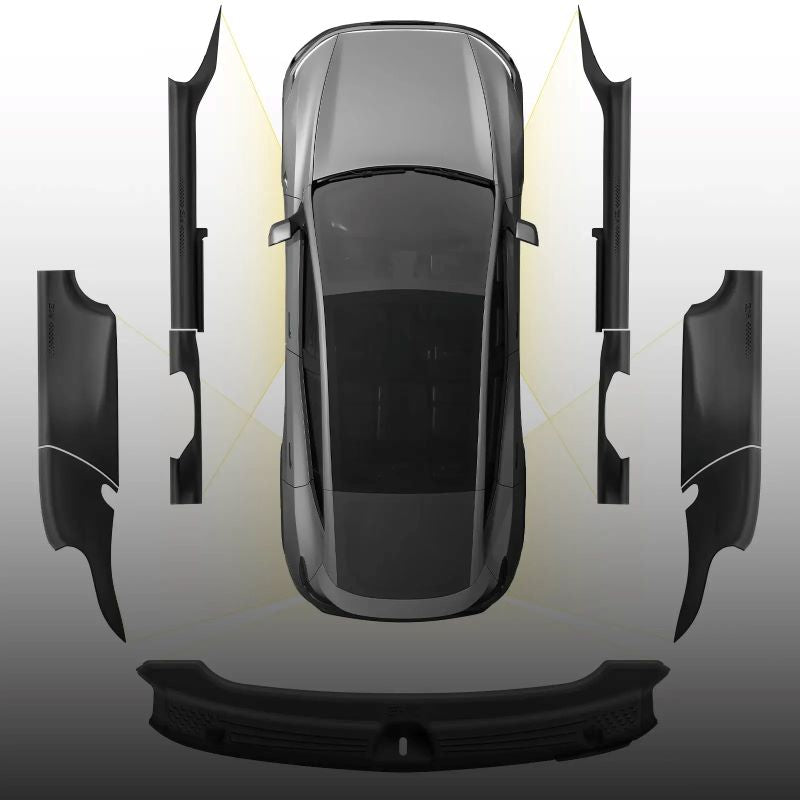
seat back protector is a molded TPE panel that attaches to the back surface of the second-row or third-row seats, covering the upholstery that is exposed when the seats are folded flat. It is made from the same Thorex™ TPE as the cargo liner, with the same waterproof, non-porous, scuff-resistant properties. When the seats are upright, the protector is essentially invisible -- it sits against the seatback and does not interfere with passenger comfort. When the seats are folded, the protector becomes the cargo floor surface in the extended load area. A Christmas tree loaded through the tailgate with the second row folded rests on the cargo liner in the trunk area and on the seat back protector over the folded seatbacks -- sap and needles land on TPE, not on upholstery [2].
When You Need Both a Cargo Liner and a Seat Back Protector
The cargo liner works alone for any load that fits within the standard trunk behind the rear seats. The seat back protector becomes necessary when the load is longer than the trunk depth and the seats must be folded. Holiday scenarios that require both include: hauling a fresh-cut Christmas tree (fold the second or third row), transporting a large flat-screen TV in its box (fold at least one side of the second row), carrying bulk rolls of gift wrap (fold one seatback), and loading a new bicycle or playset in its assembly box (fold the entire second row). In each case, the cargo liner and seat back protector together form a continuous TPE surface that covers every carpeted and upholstered surface the cargo touches [2].
How Cargo Liner and Seat Back Protector Work Together
The cargo liner covers the trunk floor including the area behind the rear axle, the wheel-well contours, and the tailgate threshold. When the rear seats are folded, the seat back protector extends that coverage forward across the folded seatbacks, bridging the gap between the cargo floor and the back of the front seats. Because both are molded from the same Thorex™ TPE material, there is no material mismatch at the seam between the cargo liner and the seat back protector -- both surfaces have the same texture, the same grip, and the same waterproof properties. Cargo slides across the seam without catching, and any liquid spilled on the seat back protector flows down onto the cargo liner where it is contained by the raised perimeter lip [2].
Year-Round Use: Why a TPE Cargo Liner Earns Its Place After Winter Ends
A TPE cargo liner installed for winter protection in November stays installed through July, and there is no reason to remove it. The same waterproof barrier, raised lip, and hose-off cleanability that protect against road salt and spilled eggnog in December also protect against beach sand and melted ice cream in August. A cargo liner is not a winter accessory -- it is permanent trunk protection that peaks in value during the holiday season and continues to protect every other month of the year.
Summer Protection: Sand, Sunscreen, and Melted Snacks
Summer cargo is summer's own version of wet, abrasive, and sticky. Beach sand packed into the trunk carpet is nearly impossible to fully extract -- it works past the pile into the carpet backing, where it abrades the fibers with every subsequent load cycle. A leaking bottle of sunscreen leaves an oily stain that penetrates deep into carpet. A cooler that drips condensation across the trunk floor on the way to a picnic creates the same moisture damage as a leaking grocery bag in winter. A melted chocolate bar in a shopping bag from a 95-degree parking lot bonds to carpet faster than pine sap. The TPE cargo liner that contained salt and slush all winter contains sand and sunscreen all summer with the same mechanism: a waterproof, non-porous surface that wipes or hoses clean in minutes [1].
Permanent Installation: Why Removal Between Seasons Is Unnecessary
A cargo liner is designed for permanent installation. It drops into the trunk once and stays there. Unlike a fabric trunk mat that needs to be removed and shampooed after a spill, a TPE liner cleans in place -- a damp cloth wipes up a milk spill in thirty seconds without unloading the rest of the cargo. The liner does not need to be removed between winter and summer because the threats it protects against are present in every season: grocery spills year-round, condensation from cold items in any weather, abrasion from sliding cargo on every trip. The liner's profile is thin enough that it does not interfere with the trunk's under-floor storage access or the operation of the cargo cover. Once it is in, the trunk remains fully functional with permanent protection underneath [1].
Cleaning Convenience Across All Four Seasons
The maintenance profile of a TPE cargo liner -- remove, rinse, dry, reinstall -- is the same in January as it is in July. After a weekend of holiday shopping deposits road salt, pine needles, and spilled cider on the liner surface, it lifts out of the trunk in one piece, rinses clean with a garden hose at standard water pressure, and goes back in once it is fully dry. 3W's cleaning guide puts the cargo liner cycle at 30-45 minutes, most of it drying time: pre-rinse, work the raised edges and wheel-well seams with a medium-bristle brush and mild dish soap, rinse until the water runs completely clear, then air-dry upright in the shade before reinstalling. TPE is non-porous, so mud, salt, sap, and food residue rinse off the surface instead of soaking in. The same routine works after a summer beach trip deposits sand and sunscreen on the liner, and after a fall pumpkin-patch outing leaves field mud in the trunk. Never reinstall a liner while it is still damp -- a damp mat traps moisture against the trunk carpet, and mold can establish within 48 hours [1][3].
Summary
Winter is the most damaging season for a family SUV or crossover trunk because winter cargo -- road salt, frozen-food condensation, leaking grocery containers, sap-dripping Christmas trees, and heavy holiday purchases -- introduces moisture, chemical residues, and organic debris that compound with every shopping trip. A universal flat rubber mat cannot contain spills, stays put only with adhesives that fail in cold weather, and leaves gaps at the edges where liquid flows underneath.
A custom-fit, 3D-scanned TPE cargo liner addresses all of these failure points: it covers the trunk floor edge to edge with no gaps, contains spills with a raised perimeter lip, stays in place through precision of fit alone, and remains flexible from −4°F to 167°F without stiffening, cracking, or off-gassing. When oversized holiday purchases require folded rear seats, a seat back protector extends that same waterproof, scuff-resistant surface across the exposed seatbacks, creating a continuous protected cargo area from tailgate to front seats. Installed once and cleaned in minutes with a garden hose, a cargo liner protects the trunk through winter, summer, and every shopping trip in between -- and the trunk carpet underneath stays factory-clean regardless of what the holiday season loads on top of it.
Frequently Asked Questions
Can road salt stains be removed from trunk carpet?
Road salt stains on trunk carpet are difficult to fully remove because the salt crystals work past the carpet pile into the backing layer. A vinegar-and-water solution dissolves the salt residue, but the moisture from the cleaning process further saturates the carpet, and the salt must be extracted completely or it re-crystallizes as the carpet dries. The most effective approach is prevention -- a waterproof cargo liner keeps salt from reaching the carpet in the first place. If the carpet is already stained, professional hot-water extraction is the most reliable method for removing embedded salt residue [1].
How do I clean a TPE cargo liner after a holiday shopping trip?
Lift the liner out of the trunk in one piece, spray it with a garden hose or pressure washer at a low setting to dislodge debris and rinse off salt residue, let the water sheet off the non-porous TPE surface, and drop the liner back into the trunk. No soap, scrubbing, or drying time is required. The entire process takes under five minutes, and the liner is ready for the next load immediately. For light cleaning between hose-downs -- a small spill or salt dusting -- a damp cloth wipes the surface clean with the liner still installed [1].
Can a cargo liner stay in the trunk year-round?
Yes. A TPE cargo liner is designed for permanent installation. It does not interfere with trunk functionality, under-floor storage access, or cargo-cover operation. The same waterproof barrier that protects against winter salt and slush also protects against summer sand, sunscreen, and condensation from coolers. There is no seasonal reason to remove it, and removing it between seasons defeats the purpose of year-round protection -- a spilled grocery item in April does the same damage to carpet as a spilled grocery item in December [1].
What happens if a gallon of milk spills in the trunk with a cargo liner installed?
The milk pools on the TPE surface within the raised perimeter lip. It does not soak through the non-porous material, and it does not flow off the edge of the liner onto the surrounding carpet. Wipe up the liquid with paper towels or a cloth, then wipe the area with a damp cloth to remove any residue. The trunk carpet underneath stays dry and uncontaminated. Without a cargo liner, the same spill soaks through the carpet into the foam padding and spare-tire well, where the milk sours and produces an odor that persists even after professional cleaning [1].
Do I need a seat back protector if I already have a cargo liner?
You need a seat back protector if you ever fold the rear seats to carry oversized cargo. The cargo liner covers the trunk floor behind the rear seats, but when the seats are folded, the exposed seatbacks become the forward cargo-contact surface -- and the cargo liner does not cover them. A seat back protector covers those exposed seatbacks with the same waterproof TPE material, extending the protected cargo surface forward. Holiday scenarios that require both include hauling a Christmas tree, a large gift in an oversized box, or bulk party supplies with the seats folded [2].




Leave a comment
All comments are moderated before being published.
This site is protected by hCaptcha and the hCaptcha Privacy Policy and Terms of Service apply.