


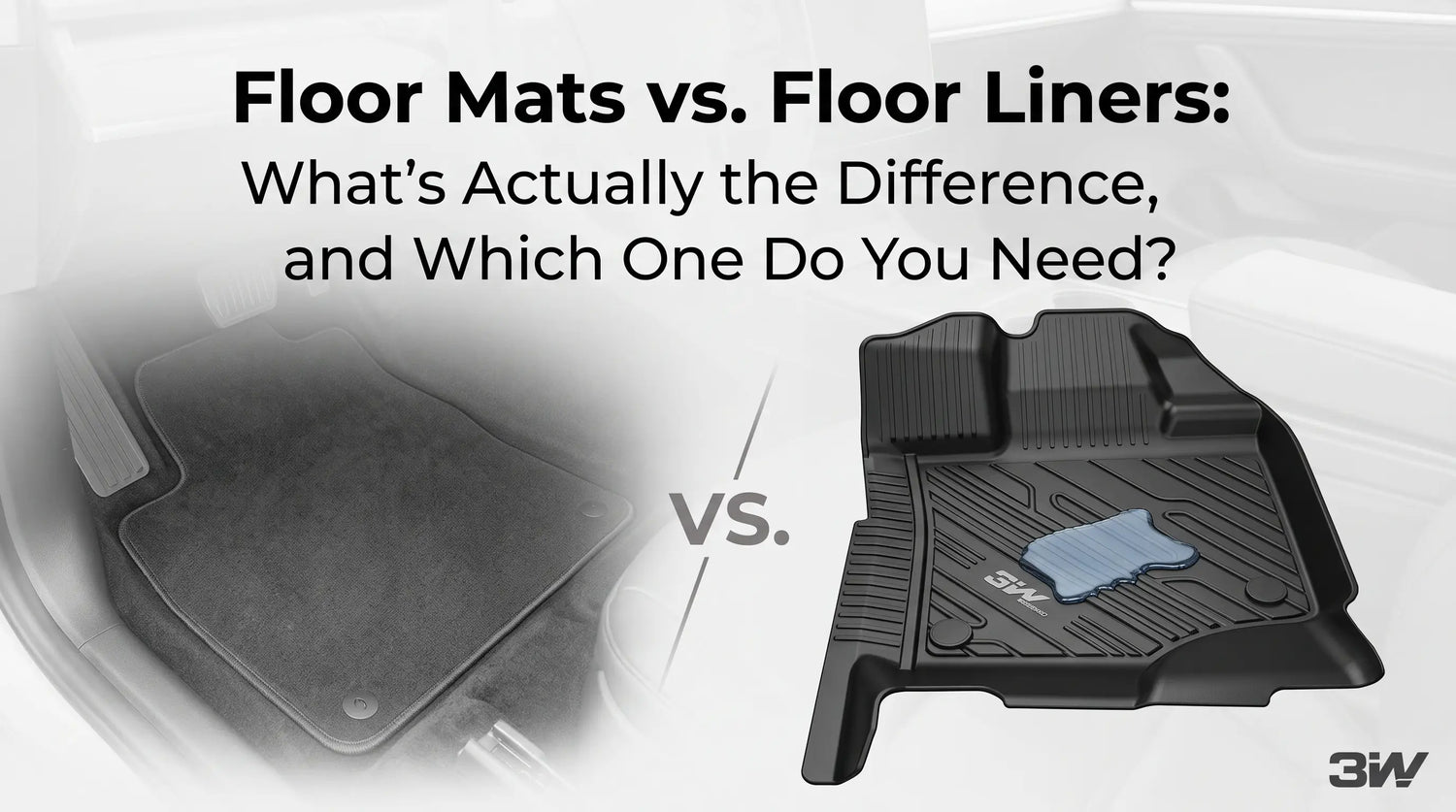
A floor mat is a flat accessory that lays on top of your vehicle's carpet. Most are universal or semi-custom—sized to fit a range of vehicles rather than one specific model. They cover the flat footwell area but stop at the edges. There is no wall to contain what spills or drips off them.
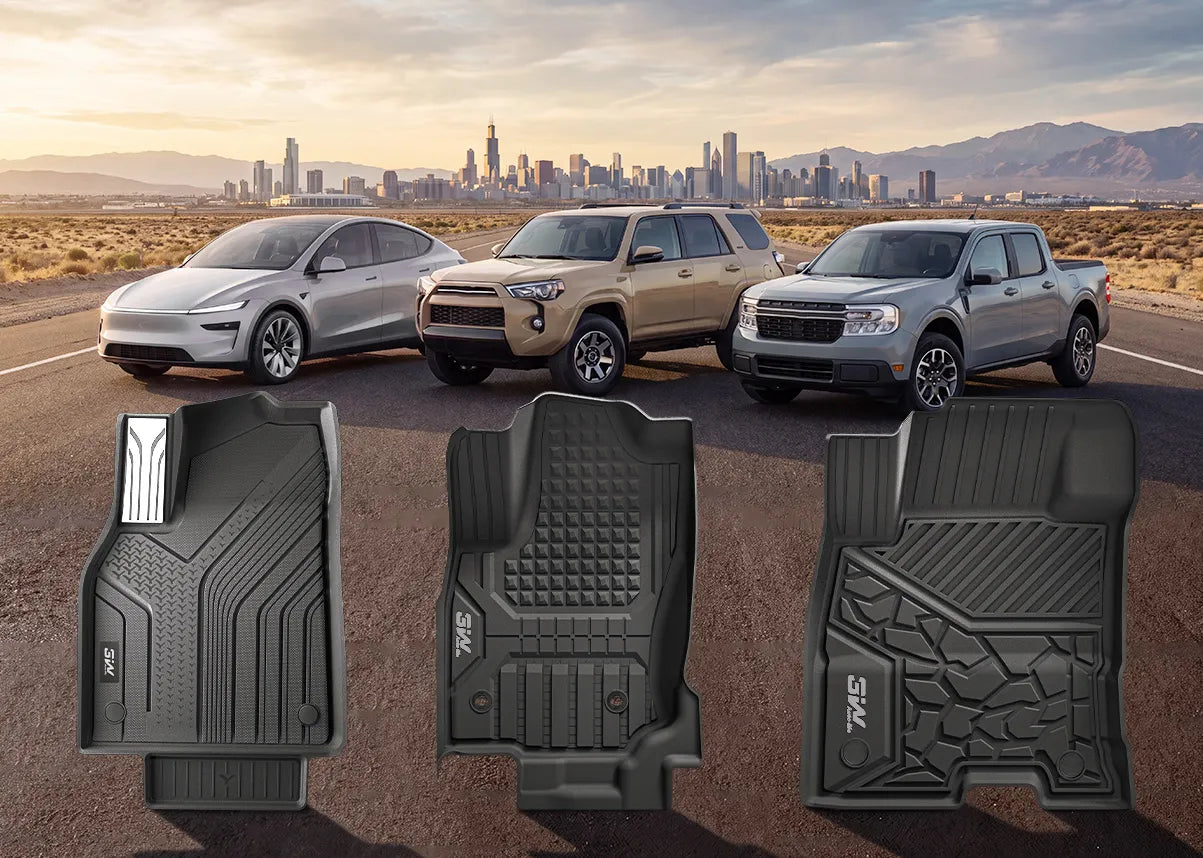
A floor liner is vehicle-specific. It is molded to the exact three-dimensional shape of a particular year, make, and model—including the raised contours along the sides, the transmission tunnel, and the floor transition edges. The raised outer walls are the defining feature: they turn the liner into a shallow basin that contains spills, mud, and snow melt rather than letting overflow reach the carpet underneath.¹²
Floor Mat vs. Floor Liner: Side-by-Side
|
Feature |
Floor Mat |
Floor Liner |
|
Fit type |
Universal or semi-custom |
Custom-fit (vehicle-specific) |
|
Raised containment walls |
No, or minimal |
Yes — traps liquids above carpet level |
|
Coverage area |
Primary flat footwell only |
Edge-to-edge, follows floor contours |
|
Installation |
Drop-in; minimal or no retention clips |
Retention clips and anti-slip studs |
|
Spill behavior |
Overflow onto carpet likely |
Contained within liner until rinsed |
|
Material |
Rubber, carpet, PVC, fabric |
TPE, rubber, injection-molded thermoplastic |
|
Cleaning |
Shake off or rinse |
Remove, rinse or hose down, reinstall |
|
Typical price |
$15–$50 (universal set) |
$80–$180 (custom-fit full set) |
Why the Raised Wall Is the Feature That Actually Matters
Most carpet damage in vehicles comes from liquid, not abrasion. A water bottle tips, boots track in snow melt, a cup leaks in the backseat—and a flat mat does nothing to stop liquid from spreading under it into the carpet padding. Mold and persistent odor follow, neither of which is cheap to remediate.
The raised wall on a custom liner—typically following the exact floor geometry of your vehicle—changes that entirely. 3W's liners use injection molding where molten TPE is pressed into a mold built to the dimensions of a specific vehicle model. The result is precise wall height at every edge, including transitions that generic thermoformed products often miss.³
How Custom Fit Is Achieved
Brands that manufacture vehicle-specific liners use either laser scanning or 3D scanning of actual vehicle floor cavities. 3W uses injection molding—a denser, more dimensionally stable process than thermoforming, which heats and stretches a flat sheet over a generic form. Thermoforming can thin the walls and leave less precise edge coverage, even when the packaging says 'custom-fit.'³
The practical difference: injection-molded liners hold their wall height after years of use. Thermoformed liners may deform at edges under heat cycles, creating gaps that allow liquid to escape. Whether a liner is injection-molded or thermoformed matters more than brand name when evaluating fit quality.

When a Floor Mat Makes Sense
A flat floor mat is the right call in a few specific situations:
- Dry climate, low-mess use — you care about aesthetics or a soft surface underfoot more than spill containment.
- Already have a custom liner and want a carpet layer for comfort — 3W's Double Layer option adds a removable carpet top to the all-weather base for exactly this purpose.³
- Short-term ownership or work vehicle — you don't need precise fit to justify the cost difference.
When a Floor Liner Makes Sense
- Rain, snow, or road salt exposure — any moisture that reaches factory carpet can cause mold, rust, and persistent odor.
- Kids, dogs, or outdoor activities — high-traffic passengers bring debris and liquid in from outside.
- You plan to sell the vehicle — original carpet condition affects trade-in appraisal. Dealers evaluate interior condition as one of five primary value factors.⁴
- EV with light-colored carpet — Tesla and other EVs often use materials that stain more visibly and cost more to replace.
- You want one product that handles all seasons without seasonal swaps.

Material: TPE vs. Rubber vs. Carpet
|
Material |
Odor |
Cold performance |
Recyclable |
Typical application |
|
TPE (e.g., 3W Thorex™) |
Odor-free (no PVC, no phthalates)³ |
Pliable to -50°F⁵ |
Yes — GRS certified at 3W³ |
All-weather custom liners |
|
Rubber (EPDM/natural) |
Noticeable rubber smell when new |
May stiffen below -10°F |
Difficult |
Heavy-duty flat mats |
|
PVC |
Strong chemical smell; fades over time |
Brittle in cold |
No |
Budget universal mats |
|
Carpet / fabric |
None |
Not water-resistant |
No |
Aesthetic daily mats |
3W uses 100% Thorex™ TPE across its liner range. Per the official product FAQ, Thorex™ emits no odor at temperatures from -4°F to 167°F.³ The Drive independently noted the material won't crack at -50°F—a meaningful spec for northern climates where rubber-compound mats can stiffen and lose edge seal.⁵
Frequently Asked Questions
Do I need a floor mat or a floor liner?
A floor mat provides basic surface coverage. A floor liner provides full containment with raised walls that prevent spills from reaching the carpet. For most North American drivers—especially in climates with rain, snow, or salt—a custom-fit liner is meaningfully better.
What is the difference between a floor mat and a floor liner?
A floor mat is typically flat and universal-fit. A floor liner is vehicle-specific and injection-molded to match your floor's exact contours, with raised edges that contain spills above carpet level.
Can I use floor mats and floor liners together?
Yes. 3W's Double Layer product places a removable carpet mat on top of a custom-fit all-weather liner. Remove the carpet layer for dirty trips; reinstall it for normal commuting.
Which lasts longer—a floor mat or a floor liner?
A custom-fit TPE liner typically outlasts a universal rubber or carpet mat. 3W provides a lifetime warranty on its liners under normal use.
Do floor liners damage the original carpet?
No. A properly installed liner sits on top of the factory carpet with no adhesive. Its purpose is to protect the original carpet—not contact it under pressure.
Are floor liners worth the cost difference over a flat mat?
For drivers in high-moisture or high-mess situations, yes. The cost difference between a $25 universal mat and a $90 custom liner is often recovered by preventing one carpet cleaning ($150–$250) or partial replacement ($300–$600).
References
[1] The Drive. "Cool Custom Floor Mats From 3W Liners Are Deeply Discounted." March 27, 2026. https://www.thedrive.com/news/armor-your-interior-and-save-30-on-indestructible-3w-liners
[2] Husky Liners. "Floor Liner vs. Floor Mat: Which Is Right for You?" May 2024. https://huskyliners.com/blog/floor-liner-vs-floor-mat/
[3] 3W Liners. "Product FAQ — Material, Fit, Warranty, and Installation." 3wliners.com. https://3wliners.com
[4] Kelley Blue Book. "FAQ — How Vehicle Condition Affects Value." kbb.com. https://www.kbb.com/faq/values/
[5] The Drive (same source as [1]) — cold resistance spec: "Won't curl or crack at -50°F."
[6] MaxPro Liner. "Floor Liners vs Floor Mats: Which Protects Your Car Better?" April 2026. https://www.maxproliner.com/post/floor-liners-vs-floor-mats-guide
[7] PR Newswire. "3W Auto-life Marks 10 Years of Crafting Premium Floor Mats." September 9, 2025. https://www.prnewswire.com/news-releases/3w-auto-life-marks-10-years-of-crafting-premium-floor-mats-for-vehicles-with-celebratory-deals-contests-and-a-durability-challenge-302550495.html
[8] Racine County Eye. "How 3W Floor Mats and Liners Transform Your Vehicle Interior." November 21, 2025. https://racinecountyeye.com/2025/11/21/3w-floor-mats-and-liners-car-review

Leave a comment
All comments are moderated before being published.
This site is protected by hCaptcha and the hCaptcha Privacy Policy and Terms of Service apply.