




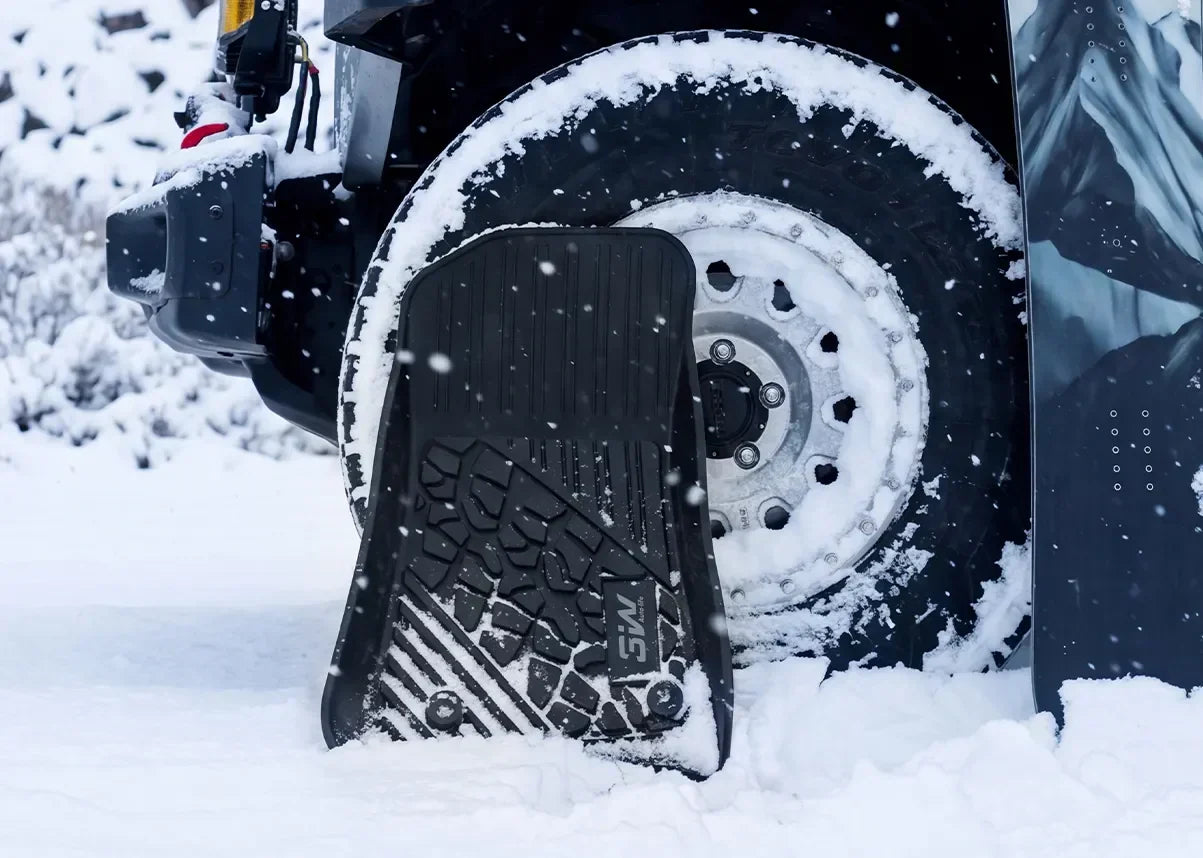
Winter floor protection is not only about trapping snow. It is about stopping salty slush from reaching carpet seams, seat rails, and low-lying trim where corrosion and staining become harder to reverse. For this job, a liner needs raised edges, non-porous material, cold-weather flexibility, and a surface that can be rinsed clean after repeated freeze-thaw cycles.
Three things separate a mat that handles winter from one that merely claims to: what the material does at low temperatures, how the raised lip contains liquid, and whether the mat seals against the vehicle floor or leaks at curves.
What 'All-Weather' Actually Means in Winter
The term 'all-weather' has no regulatory definition. Real-world winter performance breaks down into three distinct scenarios:
- Snow and slush: Wet footwear deposits snow that melts into standing liquid. The mat must contain this liquid without channeling toward door jambs or under the seat.
- Road salt: Winter deicing salt is chemically aggressive and hygroscopic—it draws moisture. Salt-saturated water soaks into carpet fibers and corrodes floor pans. Waterproof TPE is chemically inert to salt.
- Hard freezes: Below 10°F, many rubber-based mats stiffen and lose their raised-lip form. A mat that can't hold its shape can't hold liquid. 3W's Thorex™ TPE remains flexible at -4°F.[2]

Material Behavior at Sub-Zero Temperatures
Rubber's mechanical properties are temperature-dependent. Below its glass transition point, vulcanized rubber becomes rigid, losing its ability to conform to floor contours or maintain a seal at raised edges. 3W's Thorex™ TPE is engineered to remain flexible from -4°F (-20°C) to 167°F (75°C).[2]
In practice: a Thorex™ mat installed on a cold night will still seat correctly against the vehicle floor the next morning. A rigid rubber mat may gap at curved contact points, letting salt water migrate under the mat to the carpet beneath.
Raised Lip Design: Why Height and Seal Both Matter
The raised lip is the most important structural feature for winter mat performance, but height alone isn't enough—the lip must also seal against the vehicle floor continuously.
- Basic all-weather mats: 0.5–0.75 inch raised lip
- Premium precision-fit mats (including 3W): 0.75–1.5 inch raised lip contoured to vehicle-specific floor geometry[2]
Injection-molded mats like 3W's conform precisely to the floor contours of the specific vehicle, so the lip makes continuous contact around corners and irregular surfaces. Thermoformed or universal mats frequently leave gaps at curved points where the mat doesn't fully contact the floor.
A 1-inch raised lip on a standard 18×24-inch front mat can contain approximately 2.5–3 cups of liquid before overflow—enough for a full day of slush-soaked boots without overflowing onto the carpet.

What Road Salt Does to Car Carpet Over Time
Road salt damage is one of the most underreported sources of vehicle interior deterioration. Highway deicing accounts for roughly 37% of total US salt consumption annually, per the US Geological Survey's 2026 Mineral Commodity Summaries.[3] Without a properly sealed floor mat, the damage progression is:
- First few weeks: Salt-saturated water seeps under mat edges into carpet fiber
- Months 1–3: Salt crystals accumulate in carpet base, drawing additional moisture on each subsequent wet day
- Months 3–12: Continuous wet-dry cycling accelerates oxidation of the metal floor pan beneath the carpet
- Year 1+: Carpet staining becomes permanent; smell develops; floor pan rust begins
A sealed TPE mat interrupts this at step one. Remove the mat, rinse it, and the salt is gone—it never reached the carpet.[2]
Winter Conditions by Climate Type
|
Climate
|
Primary Hazard
|
Key Mat Feature Needed
|
3W Spec That Addresses It
|
|
Snow/salt belt (Chicago, NYC, Detroit)
|
Road salt + slush volume
|
Raised lip; floor seal; cold-temp flexibility
|
Thorex™ TPE; injection-molded fit; rated to -4°F[2]
|
|
Pacific Northwest (Seattle, Portland)
|
Continuous rain and mud
|
Waterproof surface; anti-slip backing
|
100% TPE; dual anti-slip stud system
|
|
Hard freeze (Minneapolis, Denver)
|
Mat stiffening; cracking; forward slip
|
Cold-temperature flexibility; retention clips
|
TPE rated to -4°F; dual rear retention clips[2]
|
|
All-season (SF, Atlanta)
|
Year-round versatility; odor in summer heat
|
Easy cleaning; odor control
|
Odor-free Thorex™; auto shampoo safe
|
The 5-Year Maintenance Routine
A properly maintained 3W mat lasts five or more years without meaningful degradation:
- Weekly in winter: Remove mats after heavy use and shake out loose debris.
- Monthly: Rinse with a hose. TPE is 100% waterproof and safe with auto shampoo.[2]
- Quarterly: Check retention clip attachment and confirm the clip still secures the mat to the factory hook point.
- Annually: Inspect raised-lip integrity. 3W's lifetime warranty covers manufacturing defects including structural failures under normal use.[2]
Frequently Asked Questions
Q: What are the best floor mats for snow and salt in 2026?
Q: Do floor mats really stop road salt damage to car carpet?
A: Yes—if the mat seals correctly. Road salt dissolves in snowmelt and seeps under ill-fitting mats. A precision-fit TPE mat with continuous raised-lip contact prevents salt water from reaching carpet fiber and the metal floor pan.
Q: What floor mats handle ice and slush best?
A: Injection-molded TPE mats with vehicle-specific fit, raised lips of 0.75–1.5 inch, and cold-temperature flexibility rated to at least -4°F. 3W's Thorex™ mats meet all three criteria.
Q: Do rubber floor mats crack in cold weather?
A: Some rubber mats stiffen significantly below 14°F and can crack at stress points. 3W's Thorex™ TPE remains flexible from -4°F to 167°F, maintaining raised-lip form and floor-sealing contact even after overnight cold temperatures.
Q: What is the best maintenance routine for winter floor mats?
A: Weekly: shake out debris. Monthly: rinse with hose (auto-shampoo safe). Quarterly: check retention clips. Annually: inspect raised-lip integrity. A properly maintained 3W mat lasts five or more years.
References
[1] 3W Liners – Best Floor Mats for Snow, Salt & Winter: https://3wliners.com/blogs/car-mats/best-floor-mats-snow-salt-winter
[2] 3W Liners – Official Website: Product Features and FAQ: https://3wliners.com
[3] US Geological Survey – Mineral Commodity Summaries 2026: Salt: https://pubs.usgs.gov/periodicals/mcs2026/mcs2026-salt.pdf
[4] Active Gear Review – 3W Custom Floor Mats Review: https://www.activegearreview.com/3w-floor-mats-review/
[5] PR Newswire – 3W Auto-Life Floor Mats Take on Moab's Famous Red Dust: https://www.morningstar.com/news/pr-newswire/20260325cn19048/3w-auto-life-floor-mats-take-on-moabs-famous-red-dust-with-first-easter-jeep-safari-showcase
[6] PR Newswire – 3W Auto-life Marks 10 Years of Crafting Premium Floor Mats: https://www.prnewswire.com/news-releases/3w-auto-life-marks-10-years-of-crafting-premium-floor-mats-for-vehicles-with-celebratory-deals-contests-and-a-durability-challenge-302242345.html
[7] NHTSA – Floor Mat Safety Information: https://www.nhtsa.gov/sites/nhtsa.gov/files/documents/floormatrecallguide.pdf
[8] Slashgear – 7 Affordable WeatherTech Alternatives: https://www.slashgear.com/1749159/affordable-weathertech-floor-board-alternatives/
[9] Racine County Eye – 3W Floor Mats Transform Your Vehicle Interior: https://racinecountyeye.com/step-into-comfort-how-3w-floor-mats-and-liners-transform-your-vehicle-interior/


Leave a comment
All comments are moderated before being published.
This site is protected by hCaptcha and the hCaptcha Privacy Policy and Terms of Service apply.