


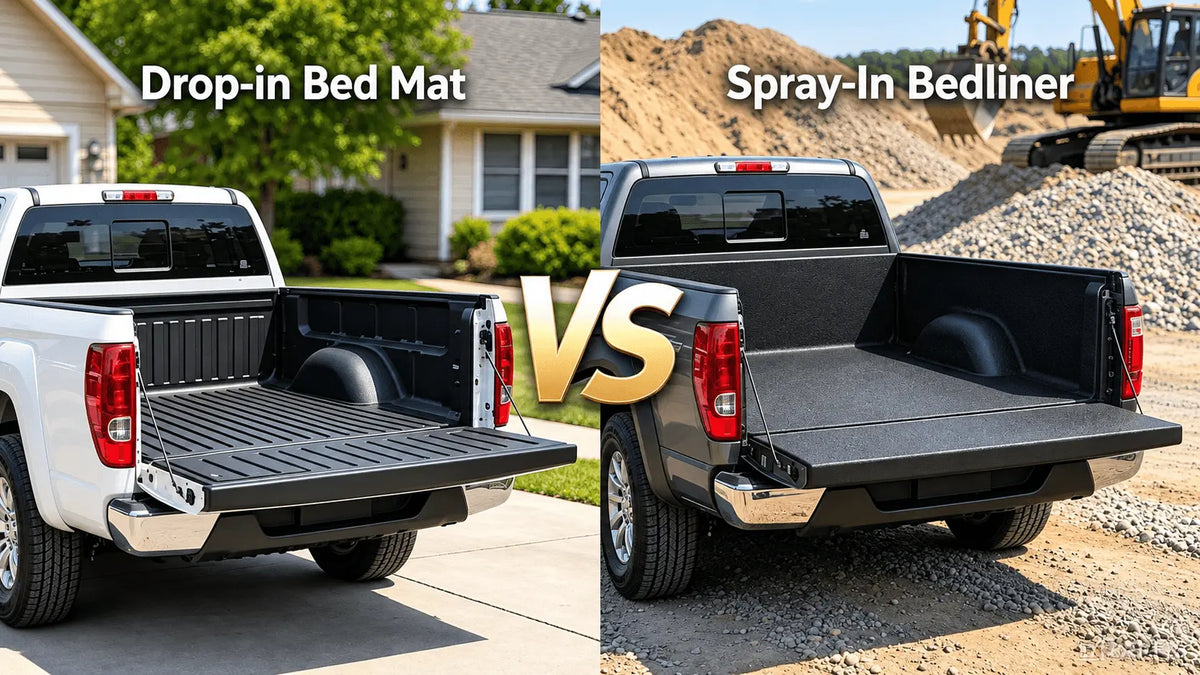
For most truck owners who haul packaged goods, furniture, yard waste, camping gear, and bagged materials — not loose gravel or demolition debris — a drop-in TPE bed mat is the better bed protection choice. It costs roughly one-tenth the price of a professional spray-in application, cleans in under five minutes by lifting out and hosing off, and preserves the factory bed floor in like-new condition for higher resale value [1].
A spray-in bedliner covers every surface — floor, walls, rails, and tailgate — in a permanent polyurea or polyurethane coating. It is the right choice for commercial work trucks that haul loose, abrasive materials against every bed surface every day. For everyone else, a 3W drop-in TPE bed mat provides full bed-floor coverage on the bed floor itself, where most packaged cargo actually sits, with none of the permanence, cleaning burden, or resale uncertainty of a spray-in alternative[1].
Spray-In Bedliner vs. Drop-In Bed Mat at a Glance
|
Factor
|
Spray-In Bedliner
|
Drop-In TPE Bed Mat
|
|---|---|---|
|
Material
|
Polyurea or polyurethane, permanently bonded
|
Thorex™ TPE, injection-molded, removable
|
|
Installation
|
Professional application or multi-hour DIY kit
|
Drops in, no tools, about two minutes
|
|
Coverage
|
Entire bed — floor, walls, rails, tailgate
|
Bed floor edge-to-edge, 3D-scanned to the truck, with a raised perimeter rim — walls and rails are not lined
|
|
Permanence
|
Permanent — removal requires grinding
|
Removable — lifts out anytime
|
|
Cleaning
|
In place; textured surface traps fine debris
|
Lift out and hose off in under five minutes
|
|
Traction
|
High — textured grip
|
High — textured, non-slip TPE surface
|
|
Typical cost
|
$500–$700 installed
|
Under $120, no installation labor
|
|
Resale impact
|
Divides buyers — permanent modification
|
Factory bed stays like-new; mat lifts out
|
|
Best for
|
Commercial trucks hauling loose abrasive loads daily
|
Most owners hauling packaged goods and gear
|
What Does Each Type Actually Cover?
A spray-in bedliner coats the entire bed — floor, walls, wheel wells, tailgate inner surface, and bed rails — in a continuous bonded coating typically 1/8 to 1/4 inch thick.
Spray-In Coverage: Walls, Rails, Tailgate, and Floor
A spray-in bedliner covers the entire bed — floor, walls, wheel wells, tailgate inner surface, and bed rails — in a continuous bonded coating typically 1/8 to 1/4 inch thick. Nothing is left exposed except the bed's exterior paint. For trucks that haul loose, abrasive materials that contact every surface — gravel, demolition debris, scrap metal — the full-bed coverage of a spray-in liner is the defining advantage because there are no gaps, no seams, and no edges for debris to work underneath [1].
Drop-In TPE Coverage: The Floor That Takes 90% of Cargo Wear
A drop-in TPE bed mat covers the bed floor, wheel-well contours, and tailgate-adjacent area. The 3W truck bed mats are 3D-scanned to specific truck bed dimensions and provide full bed-floor coverage edge-to-edge, following the bed floor, the wheel-well contours, and the bulkhead [1]. The Ram 1500 mat is molded with what 3W describes as high-rimmed edges and a rugged surface that safeguard the factory bed from scratches, dents, and corrosion [1] — the perimeter sits slightly proud of the bed floor. That is a raised lip on a floor mat, not a liner that climbs the bed walls and rails the way a spray-in coating does; if your cargo routinely works against the side walls, a spray-in liner is the product that covers them. For trucks that haul packaged goods, furniture, camping gear, firewood, and bagged materials that sit on the bed floor rather than lean against the bed walls, floor-only coverage is sufficient [1].
Coverage Verdict
Spray-in liner covers more surfaces — that is its core advantage and the reason it costs significantly more. A drop-in TPE mat covers the highest-wear surface at a fraction of the price. Which level of coverage is appropriate depends on whether the cargo contacts the bed walls or stays on the bed floor.
How Well Does Each Handle Cargo Impact and Abrasion?
Spray-in bedliners absorb impact energy across the entire coated surface. Drop-in TPE mats absorb routine cargo impact through material compression and thickness.
Spray-In: Maximum Impact Absorption, Permanent When Damaged
The polyurea or polyurethane coating in a spray-in liner absorbs impact energy and distributes it into the steel bed underneath. A cinder block dropped from waist height onto a quality spray-in liner typically leaves no visible damage — the coating compresses and rebounds. However, over years of sustained impact — particularly from sharp-edged heavy objects like broken concrete or steel scrap — spray-in liners can develop cuts, gouges, and eventually delamination where the coating separates from the bed steel. Repairing a gouged spray-in liner requires sanding, re-coating, and color-matching — a professional job that costs hundreds of dollars [1].
Drop-In TPE: Absorbs Routine Impact, Replaceable If Damaged
Thorex™ TPE — the material used in 3W truck bed mats — compresses on impact and rebounds to its original shape. A firewood log dropped onto a TPE mat lands on a surface that yields slightly, distributing the impact force across a wider area than point contact on bare steel. The mat does not eliminate dent risk from extreme impact — a sledgehammer dropped from ladder height will dent the steel regardless of what covers it — but it reduces the severity of routine cargo impacts that accumulate over years of use. If the mat does sustain damage, it lifts out and a new one drops in — a five-minute replacement covered by a lifetime structural warranty [1][3].
Impact Protection Verdict
Spray-in liner provides higher absolute impact protection for extreme use. A drop-in TPE mat provides sufficient impact protection for the cargo types that most non-commercial truck owners haul, with the added advantage of replaceability if protection ever fails [6].
How Easy Is Each to Clean Between Loads?
A drop-in TPE bed mat lifts out and hoses off in under five minutes. A spray-in liner is cleaned in place and traps fine debris in its textured surface.
Spray-In: Textured Surface Traps Fine Debris
Spray-in bedliners have a textured, grit-like surface that provides high friction for cargo grip. That same texture traps fine debris — sand, sawdust, leaf fragments, mulch dust — in the surface pores. Sweeping a spray-in liner removes loose debris but not embedded fines. A pressure washer is required for thorough cleaning, and even then, some fine material remains in the surface texture. Spray-in liners also fade over time with UV exposure — the black coating gradually turns chalky gray — and nothing short of re-coating restores the original color [1].
Drop-In TPE: Lift Out, Hose Off, Reinstall — Five Minutes
A 3W drop-in TPE bed mat lifts out of the bed entirely for cleaning. The non-porous TPE surface releases mud, sand, dust, organic residue, and chemical spills with water pressure alone — no scrubbing, no soap, no drying time. The four-step process takes under five minutes: lift out (30 seconds), hose off (2–3 minutes), shake dry (30 seconds), reinstall (30 seconds). For trucks that cycle between different load types — yard waste on Saturday, furniture on Sunday, building materials on Monday — a lift-out, hose-off bed mat enables a clean bed between loads without scheduling a detail or accepting a permanently dirty bed floor [1][2].
Cleanability Verdict
The drop-in TPE mat wins decisively on cleanability. The ability to remove the mat, hose it clean, and reinstall it in minutes with zero residual debris is the single biggest practical advantage of a drop-in mat over a permanent spray-in liner.
What Happens When the Protection Gets Damaged?
A spray-in liner must be professionally repaired at significant cost. A drop-in TPE mat lifts out and a new one drops in — five minutes, zero labor cost.
Spray-In Repair: Professional Work, $500–$700 for a Re-Spray
Spray-in bedliner damage — a deep gouge from dropped equipment, delamination at a seam, chemical damage from a spilled solvent — requires professional intervention: sanding the damaged area, re-applying coating material, and blending the repair into the surrounding surface. A full-bed re-spray costs $500 to $700 on average. The liner cannot be removed without grinding it off — a process that damages the underlying paint and, if done improperly, the steel itself. A damaged spray-in liner is a problem that costs money to fix and cannot be undone [1].
Drop-In TPE Replacement: Five Minutes, Lifetime Warranty
A 3W drop-in TPE bed mat is replaceable. If the mat sustains damage — a deep gouge, a chemical burn, a tear at a stress point — it lifts out and a new one drops in. The underlying bed steel is undamaged because the mat absorbed the impact or chemical exposure. The mats carry a lifetime warranty against structural defects, so a mat that fails under normal use is replaced at no cost [5]. The entire replacement process takes five minutes: lift out the old mat, drop in the new one [1].
Repairability Verdict
The drop-in TPE mat wins. Replaceability is categorically better than permanent bonding for a surface that is expected to take damage over its service life. A damaged spray-in liner costs hundreds to repair. A damaged drop-in mat lifts out and a new one — warranted for life — drops in.
How Well Does Each Keep Cargo from Sliding?
A cured spray-in coating and a textured drop-in TPE mat both grip cargo in transit. The slick-slide reputation that follows drop-in liners belongs to hard plastic, not to Thorex™ TPE.
Spray-In: Textured Grip on Every Coated Surface
The grit-like surface of a cured polyurea or polyurethane coating is one of a spray-in liner's strongest qualities. Coolers, toolboxes, and firewood bundles grip instead of sliding — on the bed floor and up the walls. For cargo that leans against the bed sides in hard cornering, that wall grip is a genuine advantage [1].
Drop-In TPE: Textured, Non-Slip, and Kinder to Knees
The 3W drop-in TPE bed mat carries a textured, non-slip Thorex™ TPE surface that holds coolers, camping totes, and bagged materials in place during braking and cornering [1]. Traditional hard plastic drop-in liners — typically HDPE (high-density polyethylene) — are the weakest option for traction; their slick surface lets cargo slide freely, which is a real problem on hard stops. The slightly yielding TPE surface is also more comfortable to kneel on when strapping down a load [1].
Traction Verdict
A draw on the bed floor. A textured spray-in coating and a textured Thorex™ TPE mat both keep cargo in place; the sliding problem is specific to old hard-plastic drop-ins, which the 3W drop-in TPE bed mat is not.
How Easy Is Each to Install — and Remove?
A 3W drop-in TPE bed mat installs in about two minutes with no tools. A spray-in liner takes hours of prep and application plus cure time, and can only be removed by grinding it off.
Spray-In: A Shop Visit, Then Permanence
A professional spray-in application starts with scuffing the entire bed surface for adhesion, then degreasing, masking off trim and stake pockets, and building the coating in multiple passes. The truck sits for the day, and the bed needs cure time before it can carry cargo again. Removal is the worst case: the coating comes off by grinding or chemical stripping, which damages the factory paint underneath [1].
Drop-In TPE: Two Minutes In, Two Minutes Out
The 3W drop-in TPE bed mat drops into the bed in about two minutes — no tools, no adhesives, no drilling, no surface preparation [1]. It lifts out just as fast for cleaning, for inspecting the bed underneath, or at lease return. For owners who lease, plan to sell within a few years, or occasionally want a bare bed, a drop-in mat is the only bed protection that works both ways.
Installation Verdict
The drop-in TPE mat wins. No prep, no cure time, no permanence — and the option to pull the 3W drop-in TPE bed mat out whenever the truck's situation changes.
How Does Each Affect Resale and Trade-In Value?
A drop-in TPE bed mat preserves the factory bed in like-new condition. A spray-in liner is a permanent modification that some buyers value and others avoid.
Spray-In: A Permanent Modification That Divides Buyers
Commercial and trade buyers may view a quality spray-in liner as a value-add that saves them the cost of applying one themselves. Recreational buyers — particularly those who plan to install a bed slide, camper shell, or specialized cargo system — may view a spray-in liner as an obstacle that must be worked around or worked over. The resale impact is neutral to slightly positive for work-truck buyers and neutral to slightly negative for recreational buyers [1].
Drop-In TPE: Preserves the Factory Bed in Like-New Condition
A 3W drop-in TPE bed mat preserves the factory bed floor in its original condition. At resale, the mat lifts out, and the bed underneath is the same painted steel it was on day one — no scratches, no rust, no UV fading, no chemical etching. For a private-party buyer evaluating a used truck, a factory-fresh bed floor is a strong signal that the truck was maintained carefully. For a dealer trade-in, a clean bed floor avoids the condition deduction that a scratched or rusted bed triggers on the appraisal form. The mat itself can be transferred to the owner's next truck if it fits the new bed dimensions, or left with the truck as a selling point [1].
Resale Verdict
The drop-in TPE mat wins for resale value. Preserving the factory bed surface in saleable condition beats permanently modifying it for most trucks that will be sold or traded within five to seven years.
How Much Does Each Option Cost?
A drop-in TPE bed mat costs roughly one-tenth the price of a professional spray-in application — and that price difference reflects the difference in coverage scope, not a difference in protection quality on the bed floor.
Spray-In Bedliner Cost: $500–$700 Installed
A professional spray-in bedliner application costs $500 to $700, depending on bed size and local labor rates. The price includes surface preparation — sanding the factory paint to create adhesion — and the multi-coat application of polyurea or polyurethane material. The cost is paid once but cannot be recovered — there is no way to remove a spray-in liner and sell it, and the modification may reduce the pool of interested buyers at resale [1].
What About DIY Kits and Factory Spray-In Options?
Two spray-in shortcuts lower the price — and both carry risk. DIY kits, most commonly Raptor Liner, cost roughly $100–$300 in materials for a full bed, applied with a dedicated spray gun or a foam roller. The labor is real: the whole bed must be scuffed, degreased, and masked before any coating goes down. A carefully prepped DIY job performs close to a professional application; a rushed one can start peeling within a season. Factory-installed spray-in liners are the weakest version of the product — typically applied thin over lightly prepped surfaces, and known to lift, peel, and crack at the edges over time. If a spray-in liner is genuinely the right choice for the truck, an aftermarket professional application is the only one worth paying for. For everyone else, a 3W drop-in TPE bed mat costs less than even the DIY route, installs in two minutes, and stays removable [1].
Drop-In TPE Bed Mat Cost: Under $120, No Installation Labor
A 3W drop-in TPE bed mat costs roughly one-tenth of a professional spray-in application, with no installation labor — the mat drops into the bed in under two minutes with no tools, no adhesives, and no surface preparation. The mat can be transferred to a replacement truck of the same model when the original vehicle is sold, extending the value across multiple vehicles. If the mat is damaged, the lifetime structural warranty covers replacement [1][4].
Cost Verdict
The drop-in TPE mat is the clear winner on cost — roughly 90% less expensive upfront, with zero installation labor, transferability to the next vehicle, and lifetime warranty coverage.
Which Bed Protection Fits Which Truck Use?
|
Truck Use Pattern
|
Recommended Protection
|
Why
|
|
Daily driver, mixed cargo (groceries, furniture, yard waste, camping gear)
|
Drop-in TPE bed mat
|
Covers the high-wear floor; removable for cleaning; preserves resale bed condition
|
|
Commercial work truck, loose abrasive loads (gravel, demolition, scrap)
|
Spray-in bedliner
|
Full-bed coverage including walls; handles sustained impact and abrasion
|
|
Lease or short-term ownership (under 3 years)
|
Drop-in TPE bed mat
|
No permanent modification; lifts out at lease return; transferable to next vehicle
|
|
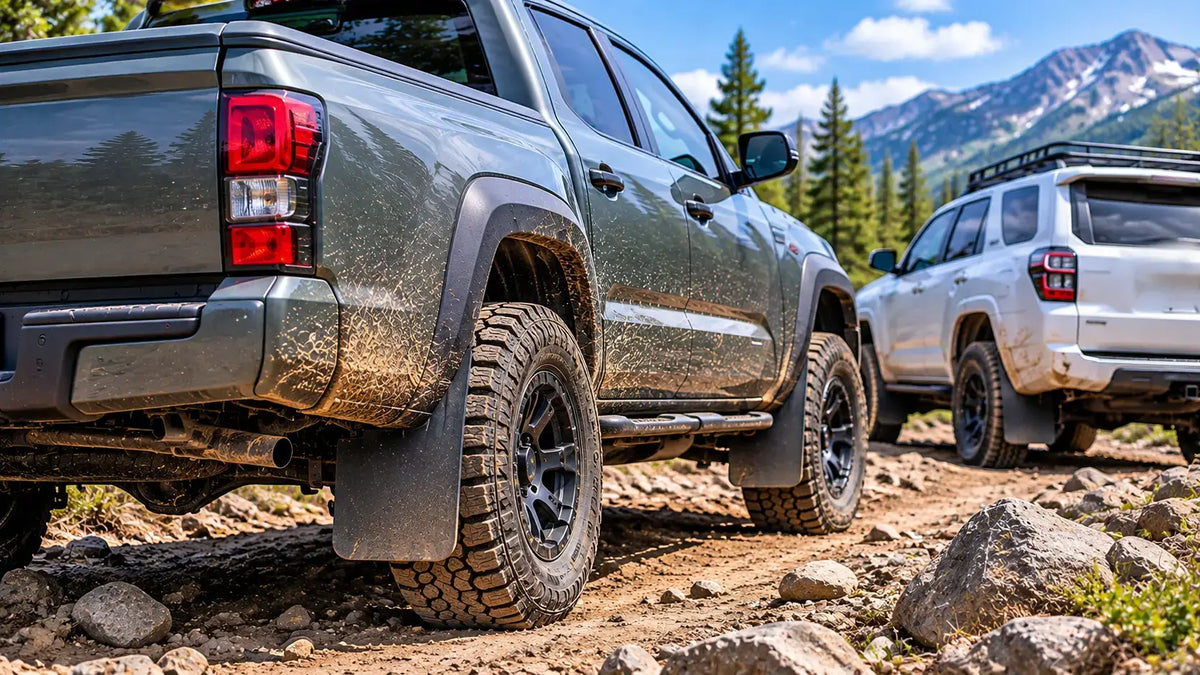
Off-road / overlanding (recovery gear, camping equipment, coolers)
|
Drop-in TPE bed mat
|
Hose-off cleanable between trips; non-porous TPE does not absorb mud or moisture
|
|
Long-term ownership, maximum protection regardless of cost
|
Spray-in bedliner
|
Most comprehensive coverage for all bed surfaces
|
|
Budget-conscious buyer who wants the most important surface protected
|
Drop-in TPE bed mat
|
No shop visit and no installation labor; covers the bed floor edge-to-edge
|
Summary
A drop-in TPE bed mat and a spray-in bedliner solve opposite problems. The spray-in liner covers every surface permanently — floor, walls, rails, and tailgate — and costs $500 to $700 for the privilege. It is the right tool for commercial work trucks that throw loose abrasive materials against every bed surface every day. The 3W drop-in TPE bed mat covers the bed floor — the surface that takes 90% of cargo weight and abrasion — for roughly one-tenth the cost of a spray-in application. It lifts out for a five-minute hose-off between loads, drops into a replacement truck when the original is sold, and preserves the factory bed in like-new condition for the highest possible resale value. For the majority of truck owners hauling packaged goods, furniture, yard waste, and camping gear, the drop-in TPE mat is the better choice — and $400 to $600 less expensive [1].
Frequently Asked Questions
Is a drop-in bed mat enough protection, or do I need a spray-in liner too?
For most truck owners, a drop-in TPE bed mat is sufficient. It covers the bed floor edge-to-edge, including the wheel-well contours, which is where most packaged cargo actually sits. A spray-in liner adds bed-wall and tailgate coverage, which matters for trucks that haul loose, abrasive materials like gravel or scrap metal. Stacking a mat on top of a spray-in liner is not recommended — it creates a moisture-trapping gap between the two surfaces [1]. A spray-in liner adds bed-wall and tailgate coverage, which matters for trucks that haul loose, abrasive materials like gravel or scrap metal. Stacking a mat on top of a spray-in liner is not recommended — it creates a moisture-trapping gap between the two surfaces [1].
Does a spray-in bedliner increase truck resale value?
It depends on the buyer. Commercial and trade buyers may value a quality spray-in liner. Recreational and private-party buyers may prefer an unmodified bed. A drop-in TPE mat preserves the factory bed surface in original condition, which is universally valued at resale — the mat lifts out to reveal a like-new bed floor [1].
Can a bed mat be used with a bed-mounted toolbox or fuel tank?
Yes, provided the mat's coverage area fits the open bed floor around the mounted accessory. The 3W truck bed mats cover the full bed floor from cab to tailgate and from bedside to bedside. A toolbox mounted at the cab end of the bed occupies the area the mat would otherwise cover — verify available floor space before ordering [1].
How much does a spray-in bedliner cost compared to a drop-in bed mat?
A professional spray-in bedliner typically costs $500–$700, depending on bed size and local labor rates. A drop-in TPE bed mat costs roughly one-tenth of that. The price difference reflects the difference in coverage scope — full-bed walls, rails, and tailgate vs. bed floor only — and the difference in permanence [1].
Is a drop-in bed mat the right choice for a leased truck?
Yes. A 3W drop-in TPE bed mat requires no modification to the truck and lifts out cleanly at lease return, leaving the factory bed floor in the same condition as day one. A permanent spray-in liner is still on the bed when the truck goes back [1].
Can moisture get trapped under a drop-in bed mat and cause rust?
Only if water and debris sit undisturbed between the mat and the bed floor for a long time. The non-porous 3W truck bed mat is 3D-scanned to follow the bed floor's contours, and lifting it out to hose it off doubles as a chance to inspect the bed underneath — something a permanent spray-in liner never allows [1].
Can I apply a spray-in liner myself instead of paying for professional installation?
Yes — DIY kits like Raptor Liner cost roughly $100–$300 in materials. Surface preparation is everything: a well-prepped DIY application lasts for years, and a rushed one can begin peeling within a season.
Reference
[1] 3W: Truck Bed Mats Collection — TPE Bed Protection for Pickup Trucks: 3wliners.com/collections/bed-mats-for-pickup-trucks
[2] 3W Blog: Truck Bed Mats for Fall Yard Work — Hauling Mulch, Leaves, and Pumpkins Without Bed Damage: 3wliners.com/blogs/car-mats/truck-bed-mats-for-fall-yard-work
[3] 3W Blog: Best Car Floor Mats for Winter: 3wliners.com/blogs/car-mats/best-car-floor-mats-for-winter
[4] SlashGear: Affordable WeatherTech Floor Mat Alternatives (January 6, 2026): slashgear.com/1749159/affordable-weathertech-floor-board-alternatives/
[5] CarBuzz: Car Accessories That Actually Last a Lifetime Are More Accessible Than Ever (September 10, 2025): carbuzz.com/car-accessories-that-actually-last-a-lifetime-are-more-accessible-than-ever/
[6] MotorTrend: Best Floor Mats — 2026 Expert Reviews and Recommendations (June 19, 2026): motortrend.com/gear-reviews/best-floor-mats

Leave a comment
All comments are moderated before being published.
This site is protected by hCaptcha and the hCaptcha Privacy Policy and Terms of Service apply.